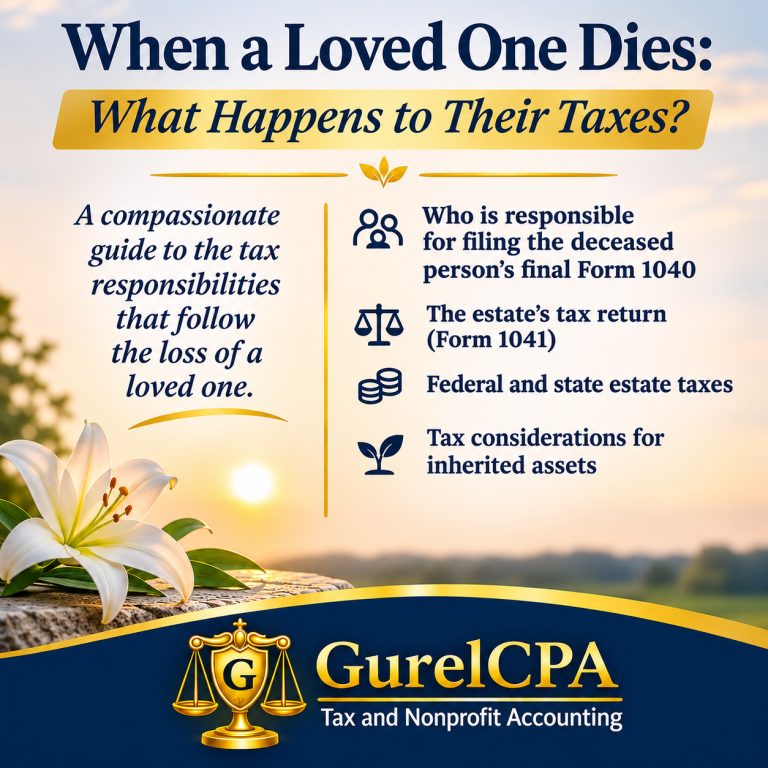
When a Loved One Dies: What Happens to Their Taxes?
Losing a spouse, family member, or someone close to you is one of life's most difficult experiences. Along with the grief come many practical responsibilities, often at a time when making decisions can feel overwhelming.
Taxes are probably among the last things anyone wants to think about. Yet certain tax responsibilities continue after a person's death, and understanding what needs to be done can help surviving family members avoid unnecessary complications.
The good news is that not every estate has complicated tax issues, and families do not have to navigate these responsibilities alone.
Who Is Responsible for Handling the Taxes?
When someone dies, an executor or personal representative may be responsible for settling their financial affairs. This person may be named in a will or appointed by a court. In some circumstances, a surviving spouse or another authorized individual may handle the necessary tax matters without formal probate proceedings.
The representative's responsibilities may include gathering financial records, identifying assets and debts, filing required tax returns, paying outstanding obligations, and distributing property to beneficiaries.
An important first step is determining who has the legal authority to act on behalf of the deceased person. The IRS may require documentation of that authority before releasing tax information.
Filing the Final Individual Income Tax Return
A person's federal income tax filing responsibilities do not necessarily end when they die.
A final Form 1040 may be required for the year of death. Generally, this return reports income received from January 1 through the date of death, along with applicable deductions and credits.
The filing deadline is generally the same as for other individual taxpayers, ordinarily April 15 of the following year, unless an applicable extension or postponement applies.
If the deceased person was married, the surviving spouse may be eligible to file a joint return for the year of death, provided the usual requirements are met. This can sometimes provide a more favorable tax result.
It is also important to determine whether any returns from earlier years remain unfiled.
The Estate May Have Its Own Tax Return
One of the more confusing aspects of settling an estate is understanding that the deceased person and their estate are separate taxpayers.
The final individual income tax return generally covers income received through the date of death. Income earned by estate assets afterward may belong to the estate.
For example, an estate might receive interest, dividends, rental income, or proceeds from the sale of investments or property.
An estate generally must file Form 1041, U.S. Income Tax Return for Estates and Trusts, if it has $600 or more in gross income during its tax year, or if it has a nonresident alien beneficiary.
An estate that needs to file its own return generally must obtain a separate Employer Identification Number (EIN) from the IRS.
Not every estate will need to file Form 1041. Much depends on the assets involved, how they are owned, and whether they generate income after death.
What About Estate Taxes?
Income taxes and estate taxes are two different things.
Federal estate tax applies primarily to estates whose taxable value exceeds a substantial exemption. As a result, most families will not owe federal estate tax.
However, some states impose their own estate or inheritance taxes, sometimes with much lower exemption amounts than the federal government.
Even when no federal estate tax is due, there may be reasons to consider filing a federal estate tax return, including preserving a deceased spouse's unused estate tax exemption for the surviving spouse.
These issues deserve particular attention when an estate includes substantial assets, real estate, a family business, or property in more than one state.
What Happens to Tax Refunds or Unpaid Taxes?
A deceased person may be entitled to a tax refund, or they may have unpaid income taxes.
If a refund is due, the executor, personal representative, or surviving spouse may be able to claim it. Depending on the circumstances, IRS Form 1310, Statement of Person Claiming Refund Due a Deceased Taxpayer, may be required.
If taxes are owed, those obligations generally must be addressed as part of settling the estate.
Importantly, family members do not automatically become personally responsible for a deceased relative's unpaid income taxes simply because they are heirs. Responsibility depends on the circumstances, including joint tax liabilities, applicable law, and the handling of estate assets.
An executor should be careful about distributing estate property before determining whether outstanding tax obligations and other creditor claims have been properly addressed.
Inherited Assets Can Have Tax Consequences
Receiving an inheritance does not ordinarily create federal income tax simply because someone inherits property. However, the type of asset inherited can make an important difference.
For example:
- Cash and bank accounts: Inherited principal generally is not taxable income to the beneficiary.
- Real estate and investments: Inherited property generally receives a tax basis based on its fair market value at the date of death, although exceptions apply. This can reduce capital gains taxes if the property is later sold.
- Traditional IRAs and retirement accounts: Distributions to beneficiaries may be subject to income tax, and special withdrawal rules often apply.
- Roth IRAs: Qualified distributions are generally tax-free, although beneficiaries may still be required to withdraw the funds within a specified period.
Understanding these differences can help families make informed decisions rather than rushing to sell assets or withdraw retirement funds.
Gather Records and Keep Good Documentation
An executor or family representative should begin gathering available tax returns, income statements, investment records, property information, and other relevant financial documents.
If prior tax returns cannot be located, the IRS provides ways for authorized representatives to obtain copies or transcripts.
IRS Form 56 may be used to notify the IRS of a fiduciary relationship. Other forms may be needed to request records, establish representation, or update mailing information.
Keeping organized records of estate income, expenses, tax payments, and distributions can make the administration process considerably easier.
Give Yourself Time, and Ask for Help When Needed
There is no simple checklist that applies to every family. Some estates involve little more than a final individual income tax return. Others may require estate income tax returns, property valuations, retirement account decisions, or coordination with an attorney.
Families should also remember that not every decision must be made immediately. Although filing deadlines and certain legal requirements deserve prompt attention, many financial decisions benefit from careful consideration.
An attorney can assist with probate and estate administration, while a CPA can help identify tax filing requirements, prepare necessary returns, and explain the tax consequences of distributing or selling inherited assets.
A Final Thought
The loss of someone close is difficult enough without the added worry of unfamiliar tax responsibilities.
Understanding the basic requirements, gathering the necessary information, and obtaining professional guidance when appropriate can help families meet their obligations while avoiding unnecessary stress.
Most importantly, handling these responsibilities does not have to happen all at once. Taking them one step at a time can make a difficult period a little more manageable.
This article provides general federal tax information. State laws and individual circumstances may affect the requirements that apply to a particular estate. Please contact me directly to discuss how this applies to your individual tax situation.