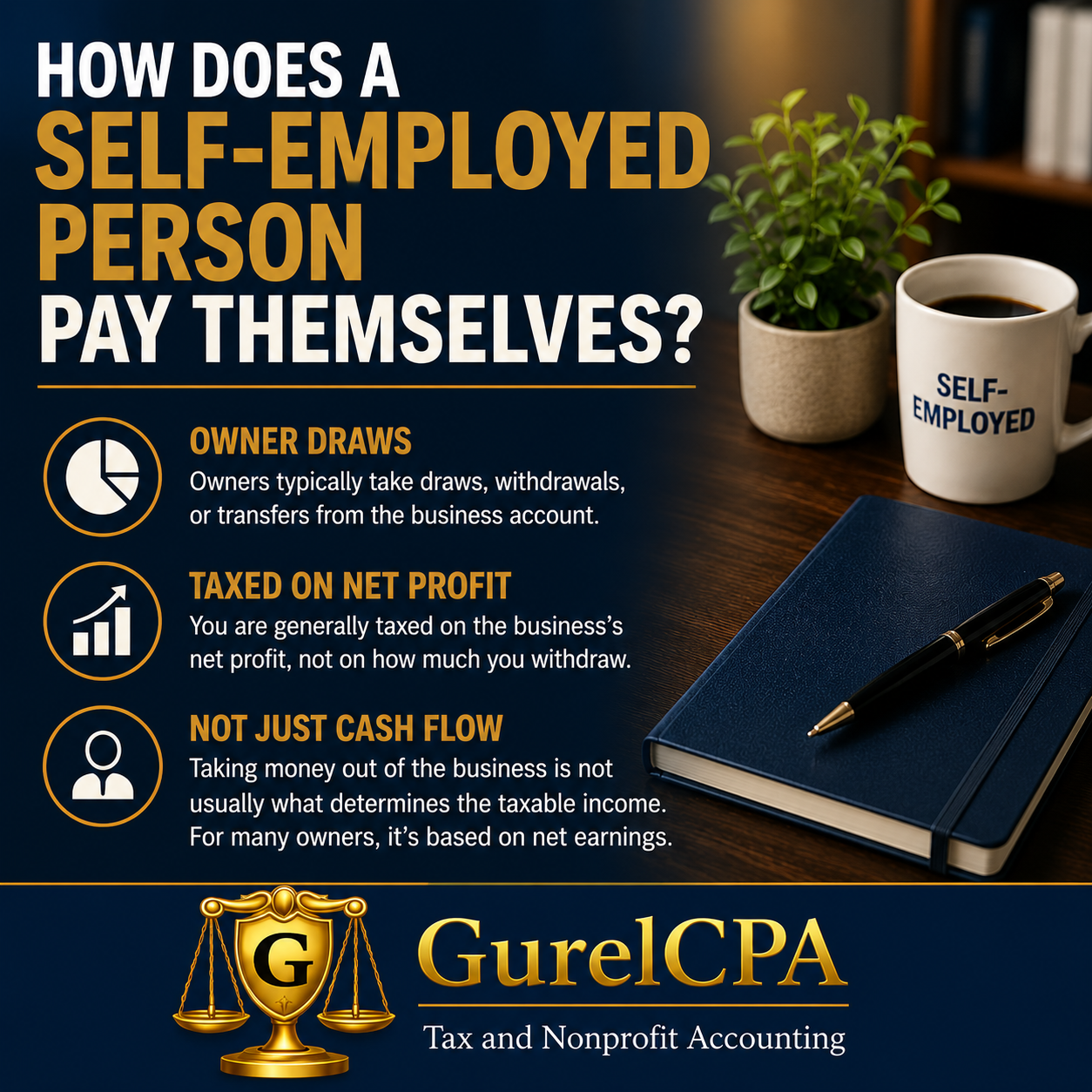
How Does a Self-Employed Person Pay Themselves?
Many people start a side business and assume they can simply put themselves on payroll and receive a regular paycheck.
But for most self-employed individuals, that is not how it works.
Sole Proprietors and Single-Member LLCs
If your business operates as a sole proprietorship or a single-member LLC taxed as a sole proprietorship, the owner does not receive a W-2 paycheck from the business.
Instead, owners typically take owner draws: transfers from the business account to a personal account
These transfers are not the same as wages.
What Is the Owner Taxed On?
As a self-employed taxpayer, you are taxed on the business’s net profit, not on how much money you withdraw.
In other words, your business income minus allowable business expenses.
Example:
Suppose a business has:
• $80,000 of income
• $30,000 of deductible expenses
The business would have:
• $50,000 of net profit
The owner is taxed on the $50,000 of net income even if they only transferred part of that money to themselves personally.
What About an S Corporation Election?
If a business elects to be treated as an S corporation for tax purposes, that can change how the owner is compensated and may allow the owner to receive a W-2 paycheck.
However, that structure also creates additional tax filings, payroll requirements, and compliance responsibilities.
Don’t Confuse Cash Flow With Taxable Income
One important concept for self-employed individuals is this:
Taking money out of the business is not what determines the taxable income.
For sole proprietors and single-member LLC owners, taxable income is generally based on the business’s net earnings.
Final Thoughts
Starting a side business creates opportunities, but it also creates tax responsibilities many people do not expect.
Understanding the difference between:
• Owner draws
• Payroll
• Net profit
• Business structure
…can help self-employed individuals avoid confusion and costly mistakes later.
Are you happy with your CPA?
I help self-employed individuals, small businesses, nonprofits, and expats navigate tax compliance and planning issues, including business structure and self-employment taxation. Free consultations are available.
The article is meant for informational purposes only. Contact me to discuss how this applies to your individual tax situation.