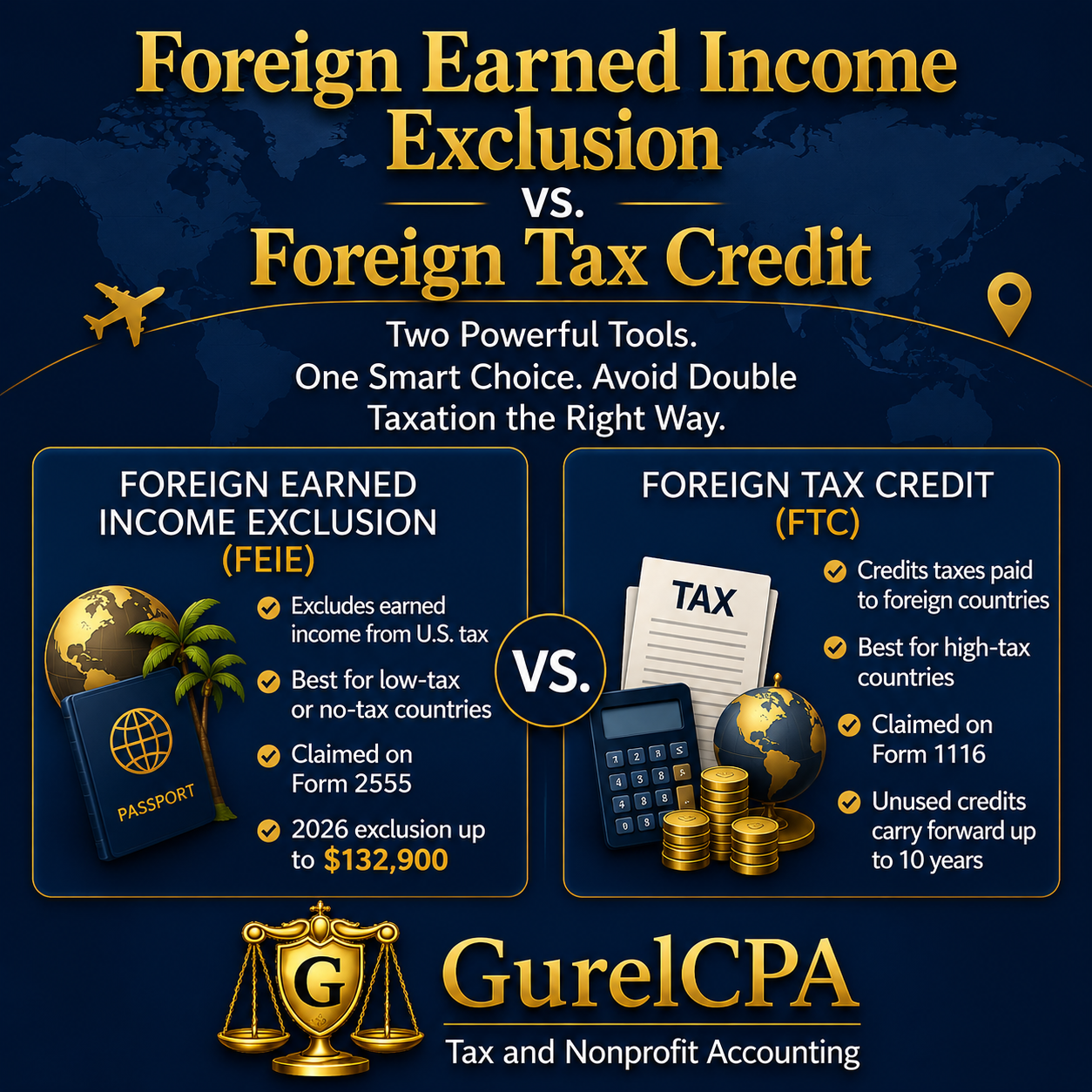
Foreign Earned Income Exclusion vs. Foreign Tax Credit
For U.S. taxpayers living or working outside the United States, foreign income does not mean freedom from U.S. taxes. The U.S. tax system taxes citizens and resident aliens on worldwide income, regardless of where they live. Fortunately, the Internal Revenue Code provides two powerful tools to reduce or eliminate double taxation:
• The Foreign Earned Income Exclusion (FEIE)
• The Foreign Tax Credit (FTC)
While both are designed to prevent double taxation, they operate in fundamentally different ways — and choosing the wrong one can cost taxpayers thousands of dollars in unnecessary tax over time. Understanding the distinction between these two strategies is essential for proper international tax planning.
What Is the Foreign Earned Income Exclusion (FEIE)?
The Foreign Earned Income Exclusion allows qualifying taxpayers to exclude a portion of their foreign earned income from U.S. taxation entirely.
Key features of the FEIE include:
• Applies only to earned income (wages, salary, self-employment income)
• Does not apply to passive income (interest, dividends, rental income, capital gains)
• Requires meeting either a Bona fide residence test, or a Physical presence test
• Must be affirmatively elected by filing Form 2555
• For 2026, qualifying taxpayers may exclude up to $132,900 of foreign earned income. The exclusion amount is adjusted annually for inflation.
If a taxpayer qualifies, they may exclude foreign earned income from U.S. taxable income, reducing federal income tax. However, the FEIE generally does not eliminate U.S. self-employment tax unless a Totalization Agreement provides relief. This is one of the most commonly misunderstood aspects of the FEIE.
The Foreign Housing Exclusion and Deduction
Taxpayers who qualify for the Foreign Earned Income Exclusion may also qualify for the Foreign Housing Exclusion or Foreign Housing Deduction. These provisions allow certain qualified housing expenses incurred while living abroad to receive additional favorable tax treatment.
Depending on where a taxpayer lives, the housing benefit can substantially increase the overall tax savings beyond the basic Foreign Earned Income Exclusion. Both benefits are generally claimed on Form 2555.
When the FEIE Is Often More Advantageous
The FEIE is typically beneficial when:
• The taxpayer lives in a low-tax or no-tax country
• Foreign taxes paid are minimal or zero
• Income is primarily earned income
• The taxpayer wants to reduce adjusted gross income (AGI) for purposes such as: student loan repayment calculations, ACA subsidy calculations, Child Tax Credit thresholds, or phase-outs of deductions and credits
What Is the Foreign Tax Credit (FTC)?
The Foreign Tax Credit provides a dollar-for-dollar credit against U.S. tax for income taxes paid to a foreign country.
Key features of the FTC include:
• Applies to both earned income and passive income
• Claimed using Form 1116
• Credit is limited to the portion of U.S. tax attributable to foreign income
• Excess credits can often be carried forward for up to 10 years
• Works best when foreign tax rates are equal to or higher than U.S. tax rates
Rather than excluding income, the FTC allows the income to remain taxable in the U.S. but offsets U.S. tax liability with foreign taxes already paid.
You Cannot Double-Dip
Although taxpayers may qualify for both the Foreign Earned Income Exclusion and the Foreign Tax Credit, the same income generally cannot receive both benefits.
Foreign taxes paid on income excluded under the Foreign Earned Income Exclusion generally cannot also be claimed as a Foreign Tax Credit. However, foreign taxes paid on income exceeding the exclusion amount may still qualify for the credit. Determining the most advantageous combination often requires careful planning.
When the Foreign Tax Credit Is Often More Advantageous
The FTC is typically beneficial when:
• The taxpayer lives in a high-tax country
• Foreign tax rates exceed U.S. tax rates
• The taxpayer has passive income (investments, dividends, rental income)
• Long-term tax efficiency is a priority
• Retirement planning is a consideration
• Medicare tax and Social Security tax planning matter
In many high-tax jurisdictions, the Foreign Tax Credit often produces superior long-term results because unused foreign tax credits may generally be carried forward for up to ten years. By contrast, income excluded under the FEIE generally provides no future tax benefit once used.
A strategy that minimizes tax this year is not always the strategy that minimizes taxes over many years.
Common Mistakes
• Assuming that living outside the United States eliminates the requirement to file a U.S. tax return.
• Choosing the FEIE when the FTC would produce better long-term results.
• Believing the FEIE eliminates self-employment tax.
• Overlooking the Foreign Housing Exclusion or Housing Deduction.
• Forgetting that separate international reporting requirements, such as the FBAR and FATCA, may still apply.
Why the Wrong Choice Can Cost Thousands
Many taxpayers assume the Foreign Earned Income Exclusion is automatically the better choice because it excludes income from U.S. taxation. In reality, taxpayers living in higher-tax countries often achieve greater long-term tax savings by claiming the Foreign Tax Credit instead.
Choosing the right strategy requires looking beyond the current year's tax return and considering future income, retirement planning, and foreign tax credit carryovers.
Final Thoughts
The Foreign Earned Income Exclusion and the Foreign Tax Credit are both valuable tools for reducing double taxation, but they serve different purposes. There is no universal "best" choice. The right strategy depends on where you live, your foreign tax rate, your sources of income, and your long-term financial goals.
A decision that produces the lowest tax bill this year may not provide the greatest savings over the next five or ten years. Careful planning before filing a return can often save taxpayers thousands of dollars over time.
The article is intended for informational purposes only. Professional guidance is essential when making international tax planning decisions.