Living Abroad? You May Still Owe U.S. Self-Employment Tax
Moving abroad does not automatically end a U.S. citizen's or resident alien's U.S. tax obligations. This can be especially important for consultants, freelancers, digital nomads, and other people who operate businesses while living overseas.
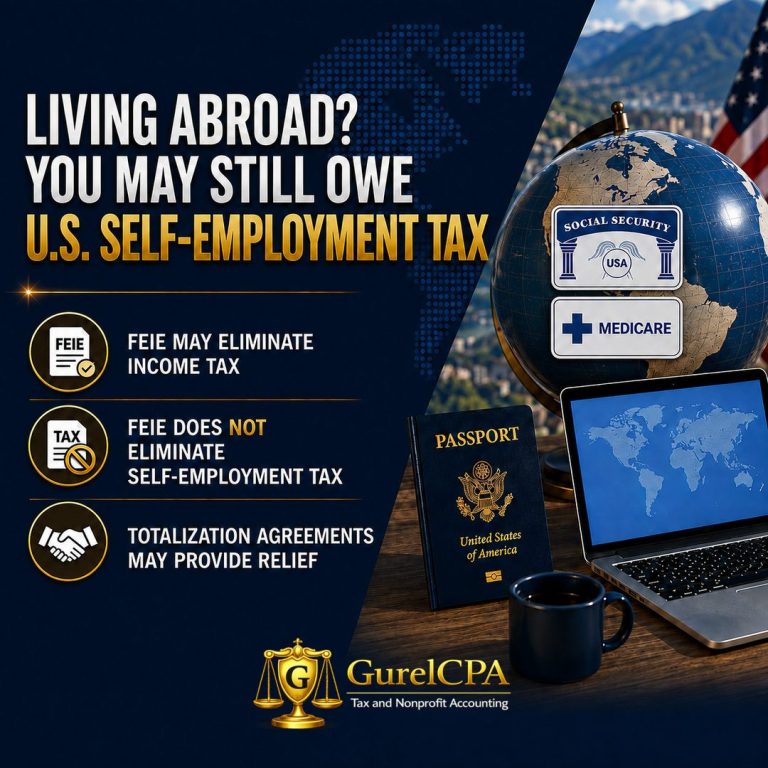
The Foreign Earned Income Exclusion may reduce regular U.S. income tax for someone who qualifies, but it does not by itself eliminate U.S. self-employment tax. A separate international Social Security agreement may provide relief, depending on the country and the taxpayer's circumstances.
What Is Self-Employment Tax?
Self-employment tax helps fund Social Security and Medicare. It generally applies when a taxpayer has at least $400 of net earnings from self-employment.
The tax is commonly described as 15.3%, consisting of 12.4% for Social Security and 2.9% for Medicare. However, the calculation is more precise than simply multiplying all business profit by 15.3%.
Generally, 92.35% of net self-employment earnings is subject to the tax. The Social Security portion applies only up to the annual Social Security earnings limit, which is $184,500 for 2026. The Medicare portion does not have the same ceiling, and higher-income taxpayers may also owe the 0.9% Additional Medicare Tax.
The Foreign Earned Income Exclusion Does Not Eliminate It
A qualifying taxpayer may elect the Foreign Earned Income Exclusion to exclude a limited amount of foreign earned income from regular federal income tax. For 2026, the maximum exclusion is $132,900 per qualifying person.
The exclusion is not automatic. The taxpayer must meet the applicable foreign tax home and bona fide residence or physical presence requirements and claim the exclusion on Form 2555.
Most importantly, the Foreign Earned Income Exclusion reduces regular income tax, not self-employment tax. A self-employed person can therefore owe little or no regular federal income tax and still have a substantial self-employment tax liability.
Totalization Agreements May Prevent Double Social Security Taxation
A person working abroad may also be required to contribute to the foreign country's Social Security, national insurance, or similar system. Without special rules, the same earnings could potentially be subject to both countries' systems.
The United States has Social Security agreements, commonly called Totalization Agreements, with a number of countries. These agreements are intended to assign a worker's coverage to one country's system and prevent duplicate Social Security taxation.
The result is not the same in every country. Coverage may depend on where the person resides, where the business is normally conducted, whether the move is temporary, and the exact terms of the agreement. Some agreements generally assign self-employed workers to the system of their country of residence, while others contain different rules and exceptions.
Documentation Is Essential
A taxpayer claiming relief under a Totalization Agreement generally needs a certificate of coverage from the country whose Social Security system applies. Depending on the agreement, the certificate may come from the U.S. Social Security Administration or the appropriate foreign agency.
The certificate establishes which country's system covers the taxpayer and supports the exemption from the other country's Social Security taxes. Simply paying foreign Social Security taxes does not necessarily create an automatic exemption from U.S. self-employment tax without the required agreement and documentation.
Who Should Pay Particular Attention?
This issue commonly affects:
- Independent contractors working abroad
- Consultants serving clients remotely
- Freelancers and digital nomads
- U.S. citizens and resident aliens operating foreign businesses
- Owners of U.S. single-member LLCs who live overseas
- People who moved an existing business from the United States to another country
Business structure also matters. A sole proprietorship, disregarded single-member LLC, partnership, S corporation, C corporation, or foreign entity may produce different U.S. tax results. The name used for a business locally does not always determine its U.S. federal tax classification.
Do Not Forget Estimated Taxes
Self-employed taxpayers generally do not have an employer withholding U.S. taxes from their earnings. Even when the Foreign Earned Income Exclusion is expected to eliminate regular income tax, estimated tax payments may still be necessary to cover self-employment tax and avoid an underpayment penalty.
The Key Point
Living abroad does not automatically eliminate U.S. Social Security and Medicare obligations. The Foreign Earned Income Exclusion and the Totalization Agreement rules address different taxes and should not be confused.
Before assuming that no U.S. self-employment tax is due, determine whether the taxpayer is subject to self-employment tax, whether a Totalization Agreement applies, which country's system provides coverage, and whether the proper certificate has been obtained.
The article is meant for informational purposes only. Please contact me directly to discuss how this applies to your individual tax situation.