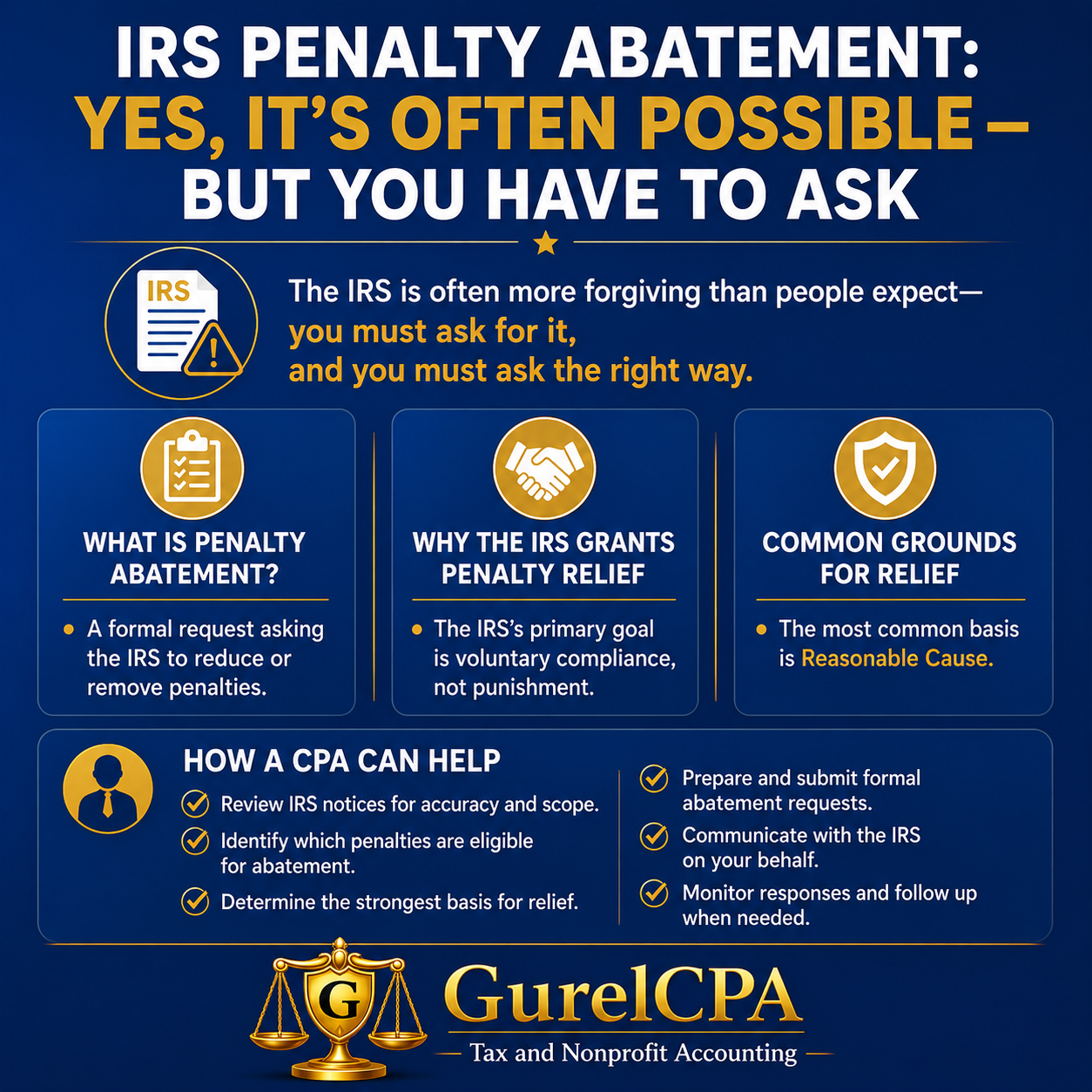
IRS Penalty Abatement: Yes, It’s Often Possible, But You Have to Ask
Receiving a notice from the IRS that includes penalties can be unsettling. Many taxpayers assume penalties are automatic, non-negotiable, and must simply be paid. In practice, that’s often not the case.
In my experience as a CPA, the IRS is frequently more forgiving than people expect, particularly when a taxpayer has a reasonable explanation and a history of compliance.
The most important thing to understand is this: penalty relief is rarely automatic — you must ask for it, and you must ask the right way.
WHAT IS AN IRS PENALTY ABATEMENT?
A penalty abatement is a formal request asking the IRS to reduce or remove penalties assessed on a tax return or tax account. Penalty relief may be available for many common situations, including:
• Failure to file a return on time
• Failure to pay tax by the due date
• Underpayment of estimated taxes
• Accuracy-related penalties
• Late payroll tax deposits
Interest is generally not removed unless the related penalty is abated, but eliminating penalties alone can significantly reduce the total amount owed.
WHY THE IRS IS OFTEN WILLING TO GRANT PENALTY RELIEF
The IRS’s primary objective is voluntary compliance, not punishment. Penalties are intended to encourage timely and accurate filing—not to penalize taxpayers who made an honest mistake and corrected it.
In practice, the IRS often grants abatements when:
• The taxpayer has a history of filing and paying on time
• The issue resulted from circumstances beyond the taxpayer’s control
• The taxpayer acted in good faith
• The problem was corrected once it was identified
COMMON GROUNDS FOR PENALTY ABATEMENT
Reasonable Cause
This is the most common basis for relief. The IRS looks at whether the taxpayer exercised “ordinary business care and prudence.” Examples may include:
• Serious illness or death in the family
• Natural disasters or fires
• Records destroyed or unavailable
• Reliance on incorrect professional advice
• Mail, banking, or payment processing disruptions
PENALTY ABATEMENT IS A STRUCTURED IRS PROCESS
Penalty abatement requests are governed by specific IRS standards and administrative guidelines. Knowing which standard applies—and how to clearly present the facts—often makes the difference between approval and denial.
This is not a negotiation or an appeal to sympathy. It is a formal request that must be framed correctly, supported by facts, and submitted through the appropriate channels.
HOW A CPA CAN HELP
As aCPA, I assist clients by:
• Reviewing IRS notices for accuracy and scope
• Identifying which penalties are eligible for abatement
• Determining the strongest basis for relief
• Preparing and submitting formal abatement requests
• Communicating directly with the IRS on the client’s behalf
• Monitoring responses and following up when needed
In many cases, penalties can be reduced or eliminated entirely—even when taxpayers initially believed they had no options.
A FINAL WORD OF ENCOURAGEMENT
IRS penalties can feel intimidating, but they are often not the end of the story. The IRS does not automatically offer penalty relief, and many taxpayers overpay simply because they never ask.
If you’ve received an IRS notice that includes penalties, it’s worth reviewing your situation before paying more than necessary. With proper guidance and a well-supported request, penalty abatement is often achievable.
The article is meant for informational purposes only. Please contact me directly to discuss how this applies to your individual tax situation.