If You're Married, Can You File as Single on Your Tax Return?
Each tax season I hear a variation of the same question:
"I'm married, but it would save me money if I filed as single. Can I just do that?"
The answer is simple under IRS rules:
If you are legally married on December 31 of the tax year, you generally cannot file as Single. An important exception applies if you are legally separated from your spouse under a decree of divorce or separate maintenance on the last day of the year. In that situation, the IRS generally considers you unmarried for filing-status purposes.
The IRS generally determines your filing status based on your marital status on the last day of the year. If you are married on December 31 and are not legally separated under a qualifying decree, the IRS considers you married for the entire year for tax filing purposes.
This rule applies even if you:
- Got married late in the year
- Lived apart from your spouse
- Managed your finances separately
- Believe you would pay less tax by filing as Single
Simply living apart from your spouse does not, by itself, make you Single for federal tax purposes. In all of these situations, the Single filing status is generally not available unless you are considered unmarried under IRS rules.
The Filing Options for Married Taxpayers
If you are married at year-end, you generally have three possible filing statuses:
Married Filing Jointly (MFJ)
This is the most common choice for married couples.
When filing jointly:
- Both spouses combine income on one tax return
- Both spouses sign the return
- Both spouses are jointly responsible for the tax
This filing status often results in the lowest total tax, but not always.
Married Filing Separately (MFS)
Married taxpayers also have the option to file separate tax returns.
Under this approach:
- If you file separately, you generally report your own income, credits, and deductions. Special rules can apply in community property states, including Washington, and some income may need to be treated as separate income or community income.
- Each spouse is responsible only for their own return
However, the IRS places several restrictions on taxpayers who choose this option. For example, many tax credits and deductions are limited or unavailable when filing separately.

Head of Household (If eligible)
A married person may qualify for Head of Household status in certain situations by being considered unmarried under IRS rules, but the requirements are strict.
Generally, to be considered unmarried for Head of Household purposes, a married taxpayer must:
- File a separate return, pay more than half the cost of keeping up the home for the year, and have a spouse who did not live in the home during the last six months of the year
- Have the home be the main home of a child, stepchild, or foster child for more than half the year, and generally be able to claim that child as a dependent (subject to special rules for divorced or separated parents)
If the requirements are met, the taxpayer may qualify to file as Head of Household. This status provides a higher standard deduction and lower tax rates than Married Filing Separately.
Why Some People Ask About Filing Single
Many people ask about filing as Single because they believe it will reduce their taxes.
But in practice, the choice isn't between Single vs. Married. The real comparison is usually between:
- Married Filing Jointly
- Married Filing Separately
- Head of Household (if eligible)
Each option has different tax consequences, and determining the best choice often requires reviewing both spouses' income and deductions.
The Bottom Line
If you are married on December 31 and are not legally separated under a decree of divorce or separate maintenance, the IRS generally does not allow you to file as Single for that tax year.
And, Head of Household is available only if you meet the special requirements to be considered unmarried. Understanding which filing status applies can make a meaningful difference in the amount of tax you pay.
Questions? Let's Talk
Tax filing status decisions can affect credits, deductions, and your total tax liability. If you're unsure which filing status is right for your situation, professional guidance can help you avoid costly mistakes.
If you would like help reviewing your filing options, feel free to contact me. I offer complimentary initial consultations to discuss your situation and determine the best path forward.
The article is meant for informational purposes only. Please contact me directly to discuss how this applies to your individual tax situation.
Friends and Family Can Help Fund an ABLE Account
Achieving a Better Life Experience (ABLE) accounts allow eligible people with disabilities to save and invest money while receiving valuable tax benefits. One particularly useful feature is that the account does not have to be funded solely by the person with the disability.
Family members, friends, employers, and others may contribute to an eligible person's ABLE account.
How ABLE Accounts Work
An ABLE account is a tax-advantaged account established for an eligible person with a disability. Money in the account can grow without current federal income taxation. Withdrawals are generally tax-free when used for qualified disability expenses.
These expenses can include:
- Housing
- Education
- Transportation
- Healthcare and wellness
- Employment training and support
- Assistive technology
- Personal support services
- Financial management and legal expenses
The definition is intentionally broad. An expense generally qualifies when it relates to the beneficiary's disability and helps maintain or improve that person's health, independence, or quality of life.
Who Can Contribute?
The designated beneficiary may contribute to the account, but contributions can also come from:
- Parents and grandparents
- Other relatives
- Friends
- Employers
- Trusts or estates
- Other individuals or organizations
For example, a family member could contribute money to an ABLE account as a birthday or holiday gift. A community organization could also help fund the account.
Contributions generally must be made in cash or cash equivalents. A person contributing to someone else's ABLE account does not receive a federal charitable deduction because the contribution is a gift to that individual, not a donation to a charitable organization. Some states may offer their own tax benefits.
The Annual Contribution Limit Applies to Everyone Combined
For 2026, the regular annual ABLE contribution limit is generally $19,000.
That is the total limit for the account, not a separate limit for each contributor. If parents contribute $10,000, grandparents contribute $5,000, and friends contribute $4,000, the account has reached its regular $19,000 annual limit.

Certain employed beneficiaries may contribute an additional amount under the ABLE to Work rules. Eligibility for the additional contribution and the amount permitted depend on the beneficiary's compensation, workplace retirement-plan participation, and other factors.
The ABLE program and the beneficiary should monitor contributions carefully to prevent the combined total from exceeding the applicable limit.
Eligibility Expanded in 2026
Beginning in 2026, a person may qualify for an ABLE account if the qualifying disability or blindness began before age 46. The previous age-of-onset requirement was before age 26.
This change significantly expands the number of people who may qualify. The person does not need to be younger than 46 when the account is opened. What matters is whether the disability began before age 46 and the other eligibility requirements are satisfied.
ABLE Accounts and Public Benefits
ABLE accounts can be especially helpful for people receiving means-tested public benefits.
The Social Security Administration generally excludes up to $100,000 in an ABLE account when determining the beneficiary's resources for Supplemental Security Income (SSI). Different rules can apply once the account exceeds that amount.
Housing withdrawals and other transactions may require special attention. Beneficiaries receiving SSI, Medicaid, or other public benefits should coordinate ABLE account activity with the applicable program rules.
A Practical Way for Others to Help
An ABLE account gives friends and family a structured way to provide financial assistance without simply placing money into the beneficiary's regular bank account. It can help the beneficiary save for current expenses, emergencies, assistive technology, education, transportation, housing, and other disability-related needs.
Before contributing, donors should coordinate with the beneficiary or account administrator. This helps ensure that the annual limit has not already been reached and that the contribution is deposited correctly.
ABLE account rules involve both federal tax law and public-benefit considerations. Careful planning can help the beneficiary receive the intended assistance without creating unnecessary tax or benefit problems.
The article is meant for informational purposes only. Please contact me directly to discuss how this applies to your individual tax situation.
When Did You Last Fill Out a W-4?
Time to Check Your Withholding
When you started your job, you probably completed Form W-4 and handed it to your employer. When was that?
More importantly, what has changed since then?
Maybe you got married or divorced. Perhaps you had a child, bought a house, started a second job, began doing gig work, or your spouse went back to work. Your income may have increased substantially. Tax law itself may also have changed.
Your withholding may not have kept up.
Too Much Withholding Is Not Necessarily a Good Thing
A large tax refund can feel good, but it may also mean you had substantially more federal income tax withheld from your paychecks than necessary.
That money was unavailable to you throughout the year. Adjusting withholding could potentially put more of it into each paycheck instead.
The IRS notes that when too much tax is withheld, you lose the use of that money until you receive your refund.
Too Little Withholding Can Be Worse
The opposite problem can produce an unpleasant surprise.
If too little federal income tax is withheld during the year, you could owe a significant balance when you file your return. In some circumstances, insufficient tax payments during the year can also result in an underpayment penalty.
The goal generally should not be the biggest possible refund or the smallest possible paycheck withholding. The goal is to have withholding reasonably match your expected tax liability.
Life Changes Are a Good Reason to Check
The IRS recommends reviewing withholding after major life and financial changes. These can include:
- Marriage, divorce, or separation
- Birth or adoption of a child
- Buying a home
- Starting or leaving a job
- A spouse starting or leaving a job
- Taking on a second job
- Starting self-employment or gig work
- Significant changes in income, deductions, or tax credits
- Changes in tax law
Gig and self-employment income deserves special attention. A Form W-4 controls withholding from wages, but someone earning additional income from rideshare driving, delivery work, consulting, freelancing, rental activity, or another business may also need to consider estimated tax payments.

The IRS Has a Tool to Help
The IRS Tax Withholding Estimator can help taxpayers project their federal income tax liability and expected withholding based on the information they enter. The results can help an employee decide whether a new Form W-4 may be appropriate.
For 2026, the IRS updated the estimator to reflect recent tax law changes, including provisions that may affect tips, overtime, car-loan interest, seniors, family credits, homeownership, and charitable giving.
The IRS says using the estimator takes about 25 minutes on average, although a simpler tax situation may take less time.
There Is Still Time to Make an Adjustment
If you discover that your withholding is substantially too high or too low, you do not necessarily have to wait until next year to address it. There are still several months left in 2026, and a new Form W-4 can change withholding for the remaining pay periods.
Your Form W-4 is not necessarily something you should fill out once and forget. Your life changes. Your income changes. Tax laws change. Your withholding should be reviewed too.
A Practical Tax Planning Checkup
Reviewing withholding can be a simple but valuable part of tax planning. The objective is not to engineer a particular refund. It is to reduce the chance of a large unexpected balance due while avoiding unnecessary overwithholding.
The IRS Tax Withholding Estimator is available at IRS.gov. Before using it, it can be helpful to have recent pay stubs for yourself and your spouse, information about other income, and your most recent federal income tax return available.
The article is meant for informational purposes only. Please contact me directly to discuss how this applies to your individual tax situation.
IRS Scam Notices Are Rising: How to Tell What’s Real and Protect Your Options
The IRS is warning taxpayers about fraudulent communications that are becoming increasingly convincing, including fake paper letters designed to look like genuine IRS correspondence. One current scam targets cryptocurrency holders with letters directing them to a nonexistent “Digital Asset Compliance Portal.” Some fraudulent letters also use QR codes or web addresses that lead to sites made to resemble IRS.gov.
That creates two risks. You do not want to respond to a scam, but you also do not want to dismiss a genuine IRS notice as fake. A legitimate notice may carry a response deadline, and waiting too long can mean additional penalties and interest or, in some situations, the loss of important appeal rights and other options.
Do Not Assume a Letter Is Real Just Because It Looks Official
A professional-looking envelope, IRS-style letterhead, a notice number, or even information about your taxes does not by itself prove that a notice is genuine. Scammers can imitate official formatting and may already possess some personal information.
The safest approach is simple: do not verify a suspicious notice by using the contact information, QR code, or website printed on the notice itself. Verify it independently.
How to Verify an IRS Notice
Check the notice or letter number.
Genuine IRS correspondence normally includes a CP or LTR number. Use that number to search the IRS “Understanding Your IRS Notice or Letter” information at IRS.gov. A number on the page is a clue, not proof by itself.
Go to IRS.gov yourself.
Type IRS.gov into your browser rather than following a link or scanning a QR code from a questionable letter. The IRS specifically warns taxpayers not to use the QR code in the current fake Digital Asset Compliance Portal letters.
Check your IRS Online Account.
Digital copies of many IRS notices are available in the Notices and Letters section of an individual IRS Online Account. Not every notice appears online, so the absence of a notice there does not automatically mean a mailed notice is fake. If you don’t have an IRS Online Account, you should set one up: it’s fast and easy
Call the IRS independently if you are still unsure.
If the notice cannot be identified through the IRS notice search or something looks suspicious, the IRS says taxpayers can call 800-829-1040 for assistance.
Have a tax professional review it.
A CPA familiar with IRS correspondence can help determine what the notice means, whether it appears legitimate, what records are needed, and how the response should be handled.

Warning Signs of a Scam
- An unexpected message that pressures you to act immediately
- Threats intended to frighten you into paying or providing information
- Requests for personal or financial information through an unsolicited email, text, or social media message
- Demands for immediate payment using gift cards or other unusual payment methods
- A QR code or website that claims you must register through an unfamiliar IRS portal
- Instructions that discourage you from independently contacting the IRS
The IRS normally makes initial contact by U.S. mail. The agency can use other forms of communication in certain circumstances, including communications taxpayers have opted into, so the important point is not to rely on one feature alone. Verify suspicious contact independently through IRS.gov.
The Other Danger: Ignoring a Real IRS Notice
A scam should be ignored and reported. A real IRS notice should not be ignored.
Read a genuine notice carefully and identify the response date immediately. If you disagree with the IRS, responding by the due date can be essential to preserving appeal rights. If money is due, delay can also allow interest and penalties to continue increasing.
This is why uncertainty about whether a notice is real should not become a reason to put it aside. Verify it promptly, then determine what response is required.
Professional Help Can Be Most Valuable Early
Taxpayers sometimes wait until an IRS problem has escalated before asking for help. With IRS correspondence, earlier is usually better. A timely professional review can help confirm what the IRS is asking for, identify deadlines, gather the right documentation, prepare an appropriate response, and preserve the options that may still be available.
If you receive an IRS notice, do not panic, but do not delay.
Verify it. Understand it. Respond on time.
Bottom Line
Do not assume an IRS notice is real. Do not assume it is fake. Verify it independently, and do not miss the deadline while you are deciding.
If you receive a notice and are uncertain what it means or how to respond, professional help early in the process may protect options that become harder, or sometimes impossible, to recover after a deadline passes.
This article is for general informational purposes only and does not constitute tax advice. Every situation is different. If you have received an IRS notice, consult with me directly. I offer a free consultation to review your situation and determine the best course of action.
Disaster Relief Beyond the Tax Extension
When disaster strikes, extra time to file and pay taxes can provide welcome breathing room. But a tax extension may be only the first form of relief available.
Wildfires, floods, severe storms, hurricanes, tornadoes, earthquakes, landslides, and other sudden events can raise several different tax questions. Depending on the type of disaster declaration and the taxpayer's circumstances, relief may include postponed filing and payment deadlines, casualty-loss deductions, an election to claim certain losses on a prior-year return, tax-free treatment for qualifying disaster assistance, or special access to retirement funds.
These provisions do not all apply automatically or under the same rules. The first step is to identify the declaration that was issued, the area and dates it covers, and the specific loss or economic harm the taxpayer experienced.
Deadline Relief and Loss Relief Are Different
Deadline relief applies to eligible taxpayers in a covered disaster area. The IRS identifies affected taxpayers by their address of record and automatically postpones certain filing and payment deadlines. A taxpayer may receive this extra time even when the taxpayer's own home or business was not physically damaged.
Casualty-loss relief is different. To claim a casualty-loss deduction, the taxpayer must have sustained an actual loss from a qualifying sudden event. The deductible amount must take insurance proceeds and other reimbursements into account, and the taxpayer must be able to document the property, the loss, and the connection to the disaster.
This distinction matters. A community-wide extension does not mean that every resident has a deductible casualty loss, and a taxpayer with a loss should not assume that an extension is the only tax provision worth considering.
What Is a Casualty Loss
A casualty is generally damage, destruction, or loss of property caused by a sudden, unexpected, or unusual event. A fire is one example, but casualty events can also include floods, storms, hurricanes, tornadoes, earthquakes, and certain other destructive events.
For personal-use property, the loss may involve a home, vehicle, furniture, appliances, or other household belongings. Different rules apply to business and income-producing property.
The deductible loss is not simply the cost of replacing the damaged property. Tax rules generally consider the property's adjusted tax basis, the decrease in fair market value, and any applicable limitations. Insurance proceeds and other reimbursements reduce the loss. If reimbursement is reasonably expected, that portion of the loss generally cannot be deducted while the claim remains unresolved.
The Type of Disaster Declaration Matters
Similar-sounding terms can lead to confusion. A federally declared disaster, a state-declared disaster, and a qualified disaster loss are not necessarily the same thing, and the available tax treatment can differ.
Beginning with tax years after 2025, federal law expanded the personal casualty-loss rules to include qualifying losses attributable to a state-declared disaster. These losses are generally subject to a $100 reduction for each casualty and the limitation based on 10% of adjusted gross income.
Personal casualty losses attributable to a federally declared disaster are also generally subject to the $100 reduction and 10% limitation unless the event meets the narrower requirements for a qualified disaster loss. Qualified disaster losses receive more favorable treatment, including no 10% of adjusted gross income limitation and a $500 reduction for each casualty.
The exact declaration should always be reviewed before assuming that a particular set of rules applies. The name commonly used for an event in news reports may not answer the tax question.
A Federal Declaration May Offer a Prior Year Election
For an eligible loss in a federally declared disaster area, a taxpayer may be able to claim the loss on the federal income tax return for the year in which the disaster occurred. In qualifying circumstances, the taxpayer may instead elect to claim the loss on the return for the preceding year.
If the prior-year return has already been filed, an amended return may produce a refund sooner. However, the prior-year election is not automatically the better result. Income, deductions, tax rates, insurance reimbursements, and other circumstances should be compared for both years before making the election.

Some Disaster Assistance Is Not Taxed
Certain qualified disaster relief payments may be excluded from taxable income when they reimburse reasonable and necessary personal, family, living, or funeral expenses. The exclusion can also apply to certain expenses to repair or rehabilitate a personal residence or to repair or replace its contents. It generally does not apply to expenses already covered by insurance or another reimbursement.
Not every payment received after a disaster is treated the same way. Insurance proceeds, government grants, charitable assistance, employer payments, legal settlements, and payments replacing lost wages can have different tax consequences. The source of the payment and what it was intended to replace are important.
Retirement Funds May Provide Emergency Access
Federal law provides permanent rules for qualified disaster recovery distributions from eligible retirement plans and IRAs following certain federally declared major disasters. A qualified individual may generally designate up to $22,000 of distributions for a particular disaster. The usual 10% additional tax on early distributions does not apply to qualifying amounts.
Taxable income from a qualifying distribution can generally be spread over three years, and the distribution may generally be repaid to an eligible retirement plan within three years. Eligibility requires more than simply living near a disaster. The taxpayer's principal residence must be in the qualified disaster area during the applicable incident period, and the taxpayer must sustain an economic loss because of the disaster.
Documentation Should Begin as Soon as Practical
Good records are essential to evaluating disaster-related tax relief. Taxpayers should preserve photographs and videos, insurance claims, repair estimates, receipts, appraisals, inventories of damaged property, and records of government or charitable assistance.
Records should also support the property's tax basis, show when the event occurred, identify where the property was located, and explain how the loss was connected to the disaster. When original records have been destroyed, bank statements, property records, contractor records, online purchase histories, photographs, and other third-party information may help reconstruct them.
A complete record of reimbursements is equally important. A casualty loss generally cannot be deducted to the extent it has been reimbursed, and a reimbursement received after a deduction is claimed can create additional tax consequences.
Questions to Ask After a Disaster
Once immediate safety and recovery needs have been addressed, the tax review should begin with a few practical questions:
- What federal or state disaster declaration was issued, and which locations and dates does it cover?
- Did the taxpayer sustain physical property damage, an economic loss, or both?
- What insurance proceeds, grants, charitable assistance, or other reimbursements have been received or are expected?
- Which filing and payment deadlines were postponed?
- Could a casualty-loss deduction, prior-year election, or retirement-plan provision apply?
- What records are available to establish the loss and the property's tax basis?
The answers determine which forms of relief should be considered and which documentation will be needed.
The Bottom Line
Disaster relief can go far beyond a tax extension. Affected taxpayers may need to consider casualty-loss deductions, prior-year elections, the treatment of insurance and assistance payments, retirement-plan relief, and the records required to support each position.
Because each provision has its own eligibility rules, the exact disaster declaration and the taxpayer's individual facts matter. If you have suffered a loss from a wildfire or another disaster, GurelCPA can review the event, the applicable declaration, your insurance and assistance, and the tax options that may be available.
The article is meant for informational purposes only. Please contact me directly to discuss how this applies to your individual tax situation.
Affected by a Disaster?
Tax Information to Keep for Later
The Washington wildfires are a timely example of how quickly a disaster can disrupt ordinary life. The same is true after a flood, severe storm, hurricane, tornado, earthquake, mudslide, or other sudden destructive event. Safety, housing, family, and recovery come first. Taxes can wait.
There are, however, a few records worth saving when it is practical. Tax relief after a disaster can extend beyond postponed filing deadlines. A casualty-loss deduction, tax-free disaster assistance, a prior-year loss election, or special retirement-plan provisions may eventually become important. Good records make those questions easier to answer later.
Save What You Can, When You Can
Do not put yourself at risk to collect paperwork or photograph damaged property. When conditions are safe, preserve whatever information is reasonably available. Useful records may include photographs and videos, insurance correspondence, repair estimates, receipts, contractor invoices, appraisals, inventories of damaged belongings, government or charitable assistance records, and documents showing what the property originally cost.
For a home or other real property, keep purchase records, settlement statements, records of improvements, prior appraisals, property-tax assessments, and insurance documents. For vehicles and personal belongings, older photographs, purchase confirmations, credit-card statements, manuals, registrations, and online account histories may help establish ownership, condition, and value.
Lost Records Can Often Be Reconstructed
Disasters sometimes destroy the very records needed to document a loss. That does not mean the tax issue is hopeless. Records may be reconstructed from banks, credit-card companies, employers, insurance companies, contractors, county property offices, vehicle records, email accounts, cloud storage, and photographs provided by family or friends.
The goal is to create the best reasonable record of what existed before the disaster, what happened to it, what the property cost, and what insurance or other assistance was received. Keep notes explaining how estimates were developed and where replacement information came from.
Keep a Separate File for Insurance and Other Assistance
Insurance proceeds, government grants, charitable assistance, employer payments, legal settlements, and other recovery payments can affect the tax result. Save documents showing who made each payment, the amount, the date received, and what the payment was intended to cover.
Do not assume that every disaster payment is taxable. Certain qualified disaster relief payments for necessary personal, family, living, funeral, home-repair, or household-replacement expenses may be excluded from income when the requirements are met. At the same time, do not assume that every payment is tax-free. Payments for lost wages, business income, property damage, living expenses, or emotional distress may follow different rules.
The Disaster Declaration Can Change the Tax Treatment
One of the most important questions is what type of disaster declaration applies to the taxpayer's location. Different provisions may depend on a state disaster declaration, a federal disaster declaration, or a federally declared major disaster. Covered areas can also be expanded after an initial announcement.
Beginning in 2026, certain personal casualty and theft losses attributable to a state-declared disaster may qualify for a federal deduction even without a presidential disaster declaration. These losses are generally subject to a $100 reduction for each casualty and the limitation based on 10% of adjusted gross income.
A federal declaration may provide additional options. In qualifying circumstances, an eligible federal disaster loss may be claimed in the year of the disaster or elected on the preceding year's return. The prior-year election can sometimes produce a refund sooner, but both years should be compared before the choice is made.

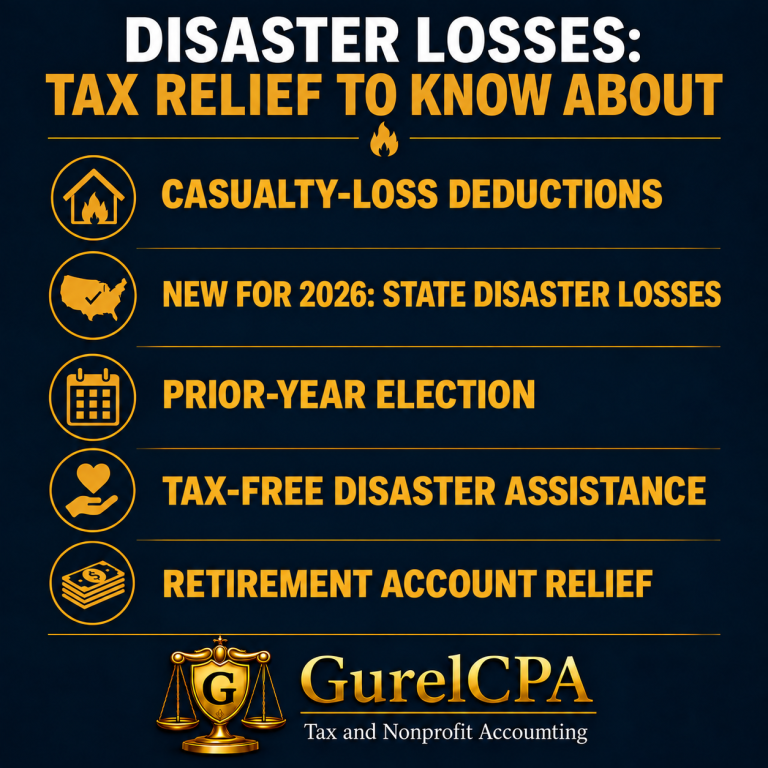
Property Damage Does Not Automatically Equal a Tax Deduction
A casualty loss generally involves property damage, destruction, or loss caused by a sudden, unexpected, or unusual event. Fires, floods, severe storms, hurricanes, tornadoes, and earthquakes are common examples.
The deductible amount is not necessarily the replacement cost or the amount spent on repairs. Tax rules may consider the property's adjusted basis, the decrease in fair market value, applicable statutory limitations, and insurance or other reimbursements. A taxpayer generally cannot deduct the portion of a loss that has been reimbursed or for which reimbursement is reasonably expected.
Deadline Relief and Loss Relief Are Different
The current Washington wildfire relief illustrates the distinction. Eligible taxpayers throughout covered counties may receive postponed federal deadlines automatically based on their address. They do not have to prove that their own property was damaged to receive that deadline relief.
A casualty-loss deduction or special disaster retirement distribution generally requires more. The taxpayer must meet the requirements of the particular provision and usually must show an actual loss or economic harm. Community-wide deadline relief can therefore apply to many people who will never claim a casualty loss.
Retirement Accounts May Offer Special Disaster Options
People who sustain an economic loss from certain federally declared major disasters may qualify for special retirement-plan or IRA rules. A qualified individual may generally designate up to $22,000 of eligible distributions for a particular disaster as qualified disaster recovery distributions.
Qualifying distributions can avoid the usual 10% additional tax on early distributions. The taxable income can generally be spread over three years, and qualifying amounts may generally be repaid to an eligible retirement plan within three years. These rules have specific residence, declaration, timing, and economic-loss requirements.
A Simple Recordkeeping Plan
Create one paper or electronic folder for the disaster and keep copies of photographs, insurance claims, assistance applications, payment records, repair estimates, invoices, receipts, property records, and correspondence. Maintain a simple dated log of important events, including evacuation, displacement, property inspections, insurance contacts, repairs, and assistance received.
Keep original records when possible, but back them up electronically. Do not email documents containing Social Security numbers or other sensitive information unless a secure method is being used.
For Anyone Affected by a Disaster
If you are dealing with a wildfire or another disaster, focus first on safety, family, housing, and recovery. Save the records you can without adding to the burden of the moment. The tax questions can be addressed when conditions are more stable.
When that time comes, verify the declaration that covered your location and review the property loss, insurance recovery, disaster assistance, and other facts together. Do not assume that assistance is taxable, and do not assume that property damage automatically creates a deduction.
GurelCPA can help review the documentation and determine which disaster and casualty-loss provisions may apply.
The article is meant for informational purposes only. Please contact me directly to discuss how this applies to your individual tax situation.
Wildfire Tax Relief Applies Across Covered Washington Counties
Wildfires do not affect only the people whose homes or businesses are physically damaged. Smoke, road closures, evacuations, power interruptions, disrupted work, displaced family members, delayed mail, and the general strain placed on a community affect everyone who lives nearby.
The IRS has announced tax filing relief that reflects that reality. It is based on where a taxpayer lives or where a business is located, not on whether that taxpayer incurred an individual loss. For taxpayers located in a covered disaster area, the IRS automatically identifies the taxpayer by the address in its records and applies the available filing and payment relief.
Who Is Included?
The covered Washington counties are Chelan, Ferry, Okanogan, Spokane, Stevens, and Yakima. The relief also applies to residents and businesses within the Confederated Tribes and Bands of the Yakama Nation, the Confederated Tribes of the Colville Reservation, and the Spokane Tribe of Indians.
Individuals who live in these areas and businesses, including tax-exempt organizations, whose principal place of business is in these areas qualify. The practical message is simple: if your address places you in the covered area, you are presumed to be affected for this IRS relief. You do not have to submit photographs, evacuation records, insurance claims, or other evidence of direct wildfire damage to receive the automatic postponement.
Many Federal Tax Deadlines Move to February 1, 2027
The IRS has postponed many federal filing and payment deadlines that fell on or after July 31, 2026, and before February 1, 2027. Eligible individuals and businesses generally have until February 1, 2027, to complete the covered filing or payment obligation.
This includes many individual and business income tax returns, partnership and S corporation returns, trust and estate returns, annual information returns for tax-exempt organizations, certain payroll and excise tax returns, and estimated income tax payments originally due during the relief period.

An Important Limitation
The relief does not postpone every tax obligation. For example, taxpayers who received an extension to file a 2025 individual income tax return may now have until February 1, 2027, to file that return. However, any tax owed with the 2025 return was originally due April 15, 2026, before the disaster relief period began. That earlier payment deadline is not postponed by this announcement. Certain information returns and federal tax deposits also follow separate rules.
What Taxpayers Should Do
Taxpayers in the covered area do not need to contact the IRS or file a special request. The relief e applies automatically based on the taxpayer's address of record.
If an eligible taxpayer receives a late-filing or late-payment penalty notice for a covered deadline, the taxpayer should call the telephone number shown on the notice and ask the IRS to remove the penalty. A taxpayer located outside the covered area may also qualify when necessary records are located inside the disaster area, but that taxpayer may need to contact the IRS Special Services line at 866-562-5227.
The Larger Message
This relief is more than an extension of dates. It is recognition that a major wildfire disrupts an entire region. A person does not have to lose a home to be affected. A business does not have to burn to experience interruptions. The IRS has treated residents and businesses throughout the covered counties as affected taxpayers and has provided additional time accordingly.
The article is meant for informational purposes only. Please contact me directly to discuss how this applies to your individual tax situation.
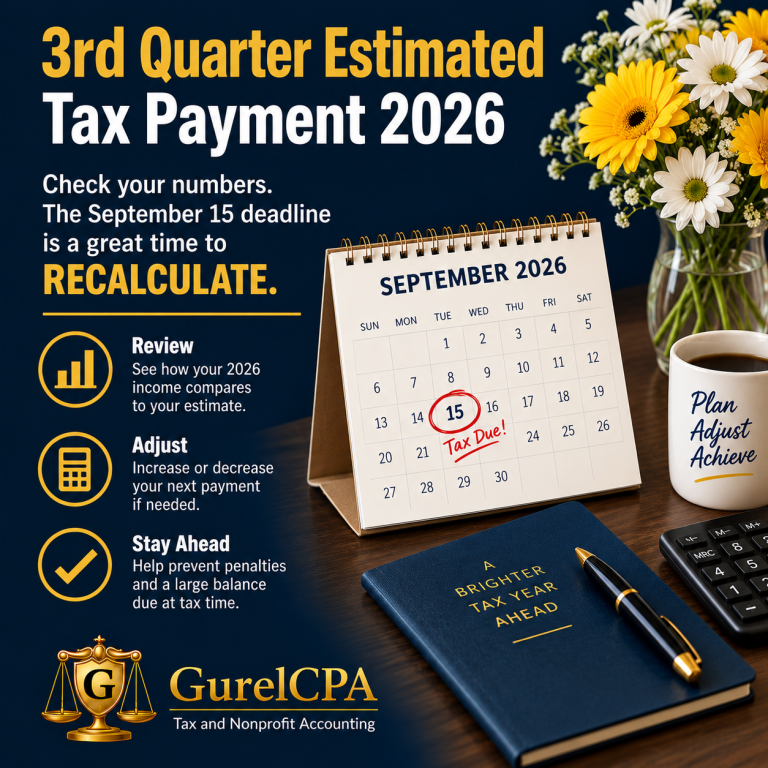
3rd Quarter Estimated Tax Deadline: September 15
A Good Time for a 2026 Tax Checkup
The third 2026 estimated tax payment is due September 15, 2026, for individual taxpayers who make quarterly estimated payments. Rather than simply sending the same amount paid in April and June, the third-quarter deadline is a useful opportunity to review what has actually happened so far this year.
By September, taxpayers often have a much clearer picture of their 2026 income. Business profits may be higher or lower than expected. Investments may have produced significant gains. Retirement distributions, rental income, bonuses, interest, dividends, or other income may also have changed. Those developments can affect whether the remaining estimated payments should be adjusted.
Start With a September Tax Checkup
A useful third-quarter review can include year-to-date business or self-employment income, investment sales and capital gains, retirement distributions, rental income, partnership or S corporation income, federal withholding, estimated payments already made, and major changes in deductions or credits.
For business owners and self-employed taxpayers, having current financial records can make this review much more useful. By September, year-to-date results provide a much better basis for estimating the full year's income than the assumptions available at the beginning of the year.
Has Anything Changed Since Your Estimates Were Prepared?
Estimated tax calculations are estimates. The IRS specifically recognizes that changes in income, deductions, adjustments, or credits during the year may require taxpayers to refigure their estimated tax.
Consider whether anything significant has changed since your 2026 estimates were originally prepared. Examples include a substantial increase or decrease in business income, the sale of stocks or other investments, a large capital gain, changes in rental income, a retirement distribution, a change in wages or withholding, new self-employment income, or a significant change in deductions or tax credits.
If the original estimate is now too low, increasing the September and January payments will reduce the risk of an underpayment penalty and an unexpectedly large balance due at tax time. If the original estimate is too high, recalculating may prevent unnecessarily sending money to the IRS months before it is actually due.
A Large Capital Gain Can Change the Picture Quickly
One of the most common reasons to revisit estimated taxes is a significant capital gain. Selling stock, investment property, cryptocurrency, or another appreciated asset can create a tax liability that was not included when the year's original estimated payments were calculated.
The timing matters as well as the amount. If a large gain occurs later in the year, the annualized income method may help demonstrate that the related income was not received during earlier payment periods.
Withholding Can Also Be Part of the Solution
Estimated payments are not the only way to address a projected shortfall. Taxpayers who receive wages, pensions, or other payments subject to federal withholding may increase withholding for the remainder of the year.
This can be particularly useful because federal income tax withholding is treated as having been paid evenly throughout the year for estimated tax penalty purposes, even when the withholding actually occurs later in the year. Depending on the circumstances, increasing withholding can therefore be an effective year-end planning tool.
Who Needs to Make Estimated Tax Payments?
Estimated tax payments are used to pay tax on income that is not subject to sufficient federal withholding. This commonly includes self-employment income, interest, dividends, rental income, capital gains, and other income received without adequate withholding.
This can affect self-employed individuals, sole proprietors and LLC owners, S corporation shareholders, partners, retirees, investors, and Americans living abroad. Even taxpayers who receive wages or retirement income may need estimated payments if their withholding is not enough to cover their total expected tax.
The $1,000 Rule
Generally, an individual will face an underpayment penalty if the tax owed after subtracting withholding and refundable credits is $1,000 or more and sufficient tax has not been paid during the year.
That does not mean every taxpayer who will owe $1,000 at filing automatically owes a penalty. The estimated tax rules include safe harbors that can help taxpayers avoid an underpayment penalty.
Understanding the Estimated Tax Safe Harbors
The goal is to pay enough during the year through withholding and estimated payments to satisfy the federal safe-harbor rules. This means paying at least 90% of the tax ultimately shown on the current-year return or 100% of the tax shown on the prior-year return, whichever required annual payment is smaller.
For higher-income taxpayers, the prior-year safe harbor generally increases from 100% to 110% when prior-year adjusted gross income exceeds $150,000 for married taxpayers or $75,000 for taxpayers filing separately.
These rules are important because an estimated tax payment does not necessarily have to equal the taxpayer's final tax liability. A taxpayer can satisfy a safe harbor and avoid an estimated tax penalty while still owing additional tax when the return is filed.
The Remaining 2026 Payment Schedule
For calendar-year individual taxpayers, the regular 2026 estimated tax installment dates are April 15, 2026; June 15, 2026; September 15, 2026; and January 15, 2027.
With the September 15 installment approaching, there is still time to review 2026 income and tax payments before the third payment is due. There will also be another opportunity to make adjustments before the final installment on January 15, 2027.
The Bottom Line
The September 15 estimated tax deadline should be viewed as more than another payment date. It is an opportunity to look at what has actually happened during 2026 and determine whether your tax plan needs to be adjusted before the year is over.
If your income, investments, business results, withholding, or other circumstances have changed significantly, this may be a good time to recalculate your estimated tax payments and consider year-end tax planning.
If you would like me to review your 2026 estimated tax situation before the September 15 payment deadline, please contact me directly.
The article is meant for informational purposes only. Please contact me directly to discuss how this applies to your individual tax situation.
The September 15 Business Tax Deadline Is Almost Here
September 15, 2026, is an important filing date for many small businesses. Calendar-year S corporations and partnerships that received valid extensions must file their 2025 federal income tax returns by that date. With the deadline approaching, now is the time to resolve missing records and unfinished bookkeeping.
Who Must File by September 15?
The deadline applies to extended 2025 Form 1120-S returns for calendar-year S corporations and extended 2025 Form 1065 returns for calendar-year partnerships. Businesses operating on a fiscal year may have a different extended deadline based on the close of their tax year.
The entity must also provide each shareholder or partner with the appropriate Schedule K-1. The K-1 reports the owner's share of income, deductions, credits, and other items that may affect the owner's individual tax return.
Start With the Accounting Records
Before the return can be completed, the books should be current and reconciled. Common items still needed include bank and credit-card statements, payroll reports, asset purchases, loan activity, owner contributions and distributions, and explanations for unusual transactions. Waiting until deadline week can leave too little time to resolve discrepancies.
Why Timely K-1s Are Important
Shareholders and partners need their Schedule K-1 before completing their individual income tax returns. Individual taxpayers with valid extensions have until October 15, 2026, to file, but a delayed or incorrect K-1 can create a last-minute problem. Finishing the business return promptly gives owners more time to review their information and complete their personal returns.

An Extension Does Not Extend Payment Time
A filing extension allows more time to submit a return. It does not postpone tax that was due at the original deadline. S corporations and partnerships commonly pass income through to their owners, but the entity may still owe certain federal or state taxes. Penalties and interest may continue to accrue on unpaid balances.
What If the Return Is Filed Late?
Late-filing penalties for partnerships and S corporations can depend on both the number of owners and the length of the delay. As a result, the penalty can become substantial even when the entity owes little or no federal income tax. If the deadline cannot be met, filing as soon as possible is better than allowing the return to remain unfinished.
Take Action Before September 15
If your extended S corporation or partnership return is still in progress, contact me soon. We can identify the remaining information, review unresolved accounting issues, and determine what must be completed before filing.
The article is meant for informational purposes only. Please contact me directly to discuss how this applies to your individual tax situation.
Minimum Wage Changes in 2026: What Employers Should Know
Minimum wage requirements continue to change across the country in 2026. The federal minimum wage remains $7.25 per hour, unchanged since 2009; but many states and local governments have adopted substantially higher rates. For employers, especially those with employees in more than one location, keeping track of the rate that applies to each worker is an important part of payroll compliance.
Minimum Wage Changes During 2026
Numerous states and local jurisdictions increased their minimum wage rates during 2026. Some increases took effect January 1, while others occur later in the year. Rates can also vary within a state because cities and counties may establish minimum wages that are higher than the statewide requirement.
Several states now have minimum wages above $15 per hour, while other states continue scheduled or inflation-based increases. Employers should not assume that the statewide rate is always the rate that applies.
Washington's 2026 Minimum Wage
Washington's statewide minimum wage is $17.13 per hour for 2026, effective January 1, 2026. That is an increase from $16.66 per hour in 2025.
Washington employers also need to be aware of local minimum wage ordinances. Several jurisdictions have higher rates than the statewide minimum. For example, Seattle's 2026 minimum wage is $21.30 per hour, and Bellingham's is $19.13 per hour. Other Washington jurisdictions, including SeaTac, Tukwila, Renton, Everett, Burien, and unincorporated King County, also have local minimum wage requirements that may exceed the state rate.
Florida Reaches $15 in September
Another significant 2026 change is coming this month. Florida's minimum wage is currently $14.00 per hour and will increase to $15.00 per hour on September 30, 2026. The increase completes the phased increases approved by Florida voters in 2020. Beginning in 2027, Florida's minimum wage will again be adjusted annually for inflation.

Why This Matters for Employers
Minimum wage changes affect more than the hourly rate shown on a paycheck. They can affect payroll budgets, overtime calculations, salary thresholds tied to minimum wage laws, and other employment-related requirements. Employers with workers in different cities or states may have several different wage rules to monitor.
Employers should:
- Review the minimum wage currently being paid to each employee.
- Check whether a city, county, or other local minimum wage ordinance applies.
- Watch for increases that take effect during the year rather than on January 1.
- Update payroll systems and labor budgets when rates change.
- Review required workplace posters and notices when a new rate takes effect.
An Uneven Wage Landscape
The minimum wage landscape remains highly uneven across the United States. Some states continue to rely on the federal $7.25 minimum wage, while Washington and a number of other states have rates well above $15 per hour. Local wage ordinances can create even larger differences.
For small businesses, the practical lesson is simple: minimum wage compliance should be reviewed by employee location rather than by relying on a single national wage figure. Employers should confirm the current state and local requirements that apply wherever their employees work.
Looking Ahead
Minimum wage rates will continue to change. Washington, for example, makes an annual cost-of-living adjustment based on the Consumer Price Index for Urban Wage Earners and Clerical Workers (CPI-W), with the following year's rate announced each September. Employers should make wage-rate reviews part of their regular year-end payroll planning rather than waiting until a change creates a compliance problem.
The article is meant for informational purposes only. Please contact me directly to discuss how this applies to your individual tax situation.
Foreign Earned Income Exclusion (FEIE) for U.S. Citizens Working Abroad
U.S. Taxes and Living Abroad
If you are a U.S. citizen or resident alien working outside the United States, you are generally still required to file a U.S. federal income tax return. The United States generally taxes U.S. citizens and resident aliens on their worldwide income, even when they live and work abroad.
One important provision that can significantly reduce U.S. income tax for qualifying individuals is the Foreign Earned Income Exclusion (FEIE). Understanding how it works and whether you qualify can make a substantial difference in your overall tax picture.
What Is the Foreign Earned Income Exclusion?
The Foreign Earned Income Exclusion allows qualifying taxpayers to exclude a portion of their foreign earned income from U.S. federal income tax. Foreign earned income generally includes wages, salaries, and self-employment income earned for services performed in a foreign country.
The exclusion applies only to earned income. It does not apply to interest, dividends, capital gains, pensions, or other investment-type income.
Important for the self-employed: The FEIE can reduce federal income tax on qualifying foreign self-employment income, but it generally does not reduce U.S. self-employment tax.
FEIE Maximum Amounts for 2025 and 2026
The maximum amount of income that can be excluded is adjusted annually for inflation.
• Tax year 2025: Up to $130,000 of qualifying foreign earned income
• Tax year 2026: Up to $132,900 of qualifying foreign earned income
Each qualifying taxpayer may claim their own exclusion. In the case of married couples where both spouses work abroad and meet the requirements, each spouse may qualify for a separate exclusion.
Basic Requirements to Qualify
To claim the FEIE, three primary conditions must generally be met:
1. Foreign Earned Income
You must have earned income from services performed in a foreign country.
2. Tax Home in a Foreign Country
Your tax home must be in a foreign country. The IRS also considers whether your “abode” remains in the United States, which can disqualify you even if you are physically overseas.
3. Meet One of the Two Residency Tests
You must meet either:
• The Bona Fide Residence Test (generally for those who establish long-term residence abroad), or
• The Physical Presence Test (generally at least 330 full days in a foreign country during a 12-month period).
How the FEIE Is Claimed
The FEIE is claimed by filing IRS Form 2555 with your federal income tax return. The exclusion is not automatic, you must affirmatively claim it.
Even if the exclusion eliminates all U.S. income tax, a filing requirement often still exists. Additionally, claiming the FEIE does not remove separate reporting obligations for foreign bank accounts or foreign financial assets.

Foreign Housing Exclusion or Deduction
In addition to the FEIE, some taxpayers may also qualify for a foreign housing exclusion (for employees) or a foreign housing deduction (for self-employed individuals).
Housing expenses above a base amount, subject to limits, may qualify. The base housing amount is tied to the FEIE maximum and increases as the exclusion amount increases.
For 2026, the base housing amount is generally $21,264.
Higher limits may apply for certain high-cost foreign cities as designated by the IRS.
FEIE vs. Foreign Tax Credit
The FEIE is not always the best option for every taxpayer. In some situations, particularly in countries with higher income tax rates, the Foreign Tax Credit may provide a better overall result, or the two strategies may be used in coordination.
However, a taxpayer generally cannot claim a Foreign Tax Credit or deduction for foreign income taxes attributable to income excluded under the FEIE or foreign housing exclusion. A credit may still be available for qualifying foreign taxes attributable to foreign income that remains subject to U.S. tax.
Choosing the correct approach requires an analysis of income type, foreign tax paid, housing costs, long-term plans, and other factors.
Common Mistakes
Some common issues that create problems for U.S. taxpayers abroad include:
• Assuming living abroad eliminates the U.S. filing requirement
• Miscounting days for the Physical Presence Test
• Confusing earned income with investment income
• Overlooking foreign bank account reporting requirements
• Ignoring potential state tax residency issues
Final Thoughts
The Foreign Earned Income Exclusion can be a powerful tool for U.S. citizens working abroad, but the rules are detailed and fact specific. Proper planning and correct filing are essential to avoid lost benefits or IRS complications.
Professional guidance can help determine whether you qualify, which test applies, and whether the FEIE, the Foreign Tax Credit, or a combination of strategies is best for your situation.
The article is meant for informational purposes only. Please contact me directly to discuss how this applies to your individual tax situation.
Donor-Advised Funds: How They Fit Into Charitable Giving
A donor-advised fund can make charitable giving easier to organize, especially for people who want to make a large charitable contribution now and decide later which charities will ultimately receive the money. It can also help donors contribute appreciated investments, group several years of giving into one tax year, and involve family members in charitable decisions.
A donor-advised fund is not the right answer for every donor. The tax deduction generally occurs when assets are contributed to the fund, not when the fund later sends grants to charities. Once contributed, the assets legally belong to the sponsoring charitable organization. The donor may recommend grants and investments, but the donor no longer owns or controls the money.
What Is a Donor-Advised Fund?
A donor-advised fund, often called a DAF, is a charitable account maintained by a sponsoring organization. The sponsor may be a community foundation, a national charitable organization, or another qualified public charity.
A donor contributes cash or other property to the account. The sponsoring organization has legal control of the assets, while the donor or another named advisor generally may recommend how the funds are invested and which eligible charities should receive grants. The sponsor must retain final authority over those decisions.
Why Donors Use DAFs
A DAF can separate the timing of the tax deduction from the timing of the grants. That feature can be useful in a high-income year, after the sale of a business or investment, or when a donor wants time to research charitable organizations before recommending grants.
Common reasons for using a DAF include:
- Combining several years of planned charitable giving into one year, sometimes called bunching, to help exceed the standard deduction and the new charitable deduction floor for itemizers.
- Contributing appreciated publicly traded stock or other assets instead of selling them first. When the rules are satisfied, the donor may avoid recognizing the built-in capital gain and may be able to claim a deduction based on fair market value.
- Creating one organized record of charitable contributions and grant recommendations.
- Making grants over several years from assets that may remain invested inside the account.
- Involving children or other family members in a long-term charitable giving plan.
The sponsor may charge administrative and investment fees, impose minimum contribution or grant amounts, limit the assets it will accept, and establish its own grantmaking policies. Those details should be reviewed before opening an account.
The Timing of the Tax Deduction
The contribution to the sponsoring organization is the charitable gift for federal income tax purposes. If a donor contributes $25,000 to a DAF in 2026 and recommends $5,000 of grants in each of the next five years, the potential charitable deduction is tied to the $25,000 contribution in 2026. The later grants do not create additional deductions.
The deduction is not automatic. It depends on whether the donor itemizes, the type of property contributed, adjusted gross income limitations, documentation, valuation requirements, and other tax rules. Contributions that cannot be fully deducted in the current year may qualify for a carryforward, generally for up to five years, subject to the applicable limits.
Important 2026 Charitable Deduction Changes
Beginning in 2026, individuals who itemize may deduct only the portion of their charitable contributions that exceeds 0.5% of adjusted gross income. For example, if adjusted gross income is $200,000, the first $1,000 of otherwise deductible charitable contributions is below the floor.
The 2026 law also provides a limited charitable deduction for taxpayers who do not itemize: up to $1,000 for most filers and up to $2,000 for married couples filing jointly. However, that deduction is limited to qualifying cash contributions and does not apply to contributions to donor-advised funds.
This difference makes planning important. A DAF contribution may still be useful for an itemizing taxpayer, particularly when contributions are grouped into one year. A non-itemizing taxpayer who wants the new deduction may be better served by making qualifying cash gifts directly to eligible operating charities.
What a DAF Cannot Do
A donor may recommend grants, but the account cannot be treated like a personal charitable checking account. Important restrictions include:
- The donor cannot take the contributed assets back or use them for personal expenses.
- A grant cannot provide the donor, a donor advisor, or a related person with more than an incidental personal benefit.
- DAF funds generally should not be used to buy event tickets, pay for tables or meals, cover the benefit portion of a membership, or obtain goods or services for the donor.
- Grants generally must go to eligible charitable organizations. DAFs are not designed to make direct gifts to individuals.
- A qualified charitable distribution from an IRA cannot be made to a donor-advised fund. A QCD must go directly from the IRA trustee to an eligible charity.
Donors should check with the sponsoring organization before recommending a grant connected to a pledge, membership, fundraising event, foreign charity, private foundation, or another situation that may require additional review.

DAFs and Appreciated Property
One of the strongest potential uses of a DAF is the contribution of appreciated property. Suppose a donor owns publicly traded stock worth $30,000 that originally cost $8,000. If the donor sells the stock, the sale may create a taxable capital gain. If the donor contributes the stock directly to a qualified DAF sponsor and all requirements are met, the donor may be able to avoid recognizing that gain and claim a charitable deduction based on the stock's fair market value.
The result can be different for property held one year or less, tangible personal property, closely held business interests, cryptocurrency, real estate, or property subject to debt. Appraisal and Form 8283 requirements may apply. The sponsor also needs time to review and accept complex assets, so these gifts should not be left until the final days of the year.
How DAFs Fit With Direct Giving
A donor-advised fund should complement charitable giving, not automatically replace direct gifts. Direct giving may be simpler for regular cash donations, urgent community needs, small gifts, and contributions connected with events or benefits. It also puts funds in the charity's hands immediately.
A DAF may be more useful for a major gift, appreciated assets, bunching deductions, or a deliberate multiyear grant plan. Donors should also consider how quickly they intend to recommend grants. A tax deduction has already been claimed when assets enter the DAF, but the operating charities do not benefit until grants are actually distributed.
What Nonprofits Should Know
A nonprofit receiving a DAF grant typically receives the payment from the sponsoring organization, often with information identifying the donor who recommended it. The donor already received any charitable acknowledgment from the sponsor when the original DAF contribution was made. The nonprofit may thank the donor for recommending the grant, but it should avoid issuing a second charitable contribution receipt that suggests the donor may claim another deduction.
Nonprofits can make DAF giving easier by providing their exact legal name, employer identification number, mailing address, and clear program information. Strong public-facing Form 990 reporting and a current website can also help donors and sponsoring organizations verify eligibility and understand how funds will be used.
Questions to Ask Before Opening a DAF
- Will I itemize deductions in the year of the contribution?
- Would bunching several years of gifts create a better tax result?
- Do I own appreciated assets that may be more tax-efficient to donate than cash?
- What fees, minimums, investment choices, and grant restrictions apply?
- How quickly do I intend to recommend grants to operating charities?
- Who should serve as successor advisor, if the sponsor permits one?
The Bottom Line
A donor-advised fund can be a useful charitable planning tool, especially for donors who itemize, contribute appreciated assets, or want to organize a multiyear giving plan. Its flexibility comes with limits: the gift is irrevocable, the sponsor has legal control, personal benefits are prohibited, and the donor receives no second deduction when grants are later distributed.
The best approach depends on the donor's income, assets, deduction status, charitable goals, and the rules of the sponsoring organization. Reviewing the plan before transferring assets can help prevent missed deductions, year-end timing problems, and grants that the sponsor cannot approve.
The article is meant for informational purposes only. Please contact me directly to discuss how this applies to your individual tax situation.
Standard Mileage vs. Actual Expenses
Which Vehicle Deduction Method Is Better?
If you use your personal vehicle for business, the IRS gives you two ways to deduct the cost:
- The standard mileage rate
- The actual expense method
You might think the question is simple: Which gives the larger deduction? But there are also important rules about when you can switch methods.
The Standard Mileage Rate
The standard mileage rate is an IRS estimate of the average cost of operating a vehicle. For 2026, it is 72.5 cents per mile for the first half of the year and 76 cents for the second half. The rate applies to cars, vans, pickups, and SUVs. It is intended to cover:
- Gas and oil
- Maintenance and repairs
- Tires
- Insurance
- Registration fees
- Depreciation
- General ownership costs
When you use the standard mileage method, you cannot separately deduct gas, repairs, insurance, depreciation, or most other vehicle expenses. Parking fees and tolls may still be deducted separately. The IRS treats all those costs as already included in the mileage rate.
How Much of the Rate Is Depreciation?
The IRS publishes only the depreciation portion of the standard mileage rate, not separate amounts for gas, insurance, or maintenance.
2024: Standard mileage rate 67 cents per mile; depreciation portion 30 cents per mile.
2025: Standard mileage rate 70 cents per mile; depreciation portion 33 cents per mile.
2026: Standard mileage rate 72.5 cents per mile; depreciation portion 35 cents per mile.
That means nearly half of the mileage rate is considered depreciation. The remainder represents fuel and operating costs.
The depreciation portion matters because it reduces your tax basis in the vehicle, even if you never separately claimed depreciation.
Actual Expenses
Under the actual expense method, you total all vehicle costs, including:
- Gas
- Oil
- Repairs
- Tires
- Insurance
- Registration
- Lease payments or depreciation
Then you multiply the total by your business-use percentage.
Example:
- Total miles driven: 20,000
- Business miles: 12,000
- Business use: 60%
If total vehicle expenses are $12,000, your deduction is:
$12,000 × 60% = $7,200
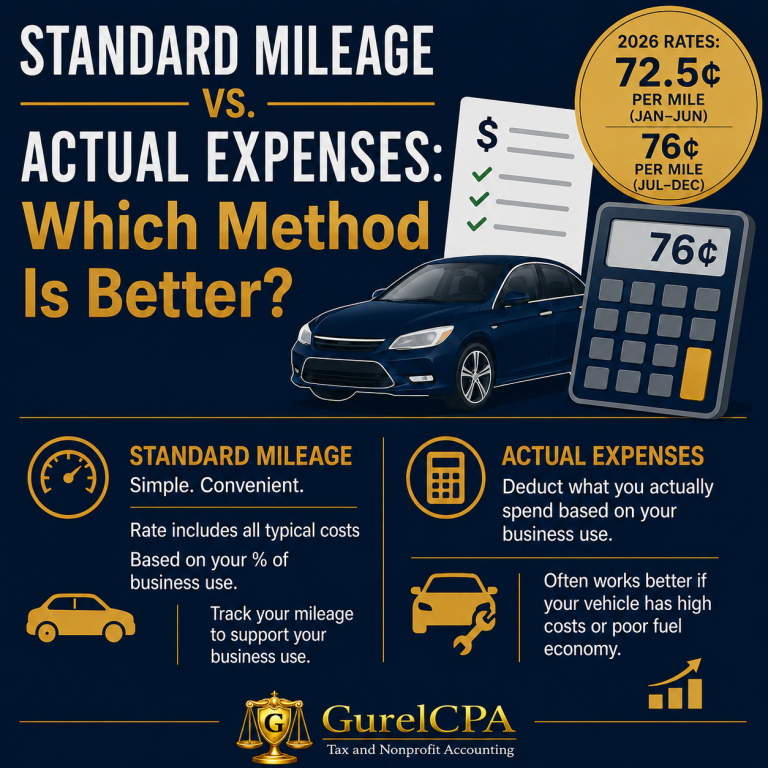
Which Method Usually Wins?
The standard mileage method often works very well when:
- The vehicle gets excellent fuel economy
- The vehicle is inexpensive to operate
- You drive many business miles
- The vehicle is already several years old
Actual expenses often work better when:
- The vehicle gets poor gas mileage
- Insurance is expensive
- Repairs are significant
- The vehicle is large or costly
- The vehicle is heavily depreciated
Can You Keep Track of Both?
Yes. Many business owners keep records of both mileage and actual expenses each year to determine which method is best.
However, there is an important rule:
If you own the vehicle and want the option of using the standard mileage rate, you must choose that method in the first year the vehicle is used for business.
- You may switch from standard mileage to actual expenses in a later year.
- If you switch to actual expenses, depreciation must generally be calculated using straight-line depreciation.
- If you start with actual expenses and use accelerated depreciation, Section 179, bonus depreciation, or MACRS, you generally cannot later switch to the standard mileage method.
For leased vehicles, if you begin with the standard mileage method, you must continue using it for the entire lease period.
Practical Advice
The safest approach is to keep a mileage log AND receipts for gas, repairs, insurance, registration, and other vehicle costs. Keeping a mileage log is important for determining your business use percentage.
That allows you and your tax preparer to compare both methods annually while preserving flexibility.
The standard mileage method is simple and often favorable for efficient vehicles with high business mileage. Actual expenses may produce larger deductions for trucks, vans, and expensive vehicles. The best method depends not only on this year's costs, but also on preserving the ability to use the most advantageous method in future years.
This article is for general information and not tax advice. The switching rules and depreciation rules can get complicated, especially when Section 179 or bonus depreciation is involved.
The Widow's Penalty: Tax Planning for a Surviving Spouse
The death of a spouse brings emotional and financial changes. One change that may come as a surprise is that the surviving spouse’s tax bill may not decrease in proportion to the household’s reduced income.
This is sometimes called the “widow’s penalty,” although it can affect a surviving spouse of any gender. A more accurate term might be the “survivor’s tax penalty.”
Why Can Taxes Increase After a Spouse Dies?
For the year in which a spouse dies, the couple can generally still file a joint tax return, provided the surviving spouse has not remarried and the other filing requirements are met.
After that year, the survivor will usually file as a single taxpayer. The qualifying surviving spouse filing status may remain available for up to two additional years, but generally only when the survivor has a dependent child and meets the other requirements. Most older surviving spouses do not qualify. The IRS explains the filing-status requirements here.
The transition from married filing jointly to single can create several problems:
- The standard deduction becomes smaller.
- Tax brackets become narrower.
- Income may reach higher tax rates more quickly.
- The income thresholds used to determine whether Social Security benefits are taxable are lower.
- Medicare income-related premium adjustments can begin at substantially lower income levels for a single taxpayer.
- The survivor may inherit additional retirement accounts that eventually produce required minimum distributions.
Meanwhile, many household expenses, including housing, insurance, utilities and property taxes, may not decrease very much.
Social Security Income Can Be Part of the Problem
When one spouse dies, the survivor generally does not continue receiving both Social Security benefits. The survivor will typically receive the higher of the two benefits, subject to Social Security rules.
Although household Social Security income may decline, the survivor’s other income may remain similar. Pensions, investment income and retirement-account distributions can leave the survivor with a relatively high taxable income for a single filer.
The Social Security tax thresholds are also less favorable for single taxpayers. These thresholds are not indexed annually for inflation, which can cause more of a retiree’s benefits to become taxable over time.
Medicare Premiums May Also Increase
Higher-income Medicare beneficiaries can pay an income-related monthly adjustment amount, commonly called IRMAA, in addition to their regular Part B and Part D premiums.
For 2026, the first IRMAA threshold is $109,000 for an individual return and $218,000 for a joint return. Medicare generally uses income from two years earlier when determining the premium. Medicare publishes the current income thresholds and premiums each year.
The individual threshold is half the joint threshold, even though the surviving spouse may retain much more than half of the couple’s income-producing assets.
Death of a spouse is considered a life-changing event for Medicare purposes. If the survivor’s current income has decreased, it may be possible to ask Social Security to reconsider an IRMAA determination.

Planning Before the First Spouse Dies
The survivor’s penalty cannot always be avoided, but advance tax planning may reduce its effect.
Consider Roth conversions while filing jointly. Converting some traditional retirement funds to a Roth IRA can create tax now, but it may reduce future required minimum distributions and taxable income for the survivor. The amount and timing must be carefully modeled.
Coordinate retirement-account withdrawals. It may make sense to take additional distributions during lower-tax years instead of waiting until required minimum distributions begin or increase.
Review how investments are owned. Couples should understand which assets will pass to the survivor, how cost basis may be adjusted at death and which accounts will continue producing taxable income.
Plan charitable giving strategically. Taxpayers who are at least age 70½ may be able to make qualified charitable distributions directly from an IRA. These distributions can satisfy charitable goals while helping control adjusted gross income.
Use the final joint-return year carefully. The year of death may provide a final opportunity to use joint tax brackets. Depending on the circumstances, that year may be appropriate for a Roth conversion, recognizing capital gains or completing other planned transactions.
Planning should consider the likely tax position of both spouses. Concentrating only on minimizing the couple’s current tax may leave the surviving spouse with a more difficult tax problem later.
Review the Plan After a Death
After a spouse dies, the survivor should review:
- Tax withholding and estimated payments
- Social Security benefits
- Pension elections
- Retirement-account beneficiaries and distribution options
- Medicare IRMAA exposure
- Investment ownership and cost basis
- The possible need for an estate tax return and portability election
- Wills, trusts, powers of attorney and account beneficiaries
Not every action should be taken immediately. Retirement accounts inherited by a surviving spouse can offer several distribution options, and the best choice depends on the survivor’s age, income and long-term plans. IRS Publication 590-B discusses distributions from inherited IRAs.
Planning for the Survivor
The widow’s penalty is not a separate tax. It is the combined effect of filing-status changes, narrower tax brackets, Social Security taxation, retirement distributions and Medicare income thresholds.
A tax projection can compare the couple’s current situation with the survivor’s expected income and taxes. This can identify planning opportunities while both spouses are alive and help the survivor avoid unnecessary surprises later.
GurelCPA offers tax compliance and advisory services for individuals and families, including retirement and survivor tax planning.
The article is meant for informational purposes only. Please contact me directly to discuss how this applies to your individual tax situation.
Gig and Self-Employed Workers?
Keep Business and Personal Funds Separate
Driving for Uber or Lyft, delivering food, renting property, freelancing, consulting, and other independent work can all create taxable business income. Even when the work is only a side job, it is important to treat it like a business.
One of the best habits a self-employed person can develop is simple: Do not comingle business and personal funds.
Why Separate Accounts Matter
Gig economy income is taxable even when it is part-time, temporary, paid in cash, or not reported on a Form 1099. At the same time, eligible business expenses may reduce taxable business income.
When business and personal transactions are mixed together in the same account, it becomes much harder to determine:
- How much the business actually earned
- Which expenses were business-related
- Whether all income was reported
- How much should be set aside for taxes
- Whether the activity was truly profitable
A bank or credit card statement filled with groceries, household bills, rideshare deposits, fuel purchases, and business supplies requires every transaction to be reviewed and classified. This can increase tax preparation time and make mistakes more likely.
Make the Recordkeeping Easier
A separate business checking account provides a central record of business income and expenses. Deposits from gig platforms, clients, and customers can go into that account. Business expenses can then be paid from the same account.
A separate credit card used only for business purchases can provide another helpful record. It does not necessarily have to be a traditional business credit card. The important point is that the card is dedicated to business use.
The IRS recommends maintaining records that clearly identify business income and expenses. The Taxpayer Advocate Service also advises small business owners to establish separate bank and credit card accounts and use them only for business activity.
Pay Yourself Instead of Paying Personal Bills Directly
Money earned by a sole proprietorship ultimately belongs to the owner, but personal spending should still be kept out of the business account.
Instead of using the business debit card to buy groceries or pay a personal utility bill, transfer money from the business account to the personal account. That transfer can be recorded as an owner's draw rather than a business expense.
Similarly, when personal money is used to help fund the business, the transaction should be identified as an owner contribution. It should not be mistaken for business income.

Separation Does Not Replace Documentation
A separate account is helpful, but a bank statement alone may not prove that an expense is deductible. Receipts, invoices, mileage records, and other supporting documents may still be needed.
Vehicle expenses deserve particular attention. A rideshare driver may use the same vehicle for both business and personal travel. The driver should maintain a timely mileage log that distinguishes business miles from commuting and other personal miles.
The same principle applies to cellphones, internet service, home offices, and other expenses that may have both personal and business components.
Separate Funds Can Also Protect a Business Entity
For someone operating through an LLC or corporation, keeping funds separate can be especially important. Regularly using company money for personal expenses may weaken the distinction between the owner and the business entity. It can also create accounting, payroll, tax, and legal complications.
Forming an LLC does not provide much practical separation if the owner continues to treat the company's bank account as a personal checking account.
A Simple System Can Be Enough
Good recordkeeping does not have to be complicated. A gig worker or sole proprietor can begin with:
- A checking account used only for business activity
- A separate card used only for business purchases
- A mileage-tracking method, if a vehicle is used
- A system for saving receipts and invoices
- Regular transfers to a savings account for estimated taxes
- Monthly review and reconciliation of the accounts
The earlier this system is established, the easier it is to understand the business and prepare an accurate tax return.
Clean Records Can Save Time and Money
Separating business and personal funds does not create a tax deduction by itself. It does, however, make legitimate deductions easier to identify and support. It can also reduce bookkeeping problems, simplify tax preparation, and provide a clearer picture of whether the work is truly worthwhile.
For gig workers and other self-employed individuals, a separate account is a small step that can prevent much larger problems later.
The article is meant for informational purposes only. Please contact me directly to discuss how this applies to your individual tax situation.
Don’t Wait Too Long to File for Your 2023 Tax Refund
Many taxpayers are surprised to learn that a tax refund does not remain available forever. If you are owed money by the IRS, there is a limited period of time to claim it. Once that deadline passes, the refund is generally lost permanently.
This issue most often affects taxpayers who have not filed a return for several years, individuals who mistakenly believe they are not required to file, students with part-time jobs, retirees with withholding, and workers who had excess withholding taken from their paychecks.
The Refund Deadline
The IRS sets a legal deadline for claiming a refund or tax credit. In most cases, the deadline is the later of:
• Three years from the date you filed your original tax return, or
• Two years from the date you paid the tax.
For most taxpayers who have not yet filed a 2023 tax return, the practical deadline to claim a refund is April 15, 2027. After that date, any refund associated with the 2023 return is forfeited to the U.S. Treasury.
Why Do Taxpayers Miss Refunds?
Many people assume that if the IRS owes them money, the IRS will automatically send it to them. Unfortunately, that is not how the system works.
The IRS generally requires a tax return or amended return to be filed before a refund can be issued. If no return is filed, the IRS may know that withholding was paid, but it will not issue the refund automatically.
Common situations include:
• A taxpayer had federal withholding from wages but never filed a return.
• A college student worked part-time and was due a refund.
• A retiree had withholding from pension payments.
• A taxpayer qualified for valuable credits but never filed.
• A taxpayer discovered a missed deduction years later but waited too long to amend the return.
Valuable Credits May Also Be Lost
The deadline does not apply only to withholding refunds. Tax credits may also be forfeited if a return is not filed on time.
For some taxpayers, credits such as the Earned Income Credit can significantly increase a refund. Waiting too long to file may result in losing those benefits entirely.
Filing an Amended Return
Sometimes taxpayers discover they missed income, deductions, or credits on a previously filed return.
A properly filed amended return can serve as a refund claim. However, amended returns are generally subject to the same refund statute deadlines. If the deadline has passed, the IRS will deny the refund even when the taxpayer was clearly entitled to it.

What If You Haven’t Filed for Several Years?
Even if some refunds have expired, it is usually still worthwhile to file delinquent returns.
Filing past-due returns can:
• Bring you back into compliance with the IRS.
• Stop additional failure-to-file issues from developing.
• Allow you to claim refunds that are still open.
• Prevent future refunds from being held by the IRS.
In many cases, taxpayers are pleasantly surprised to learn that they are owed money rather than owing money.
Take Action Before the Deadline
If you have not filed a 2023 tax return and believe you may be entitled to a refund, now is the time to act. Waiting until the last minute can create problems obtaining W-2s, 1099s, or other records needed to prepare an accurate return.
Remember, once the refund statute expires, the IRS cannot issue the refund, even if you clearly overpaid your taxes. The money becomes property of the U.S. Treasury.
If you have unfiled tax returns or believe you may be entitled to a refund from a prior year, please contact me directly for a free consultation.
This article is for informational purposes only and does not constitute tax advice. Every taxpayer's situation is unique.
What Does Your Form 990 Say About Your Nonprofit?
Your nonprofit's annual filing is also part of its public story.
Many nonprofit leaders think of Form 990 primarily as an annual IRS filing requirement. Once it is completed and filed, they may consider the job finished.
But Form 990 is more than a tax return. It is one of the most visible public documents your nonprofit produces.
The IRS makes Form 990-series filings available through its Tax Exempt Organization Search, and tax-exempt organizations generally must make their annual returns available for public inspection. Potential donors, grantors, board candidates, journalists, volunteers, and community partners may review the return before deciding whether to support or work with an organization.
That means your Form 990 does more than report numbers. It communicates your nonprofit's financial health, priorities, governance, and impact.
Here are five things readers may notice:
1. Revenue Sources and Financial Health
The financial sections of Form 990 show where an organization's revenue comes from and how its financial position has changed.
Readers may look at:
- Contributions and grants
- Program service revenue
- Fundraising revenue
- Investment and other income
- Total expenses
- Assets, liabilities, and net assets
A healthy nonprofit does not necessarily need a large budget or substantial reserves. However, the return should present a financial picture that is understandable and consistent with the organization's size, programs, and stage of development.
Large fluctuations, recurring deficits, declining contributions, or heavy reliance on one revenue source may raise questions. Those figures are not automatically signs of a problem, but the nonprofit should understand what they communicate.
Schedule O and other narrative sections may provide opportunities to explain unusual circumstances, organizational changes, or important financial developments.
2. How Resources Support the Mission
Form 990 reports how the organization uses its resources, including amounts devoted to programs, management and general activities, and fundraising.
Readers may compare what the nonprofit says it exists to accomplish with how it actually spends its money.
Program expenses alone do not tell the entire story. A nonprofit needs administration, financial management, technology, insurance, staff development, and fundraising to operate responsibly. Strong organizations invest in the systems that support their mission.
The important question is whether the spending pattern makes sense for the organization.
The return should help readers understand how financial resources support actual programs and services, rather than leaving them to interpret the numbers without context.
3. Executive Compensation
Form 990 may disclose compensation paid to officers, directors, trustees, key employees, and certain highly compensated employees.
Compensation is not inherently a concern. Nonprofits need qualified leadership, and reasonable compensation can help an organization attract and retain capable people.
Readers may nevertheless ask:
- Is the compensation reasonable for the organization's size and activities?
- Is the amount clearly and accurately reported?
- Did independent board members approve the compensation?
- Did the organization use appropriate comparison information?
- Is the process documented?
Transparency is especially important when an officer or board member is also a paid employee or contractor. Related financial arrangements should be properly reviewed, approved, documented, and disclosed.

4. Governance and Related Parties
Part VI of Form 990 asks about governance practices, management, and disclosure. It includes questions about board independence, conflicts of interest, document retention, whistleblower policies, compensation procedures, and whether the governing board received a copy of the return before filing.
The IRS does not require the board to review Form 990. However, the return asks the organization to describe its review process in Schedule O. A meaningful board review can demonstrate that the organization treats the filing as an important governance document rather than merely an administrative obligation.
The return may also disclose transactions involving officers, directors, trustees, key employees, family members, and related organizations.
These disclosures help readers evaluate whether the nonprofit has appropriate oversight and whether potential conflicts of interest are being handled responsibly.
5. The Story the Filing Tells
The most overlooked section of Form 990 may be Part III, the Statement of Program Service Accomplishments.
This is where a nonprofit can explain what it actually accomplished during the year. The IRS instructions encourage organizations to describe results using measurements such as the number of people served, events held, services provided, publications issued, or other relevant indicators.
Weak descriptions often repeat a general mission statement without explaining what occurred during the year.
A stronger description answers questions such as:
- What programs did the organization operate?
- Who benefited?
- How many people were served?
- What services were provided?
- What changed because of the organization's work?
- What important results were achieved?
Schedule O can provide additional space when the standard form does not allow enough room to tell the story clearly.
These narratives may be read by people who know little about the organization. They should be accurate, specific, and understandable without requiring inside knowledge.
Review Your Form 990 Through the Reader's Eyes
Before filing, nonprofit leaders and board members should review Form 990 from two perspectives.
First, is the return complete, accurate, and compliant with IRS requirements?
Second, what impression will it create for someone deciding whether to donate, provide a grant, join the board, volunteer, or partner with the organization?
A technically correct return can still miss an important opportunity if it contains vague program descriptions, unexplained financial changes, incomplete governance information, or disclosures that do not reflect the organization's actual strengths.
Your Form 990 is more than a tax return. It is your nonprofit's public story. Make sure it tells that story clearly.
GurelCPA works with small and emerging nonprofits to improve Form 990 and Form 990-EZ reporting, strengthen program accomplishment narratives, and present financial and governance information more effectively. I offer a free one-on-one review for nonprofits that are concerned their current filing may not fully communicate their mission and accomplishments.
The article is meant for informational purposes only. Please contact me directly to discuss how this applies to your individual tax situation.
IRS Proposes a Simpler Process for Retirement Plan Rollovers
New standardized forms could reduce paperwork and delays, but retirement plans are not required to use them yet.
Changing jobs often leaves an important financial decision: what should you do with the money in your former employer’s retirement plan? Moving those savings into another employer plan or an individual retirement account can preserve their tax-deferred status, but the rollover process has not always been simple or consistent.
The IRS is now proposing a more standardized approach. On August 12, 2026, the Treasury Department and IRS issued Notice 2026-49, which contains sample forms and proposed procedures for direct rollovers between retirement plans and IRAs. The guidance was required by Section 324 of the SECURE 2.0 Act of 2022.
Why retirement plan rollovers can be difficult
Each retirement plan may have its own forms, documentation requirements, verification procedures, and method for transmitting funds.
Participants sometimes have to coordinate separately with the plan sending the money and the plan or IRA receiving it.
Missing information, incompatible forms, and paper checks can lead to delays or failed transactions.
A direct rollover generally moves money from one retirement account to another without the participant taking possession of the funds.
When completed properly, it generally avoids current taxation and mandatory withholding.
By contrast, when a distribution is paid directly to the participant, the payer generally must withhold 20 percent of an eligible rollover distribution from an employer plan.
The participant may then have only 60 days to complete a rollover and may need to replace the withheld amount with other funds to roll over the entire distribution.
What the new IRS guidance provides
Notice 2026-49 includes four sample forms and a proposed five-step process. The forms are intended to let the receiving plan or IRA, the distributing plan, and the participant exchange the information needed to complete a direct rollover more consistently.
The proposed process is designed to reduce the amount of personal information exchanged unnecessarily and to minimize the participant’s role after the initial request.
Treasury and the IRS also encourage electronic processing and electronic transfers when they are available.
The guidance covers direct rollovers between employer retirement plans and rollovers between a retirement plan and an IRA, including rollovers in either direction when permitted. It does not apply to transfers from one IRA directly to another IRA.

The forms are optional for now
This announcement does not mean every 401(k), 403(b), governmental 457(b) plan, or IRA provider must immediately adopt the new forms. Use of the sample forms and proposed procedures is currently optional for plan sponsors. The IRS also states that using them does not presently create a special safe harbor.
As a result, individuals should continue to follow the instructions provided by both the retirement plan sending the funds and the account receiving them. A provider may use its existing forms and procedures instead of the IRS samples.
Treasury and the IRS are accepting comments through October 23, 2026. They are also considering additional guidance that could further encourage electronic transfers and possibly remove the existing option of sending certain direct-rollover checks to participants for delivery to the receiving institution.
What this means for retirement savers
The new guidance is a meaningful step toward a simpler rollover system, but it does not change the basic tax rules governing whether a distribution is eligible for rollover. It also does not make every rollover automatic.
Before moving retirement money, a participant should confirm that the receiving plan or IRA will accept the rollover, determine whether any portion of the account consists of Roth or after-tax funds, and request a direct rollover whenever appropriate. Participants should also retain copies of the request, account statements, confirmation documents, and the Form 1099-R issued for the distribution.
A rollover decision can also involve more than paperwork. Investment choices, fees, creditor protections, access to plan loans, required minimum distributions, and withdrawal options can differ between an employer plan and an IRA. Those factors should be considered before deciding where the retirement savings should go.
The Bottom Line
Notice 2026-49 could eventually make retirement plan rollovers faster and more consistent. For now, however, the standardized forms remain optional and retirement providers may continue using their existing procedures. The safest approach is to coordinate with both institutions before any money is distributed and to verify that the transaction will be processed as a direct rollover.
The article is meant for informational purposes only. Please contact me directly to discuss how this applies to your individual tax situation.
Thinking About Moving Overseas?
Money Is Only Part of the Equation
For many Americans, the idea of living overseas is appealing. A different pace of life, lower living costs, better weather, new experiences, or simply the opportunity for a change can make another country an attractive place to live or retire.
But a successful move overseas requires considerably more planning than simply deciding whether you can afford it.
In fact, having substantial income or assets can sometimes make an international move more complicated, not less.
Every Country Is Different
There is no single set of rules for Americans moving abroad.
Tax residency, income taxes, investment taxation, inheritance and gift taxes, property ownership, visas, and the treatment of retirement income vary dramatically from one country to another.
A country that works beautifully for one person's financial situation may create unexpected problems for someone else.
Before deciding where to live, it is important to understand how that country's rules will apply specifically to you.
Your U.S. Tax Obligations Usually Come With You
Moving overseas does not end a U.S. citizen's federal income tax responsibilities.
U.S. citizens remain subject to U.S. tax reporting on their worldwide income regardless of where they live. However, depending on the circumstances, provisions such as the foreign tax credit or foreign earned income exclusion may help reduce double taxation.
There can also be additional reporting requirements involving foreign bank accounts and financial assets, including FBAR and potentially Form 8938.
Living overseas means dealing with two tax systems at the same time.
More Wealth Can Mean More Complexity
Having substantial assets provides flexibility when moving abroad, but those assets can also create additional complications.
Investment accounts, retirement plans, trusts, business interests, real estate, estate planning, and other investments may receive very different tax treatment in another country.
The reverse is also important. A financial product or investment that is perfectly ordinary in your new country may have complicated U.S. tax consequences.
That is why choosing a destination based primarily on an attractive tax rate can be a mistake. The important question is how the country's tax system interacts with your particular income, investments, retirement accounts, and other assets.

Healthcare Can Be Just as Important as Taxes
Healthcare deserves careful consideration, particularly for retirees.
Some countries have national healthcare systems. Others rely more heavily on private insurance. Eligibility for public healthcare may depend on residency status, employment, age, or other factors.
Medicare generally does not cover healthcare received outside the United States, except in limited circumstances.
Before moving, consider not only the cost of healthcare but also access to physicians and specialists, prescription medications, private insurance, emergency care, and long-term care.
Plan Before You Move
International tax planning is much easier before a move than after one.
Changing tax residency, selling investments, restructuring accounts, moving money, buying foreign property, or establishing foreign financial accounts can have consequences in both the United States and your destination country.
Ideally, Americans considering an international move should review their U.S. tax situation before establishing residency abroad and coordinate that planning with a knowledgeable professional in the country where they intend to live.
The best country is not necessarily the cheapest one or the country offering the most attractive tax incentive. It is the place where your lifestyle, finances, healthcare, residency requirements, and tax situation work together.
If you are considering living or retiring overseas, I offer a free initial consultation to discuss the U.S. tax issues that may apply to your situation.
The article is meant for informational purposes only. Please contact me directly to discuss how this applies to your individual tax situation. I offer a free initial consultation, and I work with U.S. taxpayers living both in the United States and abroad.
Receiving More Than $10,000 in Cash?
Form 8300 May Be Required!
Receiving a large cash payment creates an IRS reporting responsibility that many business owners do not know about.
A business that receives more than $10,000 in cash in a single transaction, or in related transactions, generally must file Form 8300, Report of Cash Payments Over $10,000 Received in a Trade or Business.
Form 8300 reporting helps the government identify possible money laundering, tax evasion, and other financial crimes.
The Threshold Is More Than $10,000
The filing requirement generally begins when the total cash received exceeds $10,000. A payment of exactly $10,000 ordinarily does not trigger the requirement.
Businesses must combine related payments. For example, if a customer pays $6,000 in cash as a deposit and another $5,000 toward the same purchase, the business has received $11,000 in related cash payments and may need to file Form 8300.
Transactions occurring within 24 hours are generally considered related. Transactions over a longer period may also be related if the business knows, or has reason to know, that they are part of a connected series.
What Is Considered Cash?
Cash includes U.S. and foreign coins and currency.
In certain transactions, cash can also include cashier's checks, bank drafts, traveler's checks, and money orders with a face amount of $10,000 or less.
Personal checks, credit card payments, debit card payments, and electronic transfers generally are not considered cash for Form 8300 purposes.
Filing and Notification Requirements
The business receiving the cash is generally responsible for filing Form 8300. The form normally must be filed within 15 days after the business receives the payment that causes the total to exceed $10,000.
The business must obtain identifying information about the person making the payment. It must also generally provide that person with a written statement by January 31 of the following year.

Dividing Payments Does Not Avoid Reporting
A customer cannot avoid reporting by dividing a transaction into several smaller payments. This practice is known as structuring.
For example, paying $9,000 one day and $3,000 shortly afterward for the same purchase does not avoid Form 8300. Related payments need to be combined.
A business should never suggest that a customer divide payments to avoid reporting. Structuring transactions to evade federal reporting requirements can result in serious consequences.
The Bottom Line
Businesses that may receive large cash payments should have procedures for tracking payments, identifying related transactions, collecting customer information, and filing Form 8300 on time.
Receiving a large cash payment is not necessarily suspicious, and filing Form 8300 does not mean that the customer has done anything wrong. However, failing to file, filing late, or intentionally disregarding the rules can result in significant penalties.
The article is meant for informational purposes only. Please contact me directly to discuss how this applies to your individual tax situation.
Three Important Changes to Charitable Deductions in 2026
Charitable giving gets some significant tax changes beginning in 2026. Some taxpayers will gain a deduction they did not have before, while others may find that the tax benefit of their charitable contributions is reduced.
Here are three changes donors should know about.
1. A New Charitable Deduction for Taxpayers Who Do Not Itemize
Perhaps the most taxpayer-friendly change is a new deduction for people who take the standard deduction.
Beginning in 2026, taxpayers who do not itemize may deduct up to $1,000 of qualifying cash charitable contributions, or up to $2,000 for married couples filing jointly.
This is important because most taxpayers take the standard deduction and, in recent years, generally received no federal income tax deduction for their charitable gifts.
The new provision means that qualifying taxpayers can take the standard deduction and still receive an additional tax benefit for certain charitable contributions.
There are limitations. The new deduction generally applies to cash contributions to qualifying charitable organizations, so taxpayers should verify that an organization qualifies and maintain appropriate records of their donations.
2. A New 0.5% AGI Floor for Taxpayers Who Itemize
The news is less favorable for taxpayers who itemize their deductions.
Beginning in 2026, charitable contributions are deductible only to the extent that they exceed 0.5% of the taxpayer's adjusted gross income (AGI).
For example, suppose a taxpayer has AGI of $200,000. The 0.5% floor would be $1,000. If that taxpayer made $10,000 of charitable contributions during the year, the first $1,000 would fall below the new floor, leaving $9,000 potentially deductible, subject to the other charitable contribution rules and limitations.
For taxpayers who regularly make substantial charitable gifts, the effect may be relatively modest. However, it introduces another factor to consider when planning the timing and amount of charitable contributions.
It may also make strategies such as grouping, or "bunching," charitable contributions into particular tax years more useful for some taxpayers.
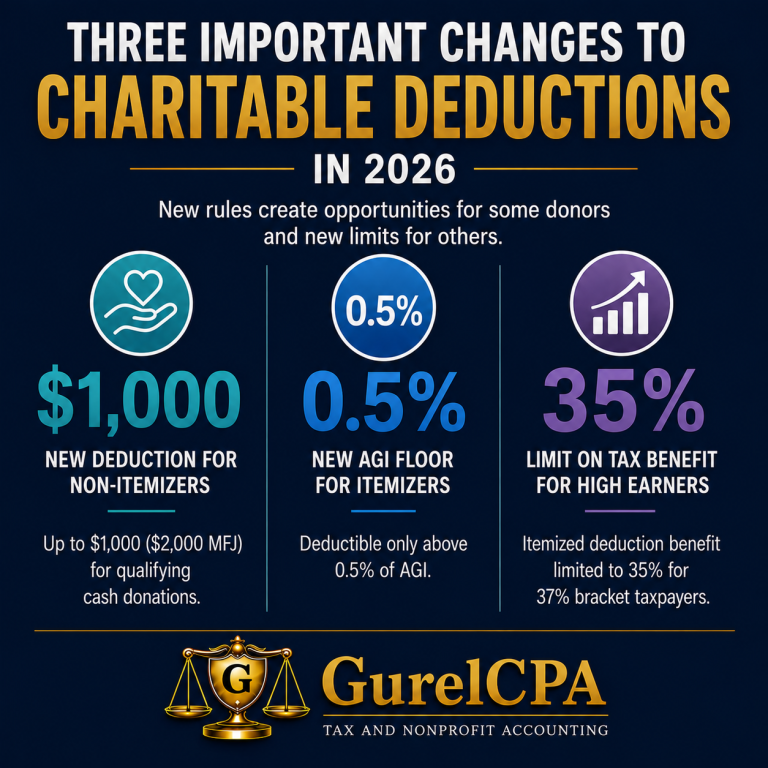
3. A 35% Limit on the Tax Benefit of Itemized Deductions for High-Income Taxpayers
There is another change affecting taxpayers in the highest federal income tax bracket.
Although the top individual federal income tax rate remains 37%, beginning in 2026 the tax benefit of itemized deductions is effectively limited to 35% for taxpayers subject to the 37% rate.
In simple terms, a dollar of charitable deduction will no longer necessarily reduce federal income tax by 37 cents for a taxpayer in the highest bracket. The maximum benefit is generally limited to 35 cents.
This provision applies to itemized deductions generally, not just charitable contributions, but it can be particularly important for high-income taxpayers making substantial charitable gifts.
Charitable Giving Becomes More of a Planning Issue
Taken together, these changes create an interesting contrast.
For millions of taxpayers who take the standard deduction, charitable giving may produce a federal income tax deduction again.
For taxpayers who itemize, the new 0.5% AGI floor may reduce the amount of their charitable deduction.
And for taxpayers in the highest income tax bracket, the value of itemized deductions is reduced further by the new 35% limitation.
None of these changes should determine whether someone supports a charitable organization. But for taxpayers who already intend to give, when they give, how much they give, and how they structure those gifts can make a difference.
That makes charitable contribution planning worth discussing before the end of the tax year rather than waiting until tax return preparation begins.
The article is meant for informational purposes only. Please contact me directly to discuss how this applies to your individual tax situation.
September 15 Is the Deadline for Extended Business Returns
If your calendar-year S corporation or partnership received an extension for its 2025 federal income tax return, the extended filing deadline is September 15, 2026.
That date is approaching quickly, and an extension does not provide additional time beyond September 15.
Which Business Returns Are Due?
The September 15 deadline applies to Form 1120-S for calendar-year S corporations and Form 1065 for calendar-year partnerships that filed valid extensions. (Fiscal-year businesses may have a different deadline based on the end of their tax year.)
The business must also provide the appropriate Schedule K-1 to each shareholder or partner by September 15. The K-1 reports the owner’s share of income, deductions, credits, and other tax items that may affect the owner’s individual return.
Schedule K-1s Matter to the Owners
Shareholders and partners need their Schedule K-1 before they can complete their individual income tax returns. Taxpayers whose personal returns are on extension generally have until October 15, 2026, but that additional month can disappear quickly when a K-1 arrives late or raises questions. Timely business filing gives each owner a better opportunity to review the K-1 and finish the individual return without a last-minute rush.
What Information May Still Be Needed?
Do not wait until the final days to gather missing information. Bank and credit-card statements, bookkeeping records, payroll reports, asset purchases, loan activity, distributions, contributions, and other owner transactions may all be needed. The accounting records should also be reconciled before the return is finalized. Unexplained balances or transactions between the business and its owners can require additional time to review.

An Extension Is Not Extra Time to Pay
A filing extension provides additional time to submit the return, not additional time to pay tax that was due at the original deadline. Although S corporations and partnerships usually pass income through to their owners, an entity can still have certain federal or state tax liabilities. Unpaid balances may continue to accrue penalties and interest.
Late-Filing Penalties Can Add Up
Partnership and S corporation late-filing penalties can increase based on the number of owners and the length of the delay. This means penalties may become significant even when the entity itself owes little or no federal income tax. Filing as soon as possible is better than allowing an overdue return to remain unfinished.
Do Not Wait Until Deadline Week
If your extended S corporation or partnership return has not been completed, contact me soon. We can determine what information is still needed, identify any accounting issues that must be addressed, and evaluate whether the September 15 deadline can be met.
The article is meant for informational purposes only. Please contact me directly to discuss how this applies to your individual tax situation.
Moving Assets Overseas?
Don’t Confuse the Exit Tax with the Foreign Transfer Rules
Many Americans assume that taxes on moving assets overseas only apply if they give up their U.S. citizenship. That's not true.
The United States has several different tax rules that can apply when money, investments, businesses, or other assets are transferred outside the United States. Because news stories often lump these rules together, it's easy to confuse one with another.
Understanding the difference can help you avoid an unexpected tax bill.
The Exit Tax
The best-known international tax rule is the U.S. Exit Tax.
The exit tax generally applies only to certain U.S. citizens or long-term green card holders who formally expatriate and meet the definition of a covered expatriate.
Instead of waiting until assets are sold, the IRS generally treats covered assets as though they were sold immediately before expatriation. Any taxable gain above the annual exclusion amount may become taxable even though the assets were never actually sold.
For most taxpayers, this rule never comes into play because they never give up their U.S. citizenship or permanent residency.
A Different Set of Rules: Transferring Assets to Foreign Corporations
Suppose you own appreciated stock, real estate, or business assets and decide to contribute them to a corporation you establish overseas.
You might assume the transaction qualifies as a tax-free corporate contribution similar to what often happens when property is transferred into a newly formed U.S. corporation.
Not necessarily.
Under Internal Revenue Code Section 367, Congress created special rules that often override the normal tax-free treatment for transfers of property to foreign corporations. In many situations, appreciated property transferred to a foreign corporation is treated as though it had been sold, causing immediate recognition of taxable gain.
In other words, you do not have to expatriate for tax to be triggered.
Example:
Assume you own stock worth $2 million with a cost basis of $500,000.
You form a corporation outside the United States and contribute the stock to that company.
Even though you received stock in exchange and did not receive cash, the IRS may require you to recognize the $1.5 million built-in gain immediately under the international transfer rules.
Foreign Trusts Have Their Own Rules
Foreign trusts are another area where taxpayers often make incorrect assumptions.
Transfers of property to foreign trusts may trigger immediate tax consequences and often require significant IRS reporting.
Loans between the trust and beneficiaries, distributions from the trust, and ownership of foreign trust assets are all governed by separate provisions of the Internal Revenue Code.
These rules are entirely different from the Exit Tax.

International Reporting Can Be Just as Important
Even when no immediate tax is due, transferring assets overseas may create reporting obligations.
- Form 926 (Transfers to Foreign Corporations)
- Form 3520 (Foreign Trusts and Certain Foreign Gifts)
- Form 5471 (Foreign Corporations)
- Form 8938 (Specified Foreign Financial Assets)
- FBAR (FinCEN Form 114)
Failure to file these forms can result in substantial penalties, even if no tax is ultimately owed.
Why These Rules Exist
Congress has long been concerned that appreciated assets could otherwise be transferred outside the U.S. tax system before gain is recognized.
As a result, the international tax rules are generally much stricter than comparable transactions involving domestic corporations.
The Bottom Line
There is no single 'foreign transfer tax' in the Internal Revenue Code.
Instead, there are several different tax systems that may apply depending on the transaction:
- Exit Tax - Applies to certain individuals who give up U.S. citizenship or long-term permanent residency.
- IRC Section 367 - May trigger tax when appreciated property is transferred to foreign corporations.
- Foreign Trust Rules - Govern transfers involving foreign trusts.
- International Reporting Rules - May require extensive IRS reporting even when no tax is immediately due.
If you are considering moving assets, starting a foreign business, creating a foreign trust, or relocating overseas, professional planning before the transaction can often prevent expensive surprises later.
The article is meant for informational purposes only. Please contact me directly to discuss how this applies to your individual tax situation. I offer a free initial consultation, and I work with U.S. taxpayers living both in the United States and abroad.
Estimated Taxes: Are You Paying Enough, or Too Much?
Estimated tax planning is not simply about avoiding an IRS penalty. The goal is to pay enough tax during the year to cover your obligation without unnecessarily sending the IRS more money than you need to.
That balance can be especially important for self-employed individuals, business owners, investors, retirees, and Americans living overseas because their income and withholding may change significantly during the year.
Are You Paying Enough?
If your income increases but your withholding or estimated payments do not, you can arrive at tax season with a large balance due and possibly an underpayment penalty. Common causes include higher business income, capital gains, rental income, larger retirement distributions, or income that has little or no federal tax withholding.
For many taxpayers, the IRS safe-harbor rules provide a useful starting point. Generally, taxpayers can avoid an estimated tax penalty if they owe less than $1,000 after withholding and refundable credits, or if their withholding and credits cover at least 90% of the current year's tax or 100% of the prior year's tax. For certain higher-income taxpayers, the prior-year safe harbor increases to 110%.
But Are You Paying Too Much?
Paying more than necessary can create a different problem. A large refund may be welcome at tax time, but it can also mean that money was sent to the government months earlier than necessary instead of remaining available for your business, investments, savings, or household expenses.
The objective should not be the largest possible refund. It should be reasonable tax payments based on your actual circumstances.
Estimated Taxes Should Be Reviewed During the Year
Last year's numbers are useful, but they may not reflect what is happening this year. If income rises or falls, investments are sold, retirement distributions change, or withholding changes, estimated payments may need to be adjusted.
A midyear or later-year tax projection can help answer the practical question: Are you on track to pay enough, but not substantially more than necessary?
A Special Consideration for Americans Living Overseas
Americans living abroad can have an especially complicated estimated tax picture. Foreign wages may have no U.S. withholding, and foreign investment income, business income, rental income, and U.S.-source income can affect the calculation.
Taxpayers who qualify for the Foreign Earned Income Exclusion may reduce their U.S. income tax, but the exclusion generally does not reduce U.S. self-employment tax. Foreign tax credits can also affect the ultimate U.S. tax liability. For these taxpayers, simply repeating last year's estimated payments may not produce the right result.
The Goal: Pay the Right Amount
Estimated tax planning is ultimately about cash-flow management as well as tax compliance. You do not want to discover a major shortfall when the return is prepared, but you also do not need to intentionally overpay the IRS throughout the year.
If your income or circumstances have changed, reviewing your projected tax liability and payments can help determine whether your estimates should be increased, decreased, or left alone.
Questions about estimated taxes or international tax issues? Contact GurelCPA for a free consultation.
The article is meant for informational purposes only. Please contact me directly to discuss how this applies to your individual tax situation.
When a Roth Conversion May Cost More Than It Saves
Why paying tax now is not always the best retirement strategy
Roth accounts are one of the best deals in retirement planning. You pay tax before the money goes into the account, the investments may grow tax-free, and qualified withdrawals are generally tax-free. Roth IRAs also generally have no required minimum distributions during the original owner’s lifetime.
Those are meaningful advantages, but they do not make a Roth the right choice in every situation. A Roth conversion requires a taxpayer to include previously untaxed retirement money in current taxable income. That can be valuable when today’s tax cost is lower than the tax that would otherwise be paid later. It can be expensive when the opposite is true.
The real question is not whether Roth accounts are good or bad. The question is whether paying tax today is better than paying it later.
First, Separate Three Different Roth Decisions
People often use the word “Roth” to describe three different strategies:
- Making Roth contributions instead of pre-tax contributions to a workplace retirement plan.
- Converting money from a traditional IRA or pre-tax retirement account to a Roth account.
- Using a backdoor Roth strategy when income is too high for a direct Roth IRA contribution.
Each decision has different rules and consequences. The largest immediate tax risk usually arises from a Roth conversion because the taxable portion of the conversion is added to income for that year.
When a Roth Conversion May Be a Poor Choice
1. You are paying tax at a higher rate now than you are likely to pay later
A conversion generally works best when the tax rate paid on the conversion is lower than the rate that would apply to future withdrawals. Someone in a high-earning year who expects substantially lower income in retirement may be volunteering to pay tax at an unnecessarily high rate.
The comparison should include more than the current marginal bracket. It should also consider expected retirement income, pensions, Social Security, required minimum distributions, future filing status, and the possibility of future tax-law changes.
2. The conversion pushes other income into a higher tax bracket
A Roth conversion stacks on top of a taxpayer’s other taxable income. A conversion that begins in one bracket may end in a higher one. The additional income can also affect deductions, credits, and other provisions tied to adjusted gross income.
This is why converting an entire account in one year may be less effective than making a series of smaller conversions. A multiyear plan can intentionally fill a chosen tax bracket without unnecessarily spilling into the next one.
3. The conversion increases Medicare premiums
For Medicare beneficiaries, a conversion may increase modified adjusted gross income enough to trigger or raise the income-related monthly adjustment amount, commonly called IRMAA. IRMAA can increase both Medicare Part B and Part D costs. Medicare normally uses tax-return information from two years earlier, so a conversion may affect premiums two years after the conversion year.
This does not automatically make the conversion a mistake, but the potential premium increase should be included in the cost calculation rather than discovered later.
4. More of your Social Security benefits may become taxable
The taxable portion of Social Security benefits depends partly on the recipient’s other income. Because a taxable Roth conversion increases income, it can cause more Social Security benefits to become taxable. The effective tax cost of the conversion may therefore be higher than the stated federal tax bracket suggests.

5. You must use retirement money to pay the tax
A conversion is generally more attractive when the taxpayer can pay the resulting tax from cash or investments outside the retirement account. If part of the IRA must be withheld or withdrawn to cover the tax, less money reaches the Roth and remains invested for retirement.
For taxpayers under age 59½, using converted or distributed retirement funds for the tax may also create early-distribution complications and possible penalties. Cash flow matters just as much as the theoretical long-term tax savings.
6. You expect to move to a lower-tax state
Someone living in a state with an income tax may pay state tax on a conversion today. If that person expects to retire in a state with no individual income tax, or in a state that excludes some retirement income, waiting may reduce the combined federal and state cost.
State rules vary, and future residence is not always certain. Still, state tax should be part of the analysis.
7. The retirement money is likely to go to charity
Taxpayers age 70½ or older may be able to make qualified charitable distributions directly from an IRA to an eligible charity. When properly completed, a QCD can exclude the distribution from income and may also count toward a required minimum distribution.
Converting money that is ultimately intended for charity may mean paying tax today on funds that could otherwise have been transferred to charity without being included in income. Pre-tax retirement accounts can also be tax-efficient assets to leave to charity at death, while Roth assets may be more valuable to individual beneficiaries.
8. You may need the money before the Roth rules are satisfied
Roth accounts are subject to five-year rules that are often misunderstood. The rule for determining whether Roth IRA earnings are part of a qualified distribution is different from the separate five-year rule that can apply to converted amounts withdrawn before age 59½.
Anyone who may need the converted funds soon should review the timing carefully. A conversion should not create a liquidity problem or an unexpected tax or penalty.
When a Roth Conversion Can Make Sense
A Roth conversion can still be an excellent strategy when:
- Income is temporarily low, perhaps between retirement and the start of Social Security or required minimum distributions.
- The conversion can be completed within a deliberately selected tax bracket.
- The taxpayer expects future required minimum distributions to create higher taxable income.
- The taxpayer has outside funds available to pay the conversion tax.
- The taxpayer wants more control over taxable income later in retirement.
- The Roth is intended as a long-term asset for the taxpayer or individual beneficiaries.
The best answer may also be partial rather than all-or-nothing. Maintaining a mix of pre-tax, Roth, and taxable accounts can provide flexibility when managing future tax brackets, Medicare premiums, charitable giving, and cash needs.
The Bottom Line
A Roth conversion is not automatically a tax-saving transaction. It is a decision to recognize taxable income now in exchange for potential tax benefits later. The value depends on the tax rate paid today, the tax rate avoided in the future, the time available for tax-free growth, and the conversion’s effect on the rest of the taxpayer’s return.
Before converting, taxpayers should estimate the full federal and state tax cost, consider Medicare and Social Security effects, identify how the tax will be paid, and compare a full conversion with smaller conversions over several years.
GurelCPA offers a free initial consultation to discuss whether a Roth conversion fits your overall tax and retirement strategy.
The article is meant for informational purposes only. Please contact me directly to discuss how this applies to your individual tax situation.
Looking for a 2026 Tax Break?
Where to Put Your Money Now That Energy and EV Credits Have Expired
As we move toward the end of 2026, taxpayers may be thinking about purchases, investments, or contributions they can make before year-end to reduce their federal income tax bill.
For the past several years, clean energy improvements and electric vehicles were frequently part of that conversation. But many of the federal tax credits that made those purchases particularly attractive have now expired.
That does not mean year-end tax planning is over. It means taxpayers may want to look elsewhere for opportunities that better fit the current tax law.
Many Popular Energy and EV Credits Are Gone
The Energy Efficient Home Improvement Credit, which helped taxpayers with qualifying improvements such as heat pumps, insulation, windows, doors, and certain heating and cooling equipment, ended for property placed in service after December 31, 2025.
The Residential Clean Energy Credit, which included qualifying solar, geothermal, battery storage, and certain other clean energy property, also ended after 2025.
Federal credits for new and previously owned clean vehicles generally ended for vehicles acquired after September 30, 2025. The Alternative Fuel Vehicle Refueling Property Credit, which could apply to qualifying EV charging equipment, ended for property placed in service after June 30, 2026.
There are transition rules, particularly for vehicles acquired before the September 30, 2025 deadline, and qualifying 2025 energy expenditures may still affect a taxpayer's return.
But for someone deciding where to put additional money during the remainder of 2026, these credits generally are no longer the opportunities they once were.
So Where Should You Look for Tax Savings Instead?
A tax deduction or credit should rarely be the only reason to spend money.
Spending $10,000 unnecessarily to save $2,000 in taxes still leaves you $8,000 poorer.
A better year-end tax planning question is: What was I already planning to save, spend, invest, or give, and can I structure that decision to receive the best available tax benefit?
Increase Retirement Contributions
For many taxpayers, putting additional money toward retirement may provide a better long-term benefit than purchasing something simply because it qualifies for a tax incentive.
For 2026, the IRA contribution limit is $7,500, with an additional $1,100 catch-up contribution for taxpayers age 50 or older.
Employer-sponsored retirement plans may provide substantially higher contribution opportunities. Depending on the type of account and the taxpayer's circumstances, contributions can potentially reduce current taxable income while building retirement savings.
Traditional IRA deductions are subject to income limitations and participation in employer retirement plans, so making a contribution does not automatically mean it will be deductible.
Self-employed taxpayers and small-business owners may have additional options through SEP IRAs, SIMPLE IRAs, solo 401(k) plans, and other retirement arrangements.
Consider an HSA if You Are Eligible
A Health Savings Account can offer unusually favorable tax treatment for taxpayers covered by a qualifying high-deductible health plan.
For 2026, the HSA contribution limit is $4,400 for self-only coverage and $8,750 for family coverage. Additional catch-up contributions may be available for eligible individuals age 55 or older.
HSA contributions may be deductible, earnings can grow tax-free, and withdrawals used for qualified medical expenses can generally be tax-free.
Unlike many use-it-or-lose-it health benefits, money in an HSA can remain in the account from year to year.
Revisit Charitable Giving
Charitable giving becomes particularly interesting in 2026.
Beginning in 2026, taxpayers who do not itemize deductions may be able to deduct qualifying cash contributions to eligible charitable organizations, up to $1,000 for an individual or $2,000 for married taxpayers filing jointly.
Taxpayers who itemize may have additional planning opportunities. Depending on the circumstances, donating appreciated securities instead of cash can be worth considering. Some taxpayers may also benefit from grouping charitable contributions into a particular year or using a donor-advised fund.
The important point is that the tax rules should complement charitable intentions, not drive them.

Buying a New Vehicle? Look at the Car Loan Interest Deduction
The federal clean vehicle credit may be gone for new purchases, but another vehicle-related tax benefit is now available.
Eligible taxpayers may deduct up to $10,000 of qualified interest paid on a loan used to purchase a qualifying new vehicle for personal use.
The deduction can potentially be claimed whether the taxpayer itemizes or takes the standard deduction. However, there are important requirements, including rules concerning the vehicle, the loan, final assembly in the United States, and the taxpayer's income.
This is a good example of why taxpayers should look at the current tax rules before making a major purchase rather than relying on what they remember from previous years.
Homeownership Can Still Produce Tax Benefits
The expiration of the residential energy credits does not mean that homeownership has lost all of its tax advantages.
Taxpayers who itemize may still be able to deduct qualifying mortgage interest and state and local taxes, including real estate taxes, subject to applicable limitations.
The state and local tax deduction rules have also changed significantly from the $10,000 limitation many taxpayers became accustomed to in previous years.
Again, these deductions generally should not be a reason to incur an unnecessary expense. But they should be considered when evaluating the tax consequences of expenses you were already planning to pay.
Do Not Forget Credits Based on Expenses You Already Have
Tax planning does not always require buying something.
For example, the Child and Dependent Care Credit was enhanced for 2026. Taxpayers paying qualifying expenses so that they can work or look for work should determine whether they are eligible.
Depending on your individual circumstances, education expenses, dependent-care expenses, business expenditures, retirement savings, charitable giving, and other transactions may provide tax benefits without making an unnecessary year-end purchase.
Sometimes the Best Tax Move Is Not Spending Money
Different spouse-relief provisions have different deadlines. If a refund has been offset, or you receive an IRS notice involving a joint tax liability, it is important to review your options promptly. Waiting can limit the relief or refund that may be available.
Year-End Planning Should Be Personal
There is no single best place to put extra money for tax purposes.
For one taxpayer, increasing a retirement contribution may make sense. For another, an HSA contribution may be more valuable. Someone already planning substantial charitable gifts may want to reconsider how and when those gifts are made. A taxpayer buying a new vehicle may want to investigate the new car loan interest deduction.
The important point is to plan before December 31 rather than discovering opportunities after the year has ended.
The disappearance of the clean energy and EV credits does not mean tax planning opportunities have disappeared with them. It simply means the opportunities have changed.
The article is meant for informational purposes only. Please contact me directly to discuss how this applies to your individual tax situation.
Injured Spouse Relief vs. Innocent Spouse Relief: What’s the Difference?
When tax problems arise in a marriage, many people assume both spouses are automatically responsible. But the IRS provides different forms of relief that may protect one spouse from the other spouse’s tax problems or other debts.
These rules are often confusing, yet they apply in very different situations. Understanding the difference is especially important for people who are separated, newly divorced, or concerned about a spouse’s past tax problems.
Injured Spouse Relief: Protecting Your Refund
Injured spouse relief applies when a couple files a joint return and all or part of the joint refund is taken, or is expected to be taken, to pay a past-due obligation that belongs to only one spouse.
This may include certain past-due federal or state taxes, child or spousal support, federal agency debts, or other debts that are legally subject to a federal refund offset. If the debt belongs only to one spouse, the other spouse may be able to recover their share of the joint refund.
The injured spouse generally requests the allocation by filing IRS Form 8379, Injured Spouse Allocation. Form 8379 can be filed with the joint tax return or, in many cases, separately after the refund has been offset.
In short, injured spouse relief protects your share of a refund. It does not eliminate the other spouse’s underlying debt.
A Special Note for Community-Property States:
The amount returned to an injured spouse is not always determined simply by who earned the income or had taxes withheld. Special allocation rules apply in community-property states. The IRS applies the applicable state community-property law when determining the injured spouse’s share of the refund.
Innocent Spouse Relief: Protecting You From Tax Owed
Innocent spouse relief addresses a different problem. When spouses file a joint federal income tax return, each spouse is generally jointly and severally liable for the tax. That can include additional tax, interest, and penalties the IRS later determines are due, even when the problem arose from the actions of only one spouse.
For example, additional tax may result because one spouse failed to report income or because an improper deduction, credit, or basis was claimed on the joint return.
Depending on the circumstances, the IRS may relieve one spouse of some or all of the additional tax, interest, and penalties. A taxpayer requests spouse relief by filing IRS Form 8857, Request for Innocent Spouse Relief. The IRS considers the information provided and determines which form of relief, if any, applies.
There Is More Than One Type of Relief
The term “innocent spouse relief” is often used broadly, but the IRS recognizes several forms of spouse relief. For joint filers, these include innocent spouse relief, separation of liability relief, and equitable relief.

Traditional innocent spouse relief generally involves an understated tax caused by erroneous items of the other spouse and considers whether the requesting spouse knew, or had reason to know, about the understatement and whether it would be unfair to hold that spouse liable.
Separation of liability relief may be particularly important for people who are divorced, legally separated, widowed, or who have lived apart from their spouse for the required period. Instead of automatically holding both spouses responsible for the entire understatement, qualifying tax liability may be allocated between them.
Equitable relief can apply in situations where the other forms of relief do not, including some cases involving tax that was correctly reported on a joint return but was never paid.
Abuse, Fear, or Financial Control Can Matter
The IRS also recognizes that domestic abuse, threats, pressure, or financial control can affect whether a spouse knew about or challenged an incorrect tax return. In appropriate circumstances, a taxpayer may still qualify for relief even if they had some knowledge of an erroneous item but did not challenge it because of fear, abuse, or coercion.
Why This Matters During Separation or Divorce
Tax problems often surface during separation or divorce. Refunds may suddenly disappear, or the IRS may pursue payment for issues tied to a former spouse. A divorce decree assigning a tax debt to one spouse does not, by itself, eliminate the IRS’s ability to collect a joint tax liability from the other spouse.
Decisions about filing jointly versus separately can also affect the outcome. In some cases, filing jointly still produces a better overall tax result, but taxpayers should understand the potential exposure before signing a joint return.
Don’t Wait Too Long
Different spouse-relief provisions have different deadlines. If a refund has been offset, or you receive an IRS notice involving a joint tax liability, it is important to review your options promptly. Waiting can limit the relief or refund that may be available.
Final Thought
Marriage does not always mean sharing tax consequences forever. Injured spouse relief and innocent spouse relief solve very different problems, and choosing the correct procedure can make a substantial financial difference.
If you are separating, divorcing, have had a joint refund taken for your spouse’s debt, or are concerned about tax liability connected with a current or former spouse, it is worth reviewing the facts before deciding how to proceed.
The article is meant for informational purposes only. Please contact me directly to discuss how this applies to your individual tax situation.
You Received an Inheritance. Will You Owe Taxes?
The inheritance itself may not be taxable, but what you inherit and what you do next can make a major difference.
Receiving an inheritance often comes during an emotional and demanding time. Along with legal paperwork and financial decisions, beneficiaries frequently ask one immediate question: Will I owe taxes on what I inherited?
For most people, simply receiving an inheritance does not create federal taxable income. Cash, real estate, investments, and other property generally are not included as income on the beneficiary's federal tax return merely because they were inherited.
However, that reassuring answer is only the beginning. The tax treatment depends on the type of asset, the income it produces, and what the beneficiary does with it afterward.
Inherited Cash
Cash received by inheritance generally is not taxable income. If you inherit $50,000 and deposit it into your bank account, the original $50,000 is not reported as income on your federal return.
However, income earned after you receive the money is taxable under the normal rules. Interest from a savings account, dividends from investments, and gains from selling investments may all need to be reported.
Inherited Homes and Other Real Estate
Inherited real estate generally receives a new tax basis equal to its fair market value on the date of the owner's death. This is commonly called a stepped-up basis because property often has appreciated during the owner's lifetime. Technically, the adjustment can also be a step-down if the property has lost value.
Suppose a parent bought a home decades ago for $80,000 and it was worth $400,000 at death. If the beneficiary's basis is $400,000 and the home is sold shortly afterward for approximately that amount, there may be little or no taxable capital gain. If the beneficiary later sells it for $450,000, the potential gain generally begins with the difference between the selling price and the inherited basis, adjusted for selling expenses and other applicable items.
A reliable date-of-death appraisal or other support for fair market value is extremely important. Years later, bank records and property information may be difficult to reconstruct. Beneficiaries should obtain the valuation and preserve it with their permanent tax records.
Inheriting a home also does not automatically provide the full home-sale exclusion available for a taxpayer's principal residence. The beneficiary must independently satisfy the ownership and use requirements to claim that exclusion.
Inherited Stocks and Other Investments
Stocks, mutual funds, and many other investments generally receive the same type of date-of-death basis adjustment. The beneficiary usually is taxed only on the gain that occurs after the valuation date, assuming the asset is later sold for more than its adjusted basis.
The brokerage firm may not always have complete or correct basis information, particularly for older holdings or assets transferred between institutions. Beneficiaries should compare brokerage records with information provided by the executor and retain the estate's valuation documents.
Inherited Traditional IRAs and Retirement Accounts
Retirement accounts are different. A traditional IRA does not receive a stepped-up basis. Withdrawals are usually taxable as ordinary income, except to the extent the account includes previously taxed contributions or another exclusion applies.
Most non-spouse beneficiaries who inherit an IRA from someone who died after 2019 must empty the account by December 31 of the tenth year following the year of death. Depending on whether the original owner had reached the required beginning date, the beneficiary may also have to take annual required minimum distributions during that ten-year period.

The ten-year rule came from the SECURE Act of 2019. Later legislation and IRS regulations added or clarified related requirements. Surviving spouses, minor children of the account owner, disabled or chronically ill beneficiaries, and beneficiaries not more than ten years younger than the owner may qualify for different treatment.
Inherited Roth IRA distributions are often income-tax-free if the applicable requirements are satisfied, but the account generally still must be distributed within the required period. A beneficiary should confirm the rules before taking money out or deciding to postpone distributions until the tenth year. Large withdrawals concentrated in one year can push the beneficiary into a higher tax bracket.
Some Inherited Income Remains Taxable
Not every inherited asset receives a fresh tax basis or escapes income tax. Certain amounts are classified as income in respect of a decedent. These are amounts the deceased person was entitled to receive but had not yet included in taxable income.
Examples can include traditional retirement-account distributions, unpaid compensation, accrued interest on certain savings bonds, and payments from an installment sale. When the beneficiary or estate receives these amounts, they retain their taxable character.
This is one reason beneficiaries should not assume that every inherited payment is tax-free simply because it came from an estate.
State Estate Taxes and Inheritance Taxes Are Different
Some states impose either an Estate Tax or an Inheritance Tax, and the rules depend on where the deceased person lived, where property is located, and the date of death. Beneficiaries and executors should review the laws of every state connected to the estate or inherited property.
More about Estate and Inheritance Taxes à https://www.gurelcpa.com/current-news/estate-vs-inheritance-tax/
Before You Sell, Transfer, or Withdraw Anything
Before making major decisions, a beneficiary should gather and preserve:
- The date-of-death value of real estate and investments.
- Appraisals, estate inventories, and any Schedule A to Form 8971 received from the executor.
- Retirement-account statements and beneficiary information.
- Records showing after-tax contributions to an inherited retirement account, if any.
- Information about unpaid income, installment obligations, or savings bonds.
- The deceased person's state of residence and the location of inherited real estate.
A little planning can prevent the loss of valuable basis information, missed retirement distributions, and an unexpectedly large tax bill. The best time to review inherited assets is before they are sold, retitled, or withdrawn.
The Bottom Line
Most inheritances do not create federal taxable income when received. The important questions come next: What type of asset was inherited? What is its tax basis? Does it contain untaxed income? Will it be sold, invested, rented, or withdrawn from a retirement account?
Each answer can lead to a different tax result. Reviewing the inheritance before taking action can help preserve records, identify deadlines, and allow the beneficiary to make better-informed decisions.
The article is meant for informational purposes only. Please contact me directly to discuss how this applies to your individual tax situation.
Living Abroad? You May Still Owe U.S. Self-Employment Tax
Moving abroad does not automatically end a U.S. citizen's or resident alien's U.S. tax obligations. This can be especially important for consultants, freelancers, digital nomads, and other people who operate businesses while living overseas.
The Foreign Earned Income Exclusion may reduce regular U.S. income tax for someone who qualifies, but it does not by itself eliminate U.S. self-employment tax. A separate international Social Security agreement may provide relief, depending on the country and the taxpayer's circumstances.
What Is Self-Employment Tax?
Self-employment tax helps fund Social Security and Medicare. It generally applies when a taxpayer has at least $400 of net earnings from self-employment.
The tax is commonly described as 15.3%, consisting of 12.4% for Social Security and 2.9% for Medicare. However, the calculation is more precise than simply multiplying all business profit by 15.3%.
Generally, 92.35% of net self-employment earnings is subject to the tax. The Social Security portion applies only up to the annual Social Security earnings limit, which is $184,500 for 2026. The Medicare portion does not have the same ceiling, and higher-income taxpayers may also owe the 0.9% Additional Medicare Tax.
The Foreign Earned Income Exclusion Does Not Eliminate It
A qualifying taxpayer may elect the Foreign Earned Income Exclusion to exclude a limited amount of foreign earned income from regular federal income tax. For 2026, the maximum exclusion is $132,900 per qualifying person.
The exclusion is not automatic. The taxpayer must meet the applicable foreign tax home and bona fide residence or physical presence requirements and claim the exclusion on Form 2555.
Most importantly, the Foreign Earned Income Exclusion reduces regular income tax, not self-employment tax. A self-employed person can therefore owe little or no regular federal income tax and still have a substantial self-employment tax liability.
Totalization Agreements May Prevent Double Social Security Taxation
A person working abroad may also be required to contribute to the foreign country's Social Security, national insurance, or similar system. Without special rules, the same earnings could potentially be subject to both countries' systems.
The United States has Social Security agreements, commonly called Totalization Agreements, with a number of countries. These agreements are intended to assign a worker's coverage to one country's system and prevent duplicate Social Security taxation.
The result is not the same in every country. Coverage may depend on where the person resides, where the business is normally conducted, whether the move is temporary, and the exact terms of the agreement. Some agreements generally assign self-employed workers to the system of their country of residence, while others contain different rules and exceptions.

Documentation Is Essential
A taxpayer claiming relief under a Totalization Agreement generally needs a certificate of coverage from the country whose Social Security system applies. Depending on the agreement, the certificate may come from the U.S. Social Security Administration or the appropriate foreign agency.
The certificate establishes which country's system covers the taxpayer and supports the exemption from the other country's Social Security taxes. Simply paying foreign Social Security taxes does not necessarily create an automatic exemption from U.S. self-employment tax without the required agreement and documentation.
Who Should Pay Particular Attention?
This issue commonly affects:
- Independent contractors working abroad
- Consultants serving clients remotely
- Freelancers and digital nomads
- U.S. citizens and resident aliens operating foreign businesses
- Owners of U.S. single-member LLCs who live overseas
- People who moved an existing business from the United States to another country
Business structure also matters. A sole proprietorship, disregarded single-member LLC, partnership, S corporation, C corporation, or foreign entity may produce different U.S. tax results. The name used for a business locally does not always determine its U.S. federal tax classification.
Do Not Forget Estimated Taxes
Self-employed taxpayers generally do not have an employer withholding U.S. taxes from their earnings. Even when the Foreign Earned Income Exclusion is expected to eliminate regular income tax, estimated tax payments may still be necessary to cover self-employment tax and avoid an underpayment penalty.
The Key Point
Living abroad does not automatically eliminate U.S. Social Security and Medicare obligations. The Foreign Earned Income Exclusion and the Totalization Agreement rules address different taxes and should not be confused.
Before assuming that no U.S. self-employment tax is due, determine whether the taxpayer is subject to self-employment tax, whether a Totalization Agreement applies, which country's system provides coverage, and whether the proper certificate has been obtained.
The article is meant for informational purposes only. Please contact me directly to discuss how this applies to your individual tax situation.
Living Abroad in Retirement?
Your U.S. Tax Obligations Don't Go Away
Many Americans dream of spending retirement overseas. Lower living costs, a different climate, or simply the chance to experience another country can make an international retirement attractive.
But moving abroad does not, by itself, end your U.S. tax obligations. If you are a U.S. citizen or resident alien, the United States taxes you on your worldwide income regardless of where you live
U.S. Taxes Generally Follow You Overseas
For a U.S. taxpayer living abroad, the basic federal income tax rules generally remain the same. Retirement income that may be taxable by the United States includes:
- Social Security benefits
- Pension and annuity income
- Traditional IRA distributions
- 401(k) and other retirement-plan distributions
- Interest, dividends, capital gains, and other investment income
Living outside the United States does not create a general exclusion for these types of income. However, tax treaties and foreign tax credits can sometimes change the ultimate tax result.
Social Security Is Still Be Taxable
U.S. Social Security benefits can be taxable even when you live abroad. Under the regular U.S. rules, the taxable portion depends on your filing status and other income. Up to 85% of your Social Security benefits can be included in taxable income.
There is an important exception: certain U.S. income tax treaties may change how Social Security is taxed. In some treaty countries, U.S. Social Security benefits may be exempt from U.S. tax when they are taxed by the country of residence. The applicable treaty must be reviewed for the country where you live.
Retirement Distributions Remain Subject to U.S. Rules
Traditional IRA, 401(k), pension, and similar retirement distributions generally remain subject to the same U.S. tax rules that would apply if you lived in the United States.
Required Minimum Distribution (RMD) rules also continue to apply while you are overseas. Under current law, the applicable RMD age is generally 73 for individuals who reach age 73 before 2033, with age 75 applying to later birth cohorts under SECURE 2.0. The precise rule depends on your birth year and the type of retirement account.
The Foreign Earned Income Exclusion Does Not Cover Retirement Income
The Foreign Earned Income Exclusion (FEIE) is frequently misunderstood. It applies to qualifying earned income, such as wages or self-employment income earned while working abroad. It does not provide an exclusion for Social Security, pensions, IRA or 401(k) distributions, or investment income.
For someone who is fully retired and no longer earning wages or self-employment income, the FEIE will not reduce the U.S. tax on retirement income.
Tax Treaties Can Make a Difference
The United States has income tax treaties with many countries. Depending on the treaty, certain types of retirement income may receive special treatment. A treaty may affect pensions, Social Security, annuities, or other income, but the rules vary substantially by country.
The country of residence and the applicable treaty provisions matter.

Foreign Tax Credits May Help Prevent Double Taxation
Living abroad can also mean becoming subject to income tax in your country of residence. If the same income is taxed by both the foreign country and the United States, you may be eligible to claim a foreign tax credit on your U.S. return for qualifying foreign income taxes.
The foreign tax credit can be an important part of retirement tax planning because it may reduce or eliminate double taxation. The availability and amount of the credit depend on the type and source of income, the foreign tax paid, and other limitations.
Do Not Forget Foreign Account Reporting
Retiring overseas often means opening local bank, investment, or other financial accounts. These accounts can create U.S. reporting obligations separate from the income tax return.
For example, a U.S. person generally must file FinCEN Form 114, commonly called the FBAR, if the aggregate value of foreign financial accounts exceeds $10,000 at any time during the calendar year. The requirement applies even if the accounts produce no taxable income.
Depending on the value and type of foreign assets, Form 8938, Statement of Specified Foreign Financial Assets, or other international information returns may also be required.
The Bottom Line
Moving overseas changes many things about retirement, but it does not automatically end your U.S. tax responsibilities. U.S. citizens and resident aliens generally remain subject to U.S. tax on worldwide income, including retirement and investment income.
At the same time, the final tax result may be affected by the country where you live, an applicable U.S. tax treaty, foreign taxes you pay, and foreign tax credits available on your U.S. return. Foreign financial accounts can also bring additional reporting requirements.
If you are already retired abroad or considering an overseas retirement, reviewing these issues before making major financial decisions can help you understand both your U.S. filing obligations and the opportunities available to avoid unnecessary double taxation.
Questions About Retiring Abroad?
If you are living abroad or planning an international retirement, I would be happy to discuss how the U.S. tax rules apply to your particular situation.
The article is meant for informational purposes only. Please contact me directly to discuss how this applies to your individual tax situation.
3rd Quarter Estimated Taxes Are Due September 15:
Is It Time to Recalculate?
For most individual taxpayers who make quarterly estimated tax payments, the third 2026 payment is due September 15, 2026. But this deadline can be more than a reminder to send the same amount you paid in April and June. It is also a good time to ask whether the estimates you started the year with still reflect what is actually happening in 2026.
By late summer, many taxpayers have a much clearer picture of their income than they did at the beginning of the year. Business profits may be higher or lower than expected. Investments may have produced significant gains. Retirement distributions, rental income, bonuses, interest, dividends, or other income may have changed.
A midyear review can help determine whether the remaining estimated payments should be adjusted.
Who Needs to Make Estimated Tax Payments?
Estimated tax payments are used to pay tax on income that is not subject to sufficient federal withholding. This commonly includes self-employment income, interest, dividends, rental income, capital gains, and other income received without adequate withholding.
This can affect self-employed individuals, sole proprietors and LLC owners, S corporation shareholders, partners, retirees, investors, and Americans living abroad. Even taxpayers who receive wages or retirement income may need estimated payments if their withholding is not enough to cover their total expected tax.
The $1,000 Rule
Generally, an individual will face an underpayment penalty if the tax owed after subtracting withholding and refundable credits is $1,000 or more and sufficient tax has not been paid during the year.
That does not mean every taxpayer who will owe $1,000 at filing automatically owes a penalty. The estimated tax rules include safe harbors that can help taxpayers avoid an underpayment penalty.
Understanding the Estimated Tax Safe Harbors
The goal is to pay enough during the year through withholding and estimated payments to satisfy the federal safe-harbor rules. Generally, this means paying at least 90% of the tax ultimately shown on the current-year return or 100% of the tax shown on the prior-year return, whichever required annual payment is smaller.
For higher-income taxpayers, the prior-year safe harbor generally increases from 100% to 110% when prior-year adjusted gross income exceeds $150,000 for married taxpayers or $75,000 for taxpayers filing separately.
These rules are important because an estimated tax payment does not necessarily have to equal the taxpayer's final tax liability. A taxpayer can satisfy a safe harbor and avoid an estimated tax penalty while still owing additional tax when the return is filed.
Why Now Is a Good Time to Recalculate
Estimated tax calculations are estimates. The IRS specifically recognizes that changes in income, deductions, adjustments, or credits during the year may require taxpayers to refigure their estimated tax.
Consider whether anything significant has changed since your 2026 estimates were originally prepared. Examples include a substantial increase or decrease in business income, the sale of stocks or other investments, a large capital gain, changes in rental income, a retirement distribution, a change in wages or withholding, new self-employment income, or a significant change in deductions or tax credits.
If the original estimate is now too low, increasing the September and January payments will reduce the risk of an underpayment penalty and an unexpectedly large balance due at tax time. If the original estimate is too high, recalculating may prevent unnecessarily sending money to the IRS months before it is actually due.
A Large Capital Gain Can Change the Picture Quickly
One of the most common reasons to revisit estimated taxes is a significant capital gain. Selling stock, investment property, cryptocurrency, or another appreciated asset can create a tax liability that was not included when the year's original estimated payments were calculated.
The timing matters as well as the amount. If a large gain occurs later in the year, the annualized income method may help demonstrate that the related income was not received during earlier payment periods.
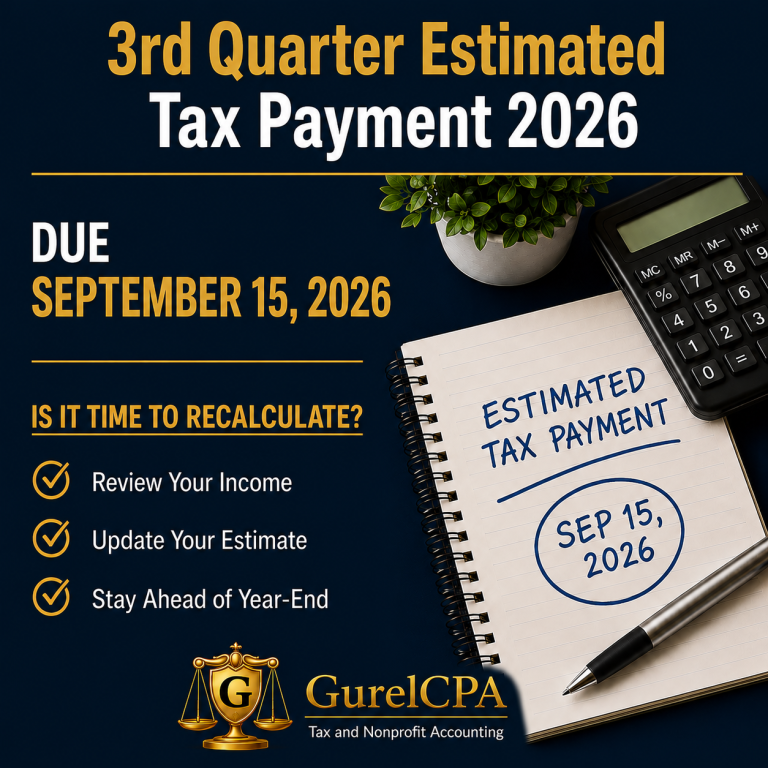
Withholding Can Also Be Part of the Solution
Estimated payments are not the only way to address a projected shortfall. Taxpayers who receive wages, pensions, or other payments subject to federal withholding may increase withholding for the remainder of the year.
This can be particularly useful because federal income tax withholding is generally treated as having been paid evenly throughout the year for estimated tax penalty purposes, even when the withholding actually occurs later in the year. Depending on the circumstances, increasing withholding can therefore be an effective year-end planning tool.
The 2026 Estimated Tax Payment Schedule
For calendar-year individual taxpayers, the regular 2026 estimated tax installment dates are April 15, 2026; June 15, 2026; September 15, 2026; and January 15, 2027.
The September 15 deadline means there is still time to review 2026 income and tax payments before the third installment is due, and there will still be another opportunity to make adjustments before the final installment in January.
A September Tax Checkup
A useful third-quarter review can include year-to-date business or self-employment income, investment sales and capital gains, retirement distributions, rental income, partnership or S corporation income, federal withholding, estimated payments already made, and major changes in deductions or credits.
For business owners and self-employed taxpayers, having reasonably current financial records can make this review much more useful. By September, year-to-date results often provide a much better basis for estimating the full year's income than the assumptions available at the beginning of the year.
The Bottom Line
The September 15 estimated tax deadline should be viewed as more than another payment date. It is an opportunity to look at what has actually happened during 2026 and determine whether your tax plan needs to be adjusted before the year is over.
If your income, investments, business results, withholding, or other circumstances have changed significantly, this may be a good time to recalculate your estimated tax payments and consider year-end tax planning.
If you would like me to review your 2026 estimated tax situation before the September 15 payment deadline, please contact me directly for a free consultation.
The article is meant for informational purposes only. Please contact me directly to discuss how this applies to your individual tax situation.
Beneficial Ownership Information Reporting Is Officially Over for U.S. Companies
FinCEN has made permanent the exemption that removed most American small businesses from federal beneficial ownership reporting.
For millions of U.S. business owners, the federal Beneficial Ownership Information reporting requirement is no longer something they need to worry about.
On August 11, 2026, the Financial Crimes Enforcement Network, commonly known as FinCEN, issued a final rule permanently exempting companies created in the United States and U.S. persons from BOI reporting under the Corporate Transparency Act. The rule makes permanent the relief that FinCEN first announced on an interim basis in March 2025.
What This Means for U.S. Businesses
A corporation, limited liability company, or other entity created under the laws of a U.S. state or Tribal jurisdiction does not have to file a BOI report with FinCEN.
U.S. persons who already obtained FinCEN identifiers are also no longer required to update or correct the personal information they submitted to obtain those identifiers.
What Happens to Information Already Submitted?
Many businesses and their owners filed BOI reports before the reporting requirements were suspended. FinCEN has announced that it will delete previously reported information about individuals it reasonably believes are U.S. persons, including information connected to a U.S. passport or driver’s license.
FinCEN says it will coordinate that deletion process with the National Archives and Records Administration to comply with federal records laws. Businesses do not need to submit a separate request for this deletion based on the guidance currently available.
Some Foreign Companies Must Still Report
The BOI reporting system has not been eliminated completely. Certain entities formed under the laws of a foreign country and registered to do business in a U.S. state or Tribal jurisdiction are still reporting companies.
Those foreign reporting companies must report information about their non-U.S. beneficial owners. They do not have to report U.S. beneficial owners or U.S. company applicants.
This distinction is important. A company created in Washington, Delaware, or another U.S. jurisdiction is exempt. A company created in another country and later registered to conduct business in the United States may still need to review the rules.

BOI Reporting Is Not the Same as Every FinCEN Filing
The final BOI rule does not cancel other federal reporting obligations administered by FinCEN. For example, it does not eliminate the requirement to file a Report of Foreign Bank and Financial Accounts, commonly called an FBAR, when the applicable requirements are met.
It also does not change ordinary federal or state tax filings, annual reports required by a secretary of state, business-license renewals, or a financial institution’s obligation to collect ownership information when opening or maintaining certain accounts.
The Bottom Line
For the typical U.S.-formed small business, BOI reporting is over. There is no initial report to file, no report to update, and no previously filed report to correct.
Businesses with a foreign organizational structure should not assume the same result. They should determine where the entity was legally formed and whether it registered to do business in the United States before deciding that no BOI filing is required.
The article is meant for informational purposes only. Please contact me directly to discuss how this applies to your individual tax situation.
Opportunity Zones: A Tax Planning Strategy Many Investors Have Forgotten
Many investors have heard of Opportunity Zones, but because the program has received less attention in recent years, some assume they no longer exist. That isn't true.
While some of the original tax incentives have expired, Opportunity Zones remain a valuable planning tool for certain investors.
If you recently sold appreciated stock, real estate, a business, or another capital asset, an Opportunity Zone investment may deserve consideration before automatically paying capital gains tax.
What Is an Opportunity Zone?
Opportunity Zones are economically distressed communities designated by the federal government to encourage long-term private investment. Investors participate by investing eligible capital gains into a Qualified Opportunity Fund (QOF), which in turn invests in qualifying Opportunity Zone property or businesses.
The objective is to encourage economic development while offering potential tax incentives for investors willing to make long-term investments.
What Is a Qualified Opportunity Fund (QOF)?
A Qualified Opportunity Fund is an investment vehicle organized for the purpose of investing in Opportunity Zone property. Rather than purchasing property directly, most investors participate through a QOF that manages qualifying investments.
Not every fund is the same. Investors should carefully review the fund's management, investment strategy, fees, liquidity, and long-term objectives before investing.
Who Might Benefit?
Opportunity Zones are primarily designed for taxpayers recognizing significant capital gains from the sale of appreciated investments, investment real estate, a business interest, or certain other capital assets. Taxpayers without meaningful capital gains generally receive little benefit from this strategy.
A Simple Example
Suppose you sell appreciated stock and realize a $500,000 capital gain. Rather than immediately paying tax on that gain, you may be able to invest the eligible gain in a Qualified Opportunity Fund within the required time period. Depending on your circumstances and applicable tax law, that investment may provide tax advantages while giving your money the opportunity to grow through a long-term investment.
Of course, investment returns are never guaranteed, and tax benefits should never be the only reason to invest.
Potential Tax Benefits
Potential benefits may include:
- Deferral of eligible capital gains under applicable law.
- Potential tax advantages on appreciation of the Opportunity Zone investment if holding-period requirements are satisfied.
- Combining long-term investment planning with community development.
These rules are technical, and all IRS requirements must be satisfied.

Opportunity Zones vs. a 1031 Exchange
A Section 1031 exchange generally applies only to qualifying real estate and requires replacement property under strict timing rules. Opportunity Zone investments are made through Qualified Opportunity Funds and may be available for eligible capital gains from several different asset types. Each strategy serves different planning objectives.
Washington Investors Should Know
Although Opportunity Zones exist throughout the United States, Washington also has numerous designated Opportunity Zones. Investors do not have to live in an Opportunity Zone to invest through a Qualified Opportunity Fund, and opportunities may exist both inside and outside Washington.
Investment Risks
Opportunity Zone investments often involve long holding periods, limited liquidity, and the normal risks associated with real estate or business investments. Evaluate the quality of the investment first. Tax savings should be viewed as an additional benefit—not the primary reason to invest.
Timing Matters
Strict IRS deadlines apply to investing eligible capital gains into a Qualified Opportunity Fund. Planning before—or immediately after—a sale is usually much more effective than trying to reduce taxes after the deadlines have passed.
A Planning Opportunity Worth Discussing
Opportunity Zones remain one of the lesser-known tax planning strategies available to investors with significant capital gains. For the right taxpayer, they may provide meaningful long-term tax benefits while supporting investment in developing communities.
The article is meant for informational purposes only. Please contact me directly to discuss how this applies to your individual tax situation. I offer a free initial consultation to discuss your tax planning opportunities.
Five Mistakes That Can Cost a Nonprofit Its 501(c)(3) Status
Receiving IRS recognition as a 501(c)(3) charitable organization is a major milestone. Unfortunately, some nonprofit leaders assume that once tax-exempt status has been granted, it lasts forever.
It doesn't.
The IRS expects tax-exempt organizations to continue operating in accordance with federal tax law. Organizations that fail to do so can lose their tax-exempt status, creating serious financial and legal consequences.
Here are five of the most common reasons nonprofits lose their 501(c)(3) status.
1. Failing to File Annual IRS Returns
This is by far the most common reason organizations lose their exemption.
Even very small nonprofits must file an annual return with the IRS. Organizations with gross receipts normally under $50,000 generally file Form 990-N (the e-Postcard), while larger organizations may file Form 990-EZ or Form 990.
If a nonprofit fails to file the required return for three consecutive years, the IRS automatically revokes its tax-exempt status by law.
Many organizations don't discover the problem until donors begin asking why contributions are no longer deductible.
2. Providing Excessive Benefits to Insiders
A nonprofit exists to serve its charitable mission—not to enrich its officers, directors, founders, or key employees.
Paying unreasonable compensation, making below-market loans, or allowing insiders to receive special financial benefits can result in IRS penalties and, in severe cases, jeopardize the organization's exemption.
Board members should always document compensation decisions and ensure transactions are fair and reasonable.
3. Becoming Too Political
A 501(c)(3) organization may educate the public about issues, but it may not participate in political campaigns or endorse candidates for public office.
Even well-intentioned actions—such as using the organization's social media accounts or facilities to support a candidate—can create problems.
Some lobbying is permitted within limits, but direct political campaign activity is prohibited..
4. Drifting Away From the Charitable Mission
The IRS granted exemption because the organization agreed to operate for specific charitable, educational, religious, scientific, or other exempt purposes.
If the organization begins operating primarily for purposes outside that mission, its exempt status may be challenged.
Boards should periodically review programs and activities to ensure they continue advancing the organization's stated exempt purpose.

5. Ignoring Good Governance
Poor governance alone doesn't automatically revoke tax-exempt status, but weak oversight often leads to larger compliance problems.
Examples include:
- Board meetings that are never documented
- Failure to maintain financial records
- Conflicts of interest that are not disclosed
- Lack of oversight over finances
- Failure to adopt or follow basic governance policies
Good governance demonstrates that a nonprofit is being operated responsibly and in the public interest.
What Happens If Exempt Status Is Revoked?
Losing tax-exempt status can have significant consequences, including:
- Donations may no longer be tax deductible.
- The organization may become subject to federal income tax.
- Grant opportunities may disappear.
- Public confidence can be damaged.
- The organization must apply for reinstatement, which can be time-consuming and costly.
Fortunately, many of these problems are entirely preventable with good compliance practices.
A Final Thought
Most nonprofits don't lose their exemption because of fraud or intentional misconduct. More often, they lose it because volunteer board members simply weren't aware of the rules.
A periodic compliance review can help identify potential issues before they become serious problems.
The article is meant for informational purposes only. Please contact me directly to discuss how this applies to your individual tax situation.
A New $1,700 Federal Tax Credit for K-12 Scholarships Is Coming
Beginning in 2027, taxpayers may have a new way to support K-12 education while receiving a significant federal tax benefit.
The new Federal Scholarship Tax Credit allows individuals to receive a dollar-for-dollar federal income tax credit of up to $1,700 per year for qualifying cash contributions to approved Scholarship Granting Organizations.
For taxpayers who make charitable contributions, this will create an interesting new tax-planning opportunity.
This Is a Tax Credit, Not Just a Deduction
Normally, when you make a charitable contribution, you may be able to claim a charitable deduction if you itemize deductions.
This new program works differently.
Beginning January 1, 2027, an individual who makes a qualifying cash contribution to an approved Scholarship Granting Organization may receive a federal income tax credit equal to the contribution, up to $1,700 per year.
For example, a qualifying $1,700 contribution could potentially reduce your federal income tax liability by $1,700.
That makes the credit considerably more valuable than a charitable deduction.
The credit is nonrefundable, so it cannot reduce federal income tax below zero. However, unused credit may generally be carried forward for up to five years.
What Is a Scholarship Granting Organization?
A Scholarship Granting Organization, or SGO, is a qualifying nonprofit organization that receives contributions and uses the funds to provide scholarships for eligible K-12 students.
SGOs must meet specific federal requirements, including requirements governing how their funds are used and the students and schools they serve.
Scholarships may be used for qualifying educational expenses that can include:
- Tuition and fees
- Books and educational supplies
- Academic tutoring
- Certain special-needs educational services
- Transportation
- School uniforms
- Computers and educational technology
- Internet access
The program is broader than simply providing assistance with private-school tuition. Qualifying scholarships may help cover eligible educational expenses for students attending public, private, or religious schools.
Who Can Receive the Scholarships?
Student eligibility is generally based on household income, with the program available to students from households with income not exceeding 300% of the area median gross income.
That is an important feature of the program. Eligibility is not necessarily limited to families traditionally considered low income. Depending on household size and where a family lives, moderate-income families may also qualify.

Your State's Participation Matters
There is an unusual feature of this federal tax credit that taxpayers need to understand.
States must elect to participate in certain aspects of the program.
Participating states identify qualifying Scholarship Granting Organizations and submit those organizations for inclusion in the federal program.
As a result, the practical availability of the credit may depend partly on where you live and whether your state participates.
Taxpayers interested in using the credit in 2027 should therefore confirm whether their state is participating and which Scholarship Granting Organizations have been approved before making a contribution.
An Interesting Combination of Tax Planning and Charitable Giving
This new credit brings together several areas that normally operate separately: federal income taxes, charitable giving, nonprofit organizations and K-12 education.
For taxpayers who already make charitable contributions, the difference between receiving a charitable deduction and receiving a potential dollar-for-dollar federal tax credit could be significant.
There will also be important details to consider, including which organizations qualify, how contributions must be documented, interaction with state tax benefits and other charitable tax rules, and additional guidance issued before the program begins.
Because the credit does not take effect until 2027, taxpayers have some time to understand the rules and determine whether participating could make sense as part of their charitable giving and tax planning.
Planning Ahead for 2027
The Federal Scholarship Tax Credit is an unusual new tax provision because it allows taxpayers to support educational scholarships while potentially receiving a federal tax credit of up to $1,700.
But don't simply make a contribution and assume it qualifies.
Before contributing, taxpayers should verify that their state is participating where required, that the organization is an approved Scholarship Granting Organization, and that the contribution meets the requirements for the federal credit.
I offer a free initial consultation to discuss federal tax questions and how new tax provisions may apply to your individual situation.
The article is meant for informational purposes only. Please contact me directly to discuss how this applies to your individual tax situation.
When Should an LLC Elect to Be Taxed as an S-Corporation?
Many business owners form a Limited Liability Company (LLC) to help protect their personal assets from liability. After that decision, another question often comes up:
Should my LLC elect to be taxed as an S-corporation?
The answer depends on your business, your income, and your long-term goals. While an S-corporation election can provide tax savings in the right situation, it also comes with additional responsibilities and costs.
First, an Important Point
An S-corporation is NOT a different type of business entity.
Most small businesses that choose S-corporation taxation are actually LLCs that have elected to be taxed as S-corporations by filing IRS Form 2553. The LLC continues to exist under state law; only its federal tax treatment changes.
Potential Tax Savings
The biggest advantage of S-corporation taxation is the potential reduction in self-employment taxes.
A sole proprietor or single-member LLC pays self-employment tax on all NET business profits.
With an S-corporation, the owner typically receives:
- A reasonable salary, which is subject to payroll taxes, and
- Additional business profits distributed as dividends, which generally are not subject to self-employment tax.
Depending on the circumstances, this structure can produce meaningful tax savings.
Potential Tax Savings Come with Responsibilities
The IRS requires owner-employees of S-corporations to receive reasonable compensation for the work they perform. Paying yourself an artificially low salary simply to avoid payroll taxes can attract IRS scrutiny.
Determining a reasonable salary depends on factors such as:
- Your duties
- Your experience
- The time you devote to the business
- Industry compensation levels
- The financial success of the business
Additional Responsibilities
An S-corporation also creates additional administrative requirements, including:
- Running payroll
- Filing payroll tax returns
- Issuing Forms W-2
- Maintaining payroll records
- Filing an annual S corporation tax return (Form 1120-S)
These added responsibilities often result in higher accounting and payroll costs.
When Does an S-Corporation Election Begin to Make Sense?
There is no magic income level that applies to everyone.
However, many tax professionals begin evaluating an S-corporation election once a business consistently earns enough profit to comfortably pay the owner a reasonable salary while still leaving additional profits available for distribution.
The potential tax savings should outweigh the additional accounting, payroll, and compliance costs.
Every business is different, so the analysis should be based on your specific circumstances.

Timing Matters
In most cases, an S-corporation election is not automatic. Eligible businesses generally make the election by filing IRS Form 2553, and the timing of that election can affect when S-corporation tax treatment begins.
Missing the filing deadline may delay S-corporation tax treatment until a later tax year, although the IRS does provide relief in certain circumstances for late elections.
Because the timing rules can be important, it is usually best to discuss an S-corporation election with your CPA before filing the form.
It Is About More Than Taxes
Business growth, retirement planning, future owners, fringe benefits, and state tax considerations can all influence whether an S-corporation election is appropriate.
For some businesses, remaining a sole proprietorship or standard LLC may be the better choice.
Don't Assume an LLC Needs an S-Corporation Election
Many online articles suggest that every LLC should elect S-corporation taxation. That simply is not true.
For some businesses, the election can save money.
For others, the additional costs and administrative burden outweigh any tax benefit.
The decision should be based on a careful review of your income, expected profits, and long-term business plans.
Final Thoughts
Choosing an S-corporation election is one of the most important tax decisions a small business owner can make.
Done at the right time, it may reduce taxes while supporting future growth. Done too early or without proper planning it can create unnecessary complexity and expense.
The article is meant for informational purposes only. Please contact me directly to discuss how this applies to your individual tax situation.
Should a Sole Proprietor Get an EIN?
Many people start a business as a sole proprietor and simply use their Social Security number (SSN) for tax purposes. In many cases, that's perfectly acceptable.
However, just because you can use your Social Security number doesn't necessarily mean you should.
For many sole proprietors, obtaining an Employer Identification Number (EIN) is a simple step that can provide practical benefits, even if they never hire an employee.
What Is an EIN?
An Employer Identification Number is a unique number issued by the IRS to identify a business. You can think of it as the business equivalent of a Social Security number.
Despite its name, you do not have to be an employer to obtain an EIN.
The IRS issues EINs free of charge, and many sole proprietors qualify for one.
Why Consider an EIN?
Protect Your Social Security Number
One of the biggest advantages is privacy.
If you use your Social Security number for invoices, Forms W-9, or information provided to customers, you will end up sharing your personal identification number with numerous businesses.
An EIN allows many business documents to use the business identification number instead of your Social Security number, reducing unnecessary exposure.
Open a Business Bank Account
Many banks require or strongly prefer an EIN when opening a business checking account.
Keeping your business and personal finances separate makes bookkeeping easier and helps create a more professional image.
Build Business Credibility
Customers, vendors, and financial institutions often expect a business to have its own tax identification number.
Using an EIN can make your business appear more established and organized.
Prepare for Future Growth
You may not have employees today, but your business could grow.
Obtaining an EIN now means you're already prepared if you later hire employees, form an LLC, or make other business changes.

When Is an EIN Required?
While many sole proprietors may choose to obtain an EIN voluntarily, the IRS requires one in certain situations, including if you:
- Hire employees
- Establish certain retirement plans
- File certain federal tax returns
- Operate specific types of businesses
If you are unsure whether your business requires an EIN, it's a good idea to ask your tax advisor.
Does an EIN Change How You're Taxed?
No.
Obtaining an EIN does not change your business structure or how your income is taxed.
A sole proprietor with an EIN continues to report business income and expenses on Schedule C of Form 1040, just as before.
An EIN is simply another taxpayer identification number for the business.
The Bottom Line
Obtaining an EIN is free, quick, and provides important privacy and administrative benefits for sole proprietors.
If you're starting a new business or wondering whether an EIN makes sense for your situation, a conversation with your CPA can help you make the right decision.
This article is for informational purposes only and does not constitute tax advice. Every taxpayer’s situation is unique. Please contact GurelCPA directly for personalized guidance and to discuss your specific circumstances.

Should You Give Your Children or Grandchildren an Early Inheritance?
Many parents and grandparents eventually ask themselves an important question:
Should I wait until I'm gone to leave an inheritance, or would it make more sense to help my family now?
There isn't one right answer. For some families, making gifts during their lifetime can be incredibly rewarding. For others, waiting may be the wiser choice. The key is understanding both the financial and tax implications before making a decision.
Why Some Families Choose to Give Early
One of the biggest advantages of an early inheritance is that your children or grandchildren may need the money much more today than decades from now.
An early gift might help with:
• A down payment on a first home
• College or graduate school expenses
• Starting a business
• Paying off high-interest debt
• Building emergency savings
• Supporting a growing family
Many parents enjoy seeing the positive impact of their generosity while they're still here to share in the experience.
Make Sure Your Own Retirement Comes First
Before giving away significant assets, ask yourself: Will I still have enough money if I live another 20 or 30 years? Consider healthcare, long-term care, inflation, emergencies, and your overall retirement security.
Cash Isn't Always the Best Asset to Give
Cash may be the simplest gift, but it is not always the most tax-efficient. Appreciated investments or real estate can have important income tax consequences.
Don't Forget About Income Tax Basis
Inherited property often receives a step-up in basis, potentially reducing future capital gains tax. Property given during your lifetime generally carries over your original basis. Sometimes waiting can save your family significant taxes.
Fairness Among Children
If you have more than one child, think about how gifts today may affect future inheritances. Clear communication and documentation are important.
Gift Tax Usually Isn't the Issue
Most taxpayers never pay federal gift tax. Larger gifts may require IRS Form 709 but usually do not create an immediate gift tax liability.
Your Estate Plan Should Still Work
Large lifetime gifts should be coordinated with your will, trust, beneficiary designations, and overall estate planning strategy.
The Bottom Line
An early inheritance can be a wonderful way to help your family, but it should be balanced against your own financial security and the potential tax consequences.
This article is for informational purposes only and should not be relied upon as tax advice. Please contact me directly to discuss how this applies to your individual tax situation.
IRS Fresh Start Program
Owing the IRS can feel overwhelming, but you have options.
The IRS offers a group of relief programs commonly referred to as the Fresh Start Program, designed to help taxpayers resolve their tax debt in a structured and manageable way. The key is choosing the right one for your individual tax situation.
What Is the IRS Fresh Start Program?
The Fresh Start Initiative is not a single program. It’s a collection of IRS tools that make it easier to:
- Set up monthly payment plans
- Reduce or eliminate certain penalties
- Settle tax debt in cases
- Avoid aggressive IRS collection actions
The IRS is willing to work with you—but only if you act.
Your Main Options
1. Installment Agreements (Payment Plans)
- Pay your balance over time, usually up to 72 months
- Predictable monthly payments
- Can usually be set up online
Best for taxpayers who can pay over time but not all at once.
2. Offer in Compromise (Settle for Less)
- Allows you to settle your tax debt for less than the full amount owed
- Based on income, expenses, assets, and ability to pay
Best for taxpayers who cannot realistically pay the full balance.
3. Penalty Relief
- First-time penalty abatement
- Relief for reasonable cause
Available for taxpayers with strong compliance history or a valid hardship.
4. Currently Not Collectible (CNC)
- Temporarily pauses IRS collections
- Provides short-term relief
Best for taxpayers facing financial hardship.

Even if you can’t pay, you should file.
There are penalties for not filing a tax return IN ADDITION TO the penalties for not paying you tax on time.
Don’t make things worse by not filing a tax return. Ignoring the IRS will not make them go away.
Questions? Let's Talk
If you’re dealing with IRS tax debt, I can help you:
- Evaluate which option is best for your situation
- Set up a payment plan or resolution strategy
- Communicate with the IRS on your behalf
A short conversation can often make things much clearer. Contact me today for a free consultation and let’s put a plan in place.
This article is for informational purposes only and does not constitute tax advice. Every taxpayer’s situation is unique. Please contact GurelCPA directly for personalized guidance and to discuss your specific circumstances.
Summer Fun Can Bring Tax Surprises
Summer is a time for vacations, weddings, kids' activities, and earning a little extra income. Most people aren't thinking about taxes while they're enjoying the season, but some common summertime activities can affect the tax return you'll file next year.
Here are several situations worth keeping in mind.
Summer Weddings Mean Tax Changes
Summer is one of the busiest wedding seasons.
Getting married doesn't automatically increase or decrease your taxes, but it does mean it's time to update several records.
Newlyweds should:
- Report any name change to the Social Security Administration.
- Update their address with the IRS, employer, and the Postal Service if they've moved.
- Review tax withholding at work.
- Decide whether Married Filing Jointly or Married Filing Separately will make the most sense at tax time.
Making these updates now can help prevent processing delays when it's time to file.
Summer Day Camp May Qualify for a Tax Credit
If you're paying for a summer day camp so you can work or look for work, part of the cost may qualify for the Child and Dependent Care Credit.
Many parents are surprised to learn that:
- Day camps may qualify.
- Overnight camps generally do not qualify.
Keep receipts and provider information in case you qualify for the credit.
A Summer Job Still Means Taxes
Students often assume they don't need to worry about taxes because they only worked during the summer.
Not necessarily.
Even if little or no federal income tax is ultimately owed, it may still be worthwhile to file a return in order to claim a refund of taxes that were withheld from paychecks.
Parents should also remember that a student's earnings can affect whether they remain a dependent in certain situations and may influence education-related tax benefits.
Side Hustles and Gig Work
Summer often brings opportunities to:
- Drive for Uber or Lyft
- Deliver food
- Sell crafts or collectibles online
- Mow lawns
- Pet sit
- Do freelance work
Unlike traditional employment, taxes usually are not withheld from gig income.
That means you may need to:
- Track all income.
- Keep records of business expenses.
- Consider making estimated tax payments.
- Report the income even if you never receive a tax form.
Many gig workers are surprised by self-employment tax when they file their return. Good recordkeeping throughout the year can make a big difference.
Mixing Business Travel with Vacation
Summer is also a popular time to combine business with vacation.
If a trip is primarily for business, many business-related travel expenses may be deductible. However, expenses related to sightseeing, family activities, or personal vacation days generally are not.
Good documentation is essential.
Keep records showing:
- Business purpose
- Dates
- Locations
- Meetings
- Receipts
Trying to deduct an entire family vacation as a business trip is a common mistake the IRS watches closely.

Selling Investments to Pay for Vacation
Some families sell stocks, mutual funds, cryptocurrency, or other investments to help fund a summer vacation.
Remember that selling appreciated investments can create taxable capital gains.
Likewise, selling digital assets may generate taxable transactions that need to be reported.
Before selling investments, it can be worthwhile to understand the tax consequences.
Home Improvements During the Summer
Summer is prime time for home improvement projects.
While most repairs aren't immediately deductible for a personal residence, certain qualifying energy-efficient improvements may qualify for federal tax credits, depending on current law.
Keeping detailed invoices and documentation can save time at tax preparation.
Renting Out Your Home
Summer festivals, sporting events, and vacations sometimes encourage homeowners to rent out their homes or a spare room.
In some situations, rental income must be reported.
However, there's also a little-known rule that may allow homeowners who rent their residence for 14 days or fewer during the year to exclude that rental income from federal income tax if the requirements are met.
This is an area where the details matter.
Don't Forget Good Records
Many tax benefits are lost simply because taxpayers don't keep adequate records.
Throughout the summer, consider saving:
- Receipts
- Mileage logs
- Travel records
- Camp invoices
- Business expense documentation
- Investment statements
A little organization now can make tax season much easier.
Final Thoughts
Summer should be about enjoying life, not worrying about taxes. But a few simple steps now can help you avoid unpleasant surprises next filing season.
Whether you're getting married, sending kids to camp, earning extra income, traveling for business, or making major purchases, understanding the tax rules ahead of time can save both money and stress.
The article is meant for informational purposes only. Please contact me directly to discuss how this applies to your individual tax situation.
COVID-Era IRS Penalty Refund Claims
What Taxpayers Should Know Now
Recent court decisions have raised important questions about whether certain IRS penalties and interest assessed during the COVID-19 emergency were legally imposed.
Although the deadline for filing protective refund claims has now passed, the litigation continues and could ultimately affect taxpayers who paid penalties during that period.
Understanding these cases may help you determine whether any future refund opportunities could apply to your situation.
Why This Matters
Recent court decisions, including Kwong v. United States and Abdo v. Commissioner, have raised an important legal question: Did the IRS begin assessing certain IRS penalties and interest too early during the COVID-19 disaster period?
Because many federal tax deadlines were extended during the national emergency, some courts have suggested that certain late-filing, late-payment, and estimated tax penalties may have been assessed prematurely.
If that interpretation is ultimately upheld, some taxpayers could become entitled to refunds.
Protective Refund Claims
Many taxpayers filed protective refund claims before the July 10, 2026 deadline to preserve their legal rights while the litigation continues. Filing a protective claim does not guarantee a refund; it simply preserves the taxpayer's ability to seek one later if the courts ultimately rule in taxpayers' favor.
What Happens Next?
The government has appealed the Kwong decision, so the litigation continues. The courts could uphold the taxpayer-friendly rulings, narrow them, or ultimately rule in favor of the government. Until the cases are resolved, the IRS is not issuing automatic refunds based on these decisions.

What If You Missed the Deadline?
If you did not file a protective claim, your options may be more limited. However, every taxpayer's circumstances are different.
Reviewing your IRS account transcripts and discussing your situation with a qualified tax professional may identify whether any other refund opportunities or exceptions remain available.
Our Recommendation
The COVID-era penalty litigation is still evolving, and future court decisions or IRS guidance could change the landscape.
If you paid significant IRS penalties during the COVID emergency period, GurelCPA can help review your situation and determine whether any opportunities may still exist.
The article is meant for informational purposes only. Please contact me directly to discuss how this applies to your individual tax situation.
Estate Tax vs. Inheritance Tax: They’re Not the Same Thing
People use the terms estate tax and inheritance tax interchangeably. In reality, they are two very different taxes.
Understanding the distinction can help you better understand estate planning discussions and may even influence where you choose to live or retire.
The good news is that most Americans will never owe either tax. The challenge is that many people assume they are the same tax, or that neither one applies because their estate is below the federal estate tax exemption.
What Is an Inheritance Tax?
An inheritance tax is imposed on the person receiving the inheritance, not on the estate itself.
Whether tax is owed generally depends on the laws of the state involved, the beneficiary's relationship to the deceased, and in some cases the amount inherited.
Many states exempt spouses from inheritance tax, and some also exempt children or other close family members. More distant relatives or unrelated beneficiaries are more likely to owe tax where an inheritance tax applies.
In simple terms: The heir pays the tax.
Estate Tax vs. Inheritance Tax
The easiest way to remember the difference is:
• Estate tax is paid by the estate.
• Inheritance tax is paid by the beneficiary.
• Estate tax is calculated before assets are distributed.
• Inheritance tax is calculated after the inheritance is received.
• Estate tax is based on the value of the estate.
• Inheritance tax is based on the recipient and applicable state law.
• The federal government has an estate tax.
• There is no federal inheritance tax.
Why State Taxes Matter
Although many people focus on the federal estate tax, several states have established their own estate or inheritance tax systems.
Today, several states impose an estate tax, five states impose an inheritance tax, and Maryland is currently the only state that imposes both an estate tax and an inheritance tax.
Because every state sets its own exemption amounts and tax rates, a family may owe state tax even though no federal estate tax is due.
This is one reason estate planning should consider both federal and state tax laws.

A Washington Example:
For readers in Washington, this distinction is especially important.
Washington imposes a state estate tax, but it does NOT impose an inheritance tax.
Beginning July 1, 2026, Washington's estate tax exclusion increased to $3 million, substantially lower than the current federal estate tax exemption. As a result, some Washington estates may owe state estate tax even though no federal estate tax is due.
Why This Matters
Estate and inheritance taxes don't affect most families, but they can become important for individuals with appreciated real estate, family businesses, investment portfolios, retirement assets, or property located in multiple states.
Understanding which rules apply can help avoid surprises and may create planning opportunities through gifting, residency decisions, charitable planning, or other estate planning strategies.
The Bottom Line
Estate tax and inheritance tax are often confused because both apply after someone dies. However, they are fundamentally different taxes.
Remember the simple rule:
• Estate tax: The estate pays.
• Inheritance tax: The heir pays.
Knowing the difference is the first step toward understanding whether either tax may affect you or your family.
The article is meant for informational purposes only. Please contact me directly to discuss how this applies to your individual tax situation. I offer a free initial consultation to discuss your tax planning questions and help you evaluate your options.
Non-Cash Charitable Contributions Require Receipts
Donating clothing, furniture, vehicles, artwork, or other property to charity can provide a valuable tax deduction, but only if you meet the IRS documentation requirements.
Missing paperwork is one of the most common reasons charitable deductions are denied.
Documentation Requirements
- Under $250: Keep a receipt or other written record showing the charity’s name, the date, and a description of the donated property.
- $250 or More: Obtain a contemporaneous written acknowledgment from the charity stating the property donated and whether you received any goods or services in return.
- Over $500: File Form 8283 (Section A) with your tax return.
- Over $5,000: Obtain a qualified appraisal, complete Section B of Form 8283, and have the appraiser and charity sign where required (exceptions apply, such as publicly traded securities).
A Few Practical Tips
- Donate only to qualified charitable organizations.
- Use fair market value, not original cost or replacement cost.
- Photograph valuable items and keep a detailed inventory.
- If a donation may exceed $5,000, talk with your CPA before making the gift.

The Bottom Line
The larger the non-cash contribution, the greater the IRS substantiation requirements. Taking a few extra steps before you donate can protect your deduction and prevent costly problems if your return is ever examined.
GurelCPA Tip:
If you're planning to donate high-value property such as artwork, vehicles, business equipment, or real estate, contact us before completing the gift. We'll help ensure you meet the IRS documentation requirements and preserve your deduction.
The article is meant for informational purposes only. Please contact me directly to discuss how this applies to your individual tax situation.
Would You Like a Second Opinion on Your Tax Return?
Most tax returns are prepared accurately. But even well-prepared returns can sometimes miss deductions, credits, tax elections, or planning opportunities.
If you are wondering whether your return could have been prepared differently, I'd be happy to take a second look.
I offer a complimentary, no-obligation review of your filed federal income tax return.
During this review, I will look for:
- Missed deductions or tax credits
- Filing elections that may have reduced your tax
- Opportunities for future tax savings
- Questions or areas that deserve a closer look
Whether you're looking for peace of mind or simply want another experienced CPA to review your return, I'm happy to help—with no cost and no obligation. If everything looks good, I'll tell you. If I see something that deserves further discussion, I'll explain what I found and what your options may be.
A Fresh Perspective Can Be Valuable
Even experienced tax professionals sometimes approach the same tax situation differently. A second opinion may provide peace of mind or identify opportunities that could save money now or in future years.

Questions? Let’s Talk!
If you're interested in a complimentary review of your federal tax return, please contact me for more details. DO NOT SEND your return unless all Social Security numbers are blacked out or otherwise masked to help protect your personal information.
The article is meant for informational purposes only. Please contact me directly to discuss how this applies to your individual tax situation.
Washington Has No State Income Tax, But…
One of the biggest misconceptions about living or doing business in Washington is that the state is "tax free."
It's true that Washington does not impose a personal state income tax like California, Oregon, Idaho, and many other states. However, that doesn't mean Washington residents or businesses avoid state taxes. Instead,Washington relies on a different combination of taxes to fund schools, transportation, public safety, and other essential government services.
Understanding how Washington's tax system works can help individuals, retirees, investors, and business owners avoid surprises and make better financial decisions.
No Personal State Income Tax
For most wage earners and retirees, Washington's biggest tax advantage is straightforward.
There is no Washington state tax on wages, salaries, pensions, IRA withdrawals, 401(k) distributions, Social Security benefits, or most other ordinary income.
For many retirees, this is one of the primary reasons Washington remains an attractive place to live.
But that is only part of the story.
Sales Tax
Washington relies heavily on sales taxes.
Depending on where you live, combined state and local sales tax rates often exceed 9%.
Unlike an income tax, sales tax is paid throughout the year whenever taxable goods and many services are purchased. Because the tax is collected a little at a time, many people underestimate how much they actually pay each year.
Property Taxes
Property taxes are another major source of state and local revenue.
These taxes help support schools, fire districts, libraries, parks, emergency services, and other local government functions.
While Washington's property taxes are lower than those in some states, they still represent a significant annual expense for many homeowners and commercial property owners.
Washington's Capital Gains Tax
Beginning in 2022, Washington imposed a tax on certain long-term capital gains above an annual exemption amount.
Fortunately, many common transactions are excluded, including sales of real estate, IRA and 401(k) distributions, most retirement income, many qualified family-owned businesses, and numerous other specifically exempt assets.
Most Washington taxpayers will never owe this tax. However, individuals selling highly appreciated stock, concentrated investment positions, or certain business interests should consider the tax consequences before completing a transaction.
Washington Estate Tax
Many people assume that because Washington has no personal income tax, it also has no estate tax.
In fact, Washington has one of the more significant state estate tax systems in the country.
Washington currently exempts only the first $3 million of a taxable estate. Estates exceeding that amount may owe Washington estate tax even when no federal estate tax is due. Because the current federal exemption is substantially higher, some families are surprised to learn that Washington estate tax planning may become important long before federal estate tax planning does.
Families with appreciated real estate, investment portfolios, family businesses, or other substantial assets should consider discussing estate planning well before it becomes necessary.

A New Tax on Very High-Income Households
Washington's tax system continues to evolve.
In 2025, lawmakers enacted a new 9.9% tax on Washington taxable income exceeding $1 million per household. The tax is scheduled to apply beginning with tax years starting January 1, 2028, with the first returns generally filed in 2029.
Because Washington has historically operated without a broad personal income tax, this legislation represents a significant change for affected taxpayers. At the same time, legal challenges are expected before the law becomes fully effective, so individuals who may be affected should continue to monitor developments.
Business Taxes
Washington also taxes businesses differently than many other states.
Rather than imposing a traditional corporate income tax, Washington primarily relies on the Business & Occupation (B&O) Tax, which is generally based on gross receipts rather
Washington's Tax System Is Different
Instead of relying primarily on a personal income tax, Washington raises revenue through a combination of sales taxes, property taxes, Business & Occupation (B&O) taxes, estate taxes, capital gains taxes on certain transactions, and new taxes affecting some very high-income households.
Each tax applies to different people under different circumstances, making planning especially important before major financial decisions.
The Bottom Line
Washington's lack of a personal state income tax is certainly an advantage for many residents.
However, it is only one piece of a much larger tax picture.
Whether you are retiring, relocating to Washington, selling investments, starting a business, or planning your estate, understanding how Washington's tax system works can help you avoid costly surprises and make better long-term financial decisions.
The article is meant for informational purposes only. Please contact me directly to discuss how this applies to your individual tax situation. I offer a complimentary initial consultation and would be happy to help determine the best approach for your business.
Important IRS Deadline:
Revalidate Your Business or Nonprofit Tax Account by July 29
If you're the Designated Official for your business or nonprofit organization's IRS Business Tax Account, there is an important deadline you shouldn't overlook.
What Is a Designated Official?
A Designated Official is the individual authorized to act on behalf of a business within the IRS Business Tax Account (This term applies to businesses AND nonprofits who have IRS Business Accounts.)
For corporations, this is generally an officer such as the President, Vice President, CEO, CFO, COO, Secretary, or Treasurer. The individual must also be authorized to legally bind the business and must have received a Form W-2 from the entity for the most recent tax year. Eligibility requirements vary depending on the entity.
This Requirement Also Applies to Many Nonprofit Organizations
This annual revalidation requirement isn't limited to for-profit businesses.
Nonprofit organizations, including 501(c)(3) charities, can establish an IRS Business Tax Account and designate an authorized individual to manage the organization's online IRS account.
For nonprofits, the Designated Official is typically an officer such as the President, Treasurer, Executive Director, or another individual authorized by the organization's governing body to act on behalf of the organization.
Maintaining an active Business Tax Account allows nonprofit leaders to securely access IRS information, review account activity, receive notices electronically, download important tax documents, and manage authorized users.
If your nonprofit has already established an IRS Business Tax Account, be sure your Designated Official completes the annual revalidation by July 29 to avoid losing that role.
Why Does This Matter?
The IRS Business Tax Account allows eligible businesses to view balances, make federal tax payments, access payment history and tax transcripts, receive IRS notices electronically, download EIN verification notices, manage authorized users, and review tax compliance information. These online services can save considerable time and eliminate paper correspondence.
What Happens if You Miss the Deadline?
If you do not complete your annual revalidation by July 29, your current Designated Official role expires. Although there is no tax penalty, you will lose your Designated Official status and must complete the registration process again before regaining full access.

Haven’t Set Up Your IRS Business Tax Account Yet?
If you've never created an IRS Business Tax Account, now is an excellent time to do it.
The IRS Business Online Account provides secure online access to many IRS services that previously required paper correspondence or lengthy phone calls. Setting up an account requires identity verification through ID.me and confirmation that you are authorized to act on behalf of the organization.
If you're unsure whether your organization already has an account or who should serve as the Designated Official, your CPA can help determine the appropriate next steps.
How to Revalidate
1. Sign in to your IRS Business Tax Account.
2. Look for the notification to renew your Designated Official role.
3. Complete the revalidation before the July 29 deadline.
The IRS opens the annual revalidation period each year beginning June 15 for most businesses.
Don't Wait Until You Need Access
Many business owners don't log into their IRS Business Tax Account until they need an EIN verification notice, an IRS transcript, or another important document.
Discovering that your Designated Official access has expired at that moment can create unnecessary delays and frustration.
Whether you're renewing an existing account or setting one up for the first time, taking a few minutes now can help ensure you have uninterrupted access when you need it most.
The article is meant for informational purposes only. Please contact me directly to discuss how this applies to your individual tax situation. I offer a complimentary initial consultation and would be happy to help determine the best approach for your business.
Working Remotely From Another State?
You May Owe More State Income Tax Than You Think
Remote work has given employees the freedom to live almost anywhere, but it has also created unexpected state tax problems. Many remote workers assume they only owe income tax where they live. Unfortunately, that is not always true.
Several states have become much more aggressive in auditing remote employees, particularly those who work for employers located in another state. One of the biggest examples is New York's long-standing 'Convenience of the Employer' rule, which has repeatedly been upheld by the courts.
What Is the "Convenience of the Employer" Rule?
If you work for a New York employer but perform your job from another state for your own convenience rather than because your employer requires it, New York may still treat those workdays as New York workdays.
That means you could owe New York income tax even if you rarely set foot in the state.
Example:
- You live in Florida.
- Your employer's office is in New York.
- You work from your Florida home by choice.
- New York may still tax some or all of your wages.
Other States Are Paying Attention
New York is not alone. Several states are increasing enforcement efforts involving remote workers, residency, payroll withholding, and state tax nexus. States are sharing information more frequently and using payroll records to identify taxpayers who may owe additional taxes.
If you worked remotely in more than one state during the year, you may need:
- Multiple state tax returns
- Credits for taxes paid to another state
- Adjustments to payroll withholding
- Careful documentation of where you actually worked
It Can Affect Employers Too
Businesses with remote employees may also create tax obligations simply by allowing an employee to work from another state.
- State payroll withholding requirements
- Business registration requirements
- State unemployment insurance obligations
- Income or franchise tax filing requirements
- Sales tax nexus in some situations

Keep Good Records
If you regularly work from multiple locations, keep records of:
- Your primary work location
- Days worked in each state
- Employer policies regarding remote work
- Travel calendars
- Payroll records
The Bottom Line
Remote work has made life more flexible, but state tax rules have not kept pace. Working from home—or from another state—can create unexpected filing requirements for both employees and employers.
If you work remotely across state lines or have employees working from multiple states, it is worth reviewing your situation before tax season rather than after receiving a notice.
Question? Let’s Talk!
Multi-state tax rules? Contact GurelCPA. We can help determine where you need to file, whether you're eligible for credits, and how to avoid costly surprises.
The article is meant for informational purposes only. Please contact me directly to discuss how this applies to your individual tax situation.
Do You Own an Interest in a Foreign Business?The IRS Wants to Know
Forms 5471 and 8865 can carry substantial penalties when overlooked.
Most people know they must report income earned outside the United States. What many do not realize is that simply owning an interest in a foreign business can create an IRS filing requirement, even if the business made little or no money.
Two of the most commonly overlooked international information returns are Form 5471 and Form 8865. These forms do not usually create additional tax by themselves, but failing to file them can result in substantial penalties.
Form 5471: Foreign Corporations
- Started a corporation outside the United States
- Own a significant percentage of a foreign corporation
- Became an officer or director under certain circumstances
- Have ownership in a controlled foreign corporation (CFC)
The form can require detailed ownership and financial information.
Form 8865: Foreign Partnerships
- Own an interest in a foreign partnership
- Control a foreign partnership
- Contribute significant property
- Meet ownership thresholds
Like Form 5471, Form 8865 requires detailed financial and ownership information.
The Penalties Can Be Severe
Failure to file can generally result in an initial $10,000 penalty per required form, with additional penalties possible if the failure continues.

International Reporting Is More Than Just FBARs
Foreign business ownership is a separate reporting requirement from FBAR and Form 8938.
Do Not Assume Someone Else Is Filing
These are U.S. information returns that are generally the responsibility of the U.S. taxpayer.
The Bottom Line
If you own, inherit, or invest in a foreign corporation or partnership, determine whether Forms 5471 or 8865 apply before filing your return.
The article is meant for informational purposes only. Please contact me directly to discuss how this applies to your individual tax situation.
The Hidden Home Insurance Rule?
It Could Cost You Thousands!
Many homeowners assume that as long as they have homeowners insurance, they are fully protected. Unfortunately, one little-known provision found in many homeowners policies can significantly reduce an insurance payout after a loss. It is commonly known as the 80% rule, and understanding it before you need it can save you thousands of dollars.
What Is the 80% Rule?
The 80% rule generally requires you to insure your home for at least 80% of its current replacement cost. Replacement cost is the amount it would take to rebuild your home using today's labor and material costs. It is not the same as your home's market value or your purchase price.
If your dwelling coverage falls below that threshold, your insurance company may reduce the amount it pays on a partial loss, even if the loss itself is well below your policy limit.
A Simple Example
Suppose your home's replacement cost is $600,000. Under the 80% rule, your policy should generally provide at least $480,000 of dwelling coverage.
If you carry only $400,000 of coverage and later suffer a $120,000 fire loss, your insurer may apply a coinsurance formula that reduces your reimbursement. Instead of paying the full covered loss (less any deductible), the insurance company may pay only a portion of it because the home was underinsured.
Why This Happens More Often Today
Over the past several years, construction costs have risen dramatically due to higher prices for lumber, concrete, roofing materials, electrical components, and skilled labor. A policy that provided adequate protection just a few years ago may no longer reflect today's rebuilding costs.
Many homeowners focus on the market value of their home, but insurers are concerned with reconstruction cost. In some areas, rebuilding can actually cost more than the home's current market value.
How to Protect Yourself
- Review your homeowners policy every year.
- Ask your insurance agent for an updated replacement-cost estimate.
- Notify your agent about major remodeling projects or additions.
- Consider whether an extended or guaranteed replacement-cost endorsement makes sense for your situation.

Don't Wait Until After a Loss
The worst time to discover you are underinsured is after your home has been damaged. A brief annual review can help ensure your coverage keeps pace with inflation and rising construction costs, reducing the chance of an unpleasant surprise during the claims process
The Bottom Line
The 80% rule is one of those insurance provisions that many homeowners have never heard of until it affects them. Spending a few minutes reviewing your policy today could help protect one of your largest financial investments tomorrow.
How Gurel CPA Can Help?
Although your insurance professional determines the appropriate level of coverage, understanding the financial consequences of being underinsured is an important part of protecting your overall financial plan. If you have questions about casualty losses, disaster-related tax issues, or other financial planning matters, Gurel CPA is here to help.
The article is meant for informational purposes only. Please contact me directly to discuss how this applies to your individual tax situation.
New Limits on Charitable Deductions
Starting with 2026 tax returns, many taxpayers who itemize deductions may receive a smaller charitable deduction than they expect.
A new tax law requires individuals who itemize to subtract 0.5% of Adjusted Gross Income (AGI) before claiming a charitable contribution deduction.
How the New Law Works
Beginning in 2026, only the portion of charitable contributions that exceeds 0.5% of your AGI is deductible. This creates a new threshold that reduces the deductible amount of many charitable gifts.
Example:
AGI: $200,000
• 0.5% of AGI = $1,000
• Charitable gifts = $5,000
• Deductible amount = $4,000
The first $1,000 of contributions is not deductible.
This Law Is Separate from Existing AGI Limits
Taxpayers may confuse the new 0.5% AGI floor with the long-standing limits on charitable deductions. They are different rules and both may apply.
• The new 0.5% AGI floor reduces the amount of contributions that can be deducted.
• The existing AGI percentage limits (such as the 60% of AGI limit for many cash gifts to public charities) continue to limit the maximum deduction that can be claimed.
In other words, itemizing taxpayers must first reduce their deduction by the new 0.5% floor, and then the remaining deduction is still subject to the applicable AGI limits.
Who Is Affected?
This change affects taxpayers who itemize deductions on Schedule A and make gifts to qualified charitable organizations. Taxpayers claiming the standard deduction are not subject to the 0.5% floor.

Why This Matters
Many generous donors will receive a smaller tax benefit than in prior years. Thoughtful year-end planning can help maximize the value of charitable giving.
Planning Opportunities
- Bunch several years of charitable gifts into one year.
- Donate appreciated securities instead of cash when appropriate.
- Use Qualified Charitable Distributions (QCDs) if you qualify.
- Coordinate charitable giving with your overall tax strategy.
Don't Let the New Law Surprise You
Charitable giving should always begin with supporting causes you care about, but understanding the new rules can help you receive every deduction available. If you expect to itemize deductions, review your charitable giving strategy before year-end.
Questions? Let’s Talk!
Contact GurelCPA. We can help you build a charitable giving strategy that supports both your favorite charities and your tax planning goals.
This article is provided for general informational purposes only and should not be considered tax advice. Each taxpayer’s situation is unique.
You Can Owe Tax on Money You Never Received
Most people assume they only pay income tax on money that actually lands in their bank account. Unfortunately, the tax law doesn't always work that way. You may owe federal income tax on income you never physically receive. These rules often surprise taxpayers and can create unexpected tax bills if they are not anticipated.
A Recent Tax Court Reminder
On July 14, 2026, the U.S. Tax Court issued its decision in Eiler v. Commissioner (167 T.C. No. 3). The taxpayers received a lawsuit settlement, but most of the settlement proceeds were paid directly to their attorneys under a contingent fee agreement.
The taxpayers argued that they should only be taxed on the amount they actually kept. The Tax Court disagreed. Relying on Commissioner v. Banks, the court held that when a lawsuit recovery is taxable, the taxpayer generally must include the entire recovery in income, including the portion paid directly to the attorney. Because the claims in this case did not qualify for a special deduction available for certain civil rights and employment cases, the attorney fees did not reduce taxable income.
The result was that the taxpayers owed tax on money they never personally received.
Other Situations Where This Can Happen
- Cancellation of Debt: When a lender forgives debt, the forgiven amount is generally taxable.
- Debt Settlements: Settling a loan or credit card for less than the balance may produce taxable cancellation-of-debt income and a Form 1099-C.
- Partnership and LLC Income: Owners are taxed on their share of business profits even if the business keeps the cash instead of distributing it.
- S Corporation Income: Shareholders generally pay tax on their share of corporate income whether or not cash distributions are made.
- Imputed Interest: The tax law sometimes treats interest as having been paid on below-market loans even when no interest actually changes hands.
- Foreclosures and Repossessions: Losing property can result in taxable gain, cancellation-of-debt income, or both depending on the facts.

Why These Rules Exist
The tax law often focuses on economic benefit rather than cash actually received. If your financial position improves because a debt disappears, a business earns income on your behalf, or another party satisfies an obligation you owe, the IRS may treat that benefit as taxable income.
Planning Can Prevent Costly Surprises
Many of these situations involve exceptions and planning opportunities. Understanding the tax consequences before signing a settlement, restructuring debt, or completing a transaction can help avoid unexpected tax bills.
How Can We Help?
Unexpected taxable income often catches taxpayers off guard because the transaction does not feel like income. If you are settling a lawsuit, negotiating debt, selling a business, or facing another complex financial transaction, Gurel CPA can help you understand the tax consequences before you make a costly decision.
The article is meant for informational purposes only. Please contact me directly to discuss how this applies to your individual tax situation.
Gifting to a Non-U.S. Citizen Spouse?
Many married couples assume they can transfer unlimited amounts of money or property to each other without worrying about gift taxes.
While that's generally true when both spouses are U.S. citizens, the rules are different when one spouse is not a U.S. citizen.
Why Is There a Different Rule?
Normally, gifts between spouses qualify for the unlimited marital deduction. However, that unlimited deduction does not apply if the recipient spouse is not a U.S. citizen because assets could leave the U.S. transfer tax system. For 2026, the IRS has increased the annual tax-free gift limit for gifts to a non-U.S. citizen spouse to $194,000, up from $190,000 in 2025.
What Does the $194,000 Limit Mean?
You may give up to $194,000 to a non-U.S. citizen spouse during 2026 without creating a taxable gift. Larger gifts generally require Form 709 and reduce your lifetime exemption rather than immediately creating gift tax.
Examples:
Example 1: A $150,000 gift is fully covered by the annual exclusion.
Example 2: A $250,000 gift leaves $56,000 that generally uses part of the lifetime exemption and requires Form 709.
Estate Planning Opportunities
Making annual gifts within the exclusion can gradually transfer wealth while reducing future estate tax exposure. International families should coordinate gift, estate, and immigration planning.

Don't Confuse This With the Regular Gift Exclusion
For 2026:
- Annual gift exclusion to most individuals: $19,000
- Annual gift exclusion to a non-U.S. citizen spouse: $194,000
Bottom Line
If your spouse is not a U.S. citizen, don't assume the unlimited marital deduction applies. The higher 2026 exclusion provides additional planning opportunities, but larger gifts should be reviewed with a qualified tax advisor.
Questions about international tax planning or gift tax reporting? Contact GurelCPA to discuss your situation.
The article is meant for informational purposes only. Please contact me directly to discuss how this applies to your individual tax situation.

Hurricane and Wildfire Season Is Here: Are Your Tax Records Protected?
June marked the beginning of hurricane season in many parts of the United States and wildfire season in others.
While most people think about protecting their homes and families, it's equally important to protect the financial and tax records you may need after a disaster.
The IRS reminds taxpayers that a little preparation today can save significant stress and frustration later.
Start With Important Documents
- Tax returns
- Supporting tax documents
- Property records
- Insurance policies
- Estate planning documents
- Vehicle titles
- Business records
- Nonprofit financial records
Store digital copies securely in cloud storage or on an encrypted external drive kept in a separate location.
Take Photos of Valuable Property
- Furniture
- Electronics
- Appliances
- Artwork
- Jewelry
- Tools and equipment
- Business assets
These records may make it easier to support insurance claims and document losses if a disaster occurs.
Create and Maintain an IRS Online Account
- Tax transcripts
- Account balances
- IRS notices
- Payment history
- Filing information
If your paper records are lost, online access may help you obtain information needed to reconstruct your tax files.
Businesses and Nonprofits Should Take Extra Precautions
Business owners and nonprofit organizations should also protect accounting files, payroll records, vendor contracts, donor records, grant documentation, board minutes, and organizational documents. Cloud-based systems provide additional protection.
Tax Relief May Be Available After a Disaster
When a major disaster receives a federal disaster declaration, the IRS often provides extended filing deadlines, payment relief, and penalty relief. Taxpayers in designated disaster areas frequently receive this relief automatically.
Don't Wait Until Disaster Strikes
Taking a few hours now to organize records, back up documents, and document valuable property could save days or weeks of work later.
Need Help?
If you're unsure which tax and financial records should be retained or how long to keep them, contact me directly.
I offer a free consultation and can help you develop a recordkeeping system that protects your information and makes tax season easier.
This article is for informational purposes only and does not constitute tax advice. Every situation is different, especially when multiple years of unfiled returns are involved.
Don’t Give Them the House. Let Them Inherit It.
Many parents assume that giving a house to their children during their lifetime is a smart way to avoid probate or simplify their estate.
In reality, making a lifetime gift of appreciated real estate can create a significant tax problem for your children. In most cases, allowing your heirs to inherit the property instead of receiving it as a gift can save them tens or even hundreds of thousands of dollars in capital gains tax.
The Difference Is the Tax Basis
When you give someone a house during your lifetime, they generally receive your original tax basis in the property. This is called a carryover basis.
Example:
- You bought your home years ago for $150,000.
- Today it is worth $700,000.
- You give the house to your daughter.
Your daughter's tax basis is still $150,000. If she later sells the home for $700,000, she could owe capital gains tax on approximately $550,000 of gain, subject to any available exclusions.
What Happens If They Inherit the House?
When property is inherited, most assets receive a step-up in basis. The property's tax basis generally becomes its fair market value on the date of death (or an alternate valuation date if elected by the estate).
- Original purchase price: $150,000
- Value at death: $700,000
- Heir's new tax basis: approximately $700,000
If the property is sold shortly after inheritance for about that amount, there may be little or no taxable capital gain.
What About Probate?
Avoiding probate does not necessarily require giving away the property during your lifetime. Depending on your situation, alternatives may include:
- Revocable living trust
- Transfer-on-death deed (where available)
- Appropriate joint ownership arrangements
- Other estate planning techniques recommended by your attorney

Are There Exceptions?
Yes. There are situations where lifetime transfers make sense, including:
- Medicaid planning
- Asset protection planning
- Certain irrevocable trust strategies
- Other specialized estate planning situations
These decisions should always be made after considering both the legal and tax consequences.
The Bottom Line
One of the most expensive estate planning mistakes families make is giving appreciated real estate to children too soon. In many cases, allowing loved ones to inherit the property instead can provide a valuable step-up in basis and dramatically reduce future capital gains taxes.
Before transferring a home, vacation property, rental house, or other appreciated real estate, speak with both your CPA and your estate planning attorney. A simple planning decision today could save your family a substantial amount in taxes tomorrow.
Questions about gifting property or estate tax planning?
GurelCPA helps individuals and families understand the tax consequences of gifting, inheriting, and selling real estate so they can make informed financial decisions before transferring valuable assets.
The article is meant for informational purposes only. Please contact me directly to discuss how this applies to your individual tax situation.

IRS Raises Standard Mileage Rates Mid-Year for 2026
Business Drivers Get a Bigger Deduction Beginning July 1
In an unusual mid-year move, the IRS has increased the optional standard mileage rates for the remainder of 2026 due to rising fuel costs. If you use your personal vehicle for business, medical, or certain moving purposes, this change could increase your tax deduction.
The new rates apply to miles driven on or after July 1, 2026.
New Standard Mileage Rates
For miles driven from January 1 through June 30, 2026, the standard mileage rates are:
- Business: 72.5 cents per mile
- Medical: 20.5 cents per mile
- Qualifying military moving: 20.5 cents per mile
- Charitable: 14 cents per mile
For miles driven on or after July 1, 2026, the rates are:
- Business: 76 cents per mile
- Medical: 23.5 cents per mile
- Qualifying military moving: 23.5 cents per mile
- Charitable: 14 cents per mile (unchanged)
Moving expenses are deductible only for qualifying active-duty members of the U.S. Armed Forces and certain members of the intelligence community.
Who Benefits?
- Self-employed individuals
- Independent contractors
- Gig workers (Uber, Lyft, DoorDash, Instacart, etc.)
- Sole proprietors
- Farmers
- Small business owners who use their personal vehicles for business
Keep Good Mileage Records
Because the rate changed in the middle of the year, you'll need to separate your mileage into two periods:
- Miles driven January 1 through June 30
- Miles driven July 1 through December 31
Standard Mileage vs. Actual Expenses
The standard mileage rate is optional. Some taxpayers may receive a larger deduction by deducting their actual vehicle expenses instead. Actual expenses can include:
- Gas and oil
- Repairs and maintenance
- Tires
- Insurance
- Registration fees
- Depreciation (subject to IRS rules)
A Rare Mid-Year Change
The IRS normally announces one mileage rate each fall for the following calendar year. Mid-year adjustments are uncommon and generally occur only when fuel prices change dramatically. The last mid-year increase occurred in 2022.
Bottom Line
If you drive for business, be sure your mileage records reflect the new rates beginning July 1st. Even a few thousand business miles can produce a meaningful additional deduction.
If you have questions about deducting vehicle expenses or would like help determining whether the standard mileage method or actual expenses will save you more tax, contact GurelCPA. We're here to help you keep more of what you earn.
This article is for informational purposes only and should not be relied upon as tax advice. Please contact me directly to discuss how this applies to your individual tax situation.
The IRS May Text You... But Here's How to Know if It's Real
For years, taxpayers have been told one simple rule:
"The IRS will never text you."
That advice was accurate for many years. Today, however, it's no longer true.
The IRS has expanded its digital services and now sends certain text messages to taxpayers who have opted in to receive them. The change is intended to improve customer service, but it also gives scammers another opportunity to confuse taxpayers.
Here's what you need to know.
When the IRS May Send a Text
The IRS now uses text messaging for a limited number of situations, including:
IRS News and Updates
If you've signed up to receive IRS news and announcements, you may receive text notifications about:
• Tax law changes
• IRS Newswire updates
• Account notifications
• Security verification codes
These messages are optional and require you to subscribe first.
IRS Appointment Reminders
If you've scheduled an appointment at an IRS Taxpayer Assistance Center and choose to receive text updates, the IRS may send reminders or let you know when it's your turn to be seen.
IRS Callback Notifications
Instead of waiting on hold, some IRS phone services now offer a callback option. If you request one, the IRS may text you when an agent is preparing to return your call.
The IRS Still Will NOT Text You About These Things
The IRS will never send an unexpected text asking you to:
• Pay taxes immediately
• Click a link to claim a refund
• Provide your Social Security number
• Verify your banking information
• Send passwords or security codes
• Scan a QR code to avoid penalties
If a message does any of these things, it's almost certainly a scam.
Watch for IRS Short Codes
Legitimate IRS text messages come from official short code numbers rather than ordinary 10-digit phone numbers.
Current IRS short codes include:
• 91040 – IRS news, appointment reminders, account notifications, and security codes
• 34381 – IRS callback notifications
Even so, scammers continue to get more sophisticated. Never assume a message is legitimate simply because it appears professional.

One Important Security Tip
If you receive a text containing a security code that you didn't request, don't ignore it. It may mean someone is attempting to access your IRS Online Account.
Never give that code to anyone. Instead, log directly into your IRS Online Account yourself and review your account activity.
What To Do if You Receive a Suspicious IRS Text
• Don't click any links.
• Don't reply.
• Don't provide personal information.
• Take a screenshot if possible.
• Forward the message to phishing@irs.gov.
• Forward the text to 7726 (SPAM).
• Delete the message afterward.
Bottom Line
IRS communication is gradually becoming more digital, but scammers are evolving just as quickly.
A legitimate IRS text will only be sent in limited situations that you initiated or specifically agreed to receive. If a text unexpectedly demands money, personal information, or immediate action, treat it as a scam until proven otherwise.
If you're ever unsure whether an IRS message is legitimate, contact GurelCPA before responding. A few minutes of caution can prevent identity theft and costly fraud.
The article is meant for informational purposes only. Please contact me directly to discuss how this applies to your individual tax situation.
IRS Makes Penalty Relief Automatic for Many Taxpayers
The IRS has announced a significant taxpayer-friendly change that will make it easier for eligible individuals and businesses to avoid certain IRS penalties. Instead of requiring taxpayers to request relief, the IRS will begin granting qualifying penalty relief automatically to taxpayers with a strong history of compliance.
What's Changing?
For many years, taxpayers who qualified for First Time Abate (FTA) penalty relief had to know the program existed and contact the IRS to request it. Many eligible taxpayers never received this relief simply because they didn't know to ask.
The IRS is replacing that process with a new system called Automatic Exemption from Penalty (AEP).
Under AEP, the IRS will determine eligibility during return processing and automatically remove qualifying penalties without requiring taxpayers to file a request or make a phone call.
Who May Qualify?
- Filing required tax returns on time for the previous three years.
- Paying tax due on time (or making appropriate payment arrangements).
- Not having received similar administrative penalty relief during the look-back period.
Which Penalties Are Covered?
- Failure-to-File penalties
- Failure-to-Pay penalties
- Failure-to-Deposit penalties (primarily for businesses)
Interest on unpaid taxes still applies, and taxpayers remain responsible for paying any tax owed.
When Does It Begin?
The IRS is beginning the transition during the summer of 2026.
• 2025 tax year returns and 2026 quarterly business returns are part of the transition period. Some eligible taxpayers may still receive penalty notices during this phase. If that happens, qualifying taxpayers can still request First Time Abate under the existing rules.
• For returns with original due dates on or after January 1, 2027, AEP is expected to replace First Time Abate for eligible taxpayers, making the relief automatic.

If You Don't Qualify
Taxpayers who don't meet the requirements for AEP may still request penalty relief based on reasonable cause, such as serious illness, natural disasters, or other circumstances beyond their control. The IRS will continue reviewing those requests individually.
Why This Matters
This change removes one of the biggest frustrations in the penalty relief process. Previously, taxpayers often needed to know about the First Time Abate program or hire a tax professional to request it. Under the new system, many eligible taxpayers will receive the relief automatically, reducing paperwork, phone calls, and unnecessary penalties.
Need Help?
If you've received an IRS penalty notice, don't assume you must pay it. You may qualify for automatic relief or another form of penalty abatement. Before paying an IRS penalty, it's worth having the notice reviewed to determine whether relief is available.
The article is meant for informational purposes only. Please contact me directly to discuss how this applies to your individual tax situation.
No Tax on Tips and Overtime: What Workers Need to Know
Millions of American workers may qualify for new federal tax deductions for tips and overtime beginning with the 2025 tax year.
Although these provisions are often called “No Tax on Tips” and “No Tax on Overtime,” the name is a little misleading. The income is still taxable, but eligible workers may be able to claim a deduction that reduces their federal taxable income when they file their tax return. These deductions are currently scheduled to apply for tax years 2025 through 2028.
Who May Qualify?
You may benefit if you receive:
- Qualified tips in an occupation that customarily and regularly receives tips.
- Qualified overtime compensation required under federal overtime rules.
- Income below the phase-out thresholds.
The deductions begin to phase out when modified adjusted gross income exceeds $150,000 for most individual filers and $300,000 for married couples filing jointly.
This Isn't a Tax-Free Paycheck
Many people expected these rules to eliminate taxes from each paycheck. That isn't how they work.
- Federal income tax may still be withheld.
- Social Security and Medicare (FICA) taxes still apply.
- State income taxes may still apply, depending on your state.
Instead, you'll generally claim the deduction when you file your federal tax return, which could reduce the tax you owe or increase your refund.
How Will It Show Up at Year-End?
For the 2025 tax year, employers were given transition relief. That means not every employer will report qualified tips or qualified overtime the same way. You may receive the information:
- On your Form W-2.
- In Box 14 of your W-2.
- On a separate employer statement.
- Through your employer's payroll portal.
Don't assume that if you don't see a special code on your W-2 you aren't eligible. Keep your year-end payroll information with your tax records.

What Should You Do Now?
- Save your year-end payroll documents.
- Review your W-2 carefully when it arrives.
- Make sure your tax preparer knows you received qualifying tips or overtime.
- Ask questions if your employer's reporting isn't clear.
The IRS continues to issue guidance, and reporting should become more standardized in future years.
The Bottom Line
These new deductions could reduce your federal income tax if you qualify, but they are not automatic paycheck exemptions and they don't eliminate payroll taxes.
The most important thing is making sure your year-end tax documents accurately reflect your qualifying tips or overtime so you receive every deduction you're entitled to.
Questions? Let’s Talk!
If you have questions about whether you qualify or how these new deductions apply to your situation, I'd be happy to help.
This article is provided for general informational purposes only and should not be considered tax advice. Each taxpayer’s situation is unique.
You Don't Need to Keep Paper Receipts
Many taxpayers think the IRS requires a receipt for every deduction. That is not exactly the rule.
The real rule is this: if you claim a deduction, credit, or business expense, you must be able to substantiate it. In plain English, you need records that show what you spent, when you spent it, and why it was deductible.
What does “substantiate” mean?
To substantiate an expense means you can support it with records. Depending on the item, that may include a receipt, invoice, canceled check, bank or credit card statement, mileage log, charitable acknowledgment, or other documentation.
But a bank or credit card statement alone is often not enough. It may show that money was spent, but not exactly what was purchased or whether it was deductible.
Do you always need a receipt?
Not always in the narrowest technical sense, but in practice, keeping the receipt is usually the safest approach.
If you want to deduct an expense, keep the receipt and any related backup that helps explain it. A store receipt may show what was purchased, while a credit card statement may only show the total charge.
Why receipts matter
Receipts and supporting records help in three ways.
- They help you prepare an accurate return.
- They help your tax preparer determine what is and is not deductible.
- They protect you if the IRS questions the return later.
If the IRS examines your return and you cannot support a deduction, the deduction may be denied even if you really did spend the money.
Some categories need especially strong documentation:
Business meals and travel
Business meals and travel are areas where taxpayers often run into trouble. You should keep records showing the amount, date, place, and business purpose of the expense. For meals, it is also helpful to note who was involved.
Vehicle expenses and mileage
If you claim business mileage, you should keep a contemporaneous mileage log showing the date, destination, business purpose, and miles driven. Reconstructing mileage later is much weaker.
Charitable contributions
For charitable deductions, the rules are stricter than many people realize.
For any single contribution of $250 or more, you generally need a contemporaneous written acknowledgment from the charity.
For smaller donations, a bank record, receipt, or written communication from the organization may be enough, depending on the facts.
What about the “under $75” rule?
Many taxpayers have heard that receipts are not required for amounts under $75. That idea is often misunderstood.
There are limited exceptions in certain situations, but taxpayers should not treat “under $75” as a general rule for undocumented deductions. As a practical matter, if you are claiming it, keep the record.

Are digital receipts acceptable?
Yes. Digital records are acceptable.
Scanned receipts, PDF invoices, emailed confirmations, bookkeeping software records, and organized electronic files are all fine as long as they are legible, accurate, and accessible.
You do not have to keep boxes of paper if you have a reliable digital system.
How long should taxpayers keep receipt records?
A common rule of thumb is at least three years after the return is filed. Some records should be kept longer.
If the records relate to property basis, depreciation, investments, or other items that affect future returns, keep them as long as they remain relevant, plus the applicable retention period after the item is sold or disposed of.
What happens if you do not have receipts?
If you cannot substantiate a deduction, the IRS may disallow it. That can lead to additional tax, penalties, interest, and stress.
Good recordkeeping is not just paperwork. It is part of protecting the deduction itself.
Practical advice for taxpayers
The easiest approach is to use a simple system and stay consistent.
- Save receipts when the purchase happens.
- Use a separate business bank account or credit card for business activity.
- Scan or photograph paper receipts.
- Keep digital folders by year and category.
- Make notes about business purpose while the details are still fresh.
- Maintain mileage logs in real time.
Final thoughts
IRS receipt requirements are really about proof.
The question is not just whether you spent the money. The question is whether you can show that the expense was legitimate, deductible, and properly reported.
Good records make tax preparation easier, reduce audit risk, and put you in a stronger position if the IRS ever asks questions.
Questions? Let’s Talk
At GurelCPA.com, I help taxpayers and business owners not only file accurate returns, but also build practical recordkeeping habits that support those returns.
This article is for informational purposes only and does not constitute legal, tax, or accounting advice for your specific situation. Tax rules can vary based on the facts and circumstances involved. Please contact me directly to discuss your situation and schedule a free consultation.
Are You Happy With Your CPA?
That is the Question I Ask Prospective Clients
If the Answer is Yes:
That’s something to value. A strong CPA relationship is built on trust, communication, and long-term understanding — and if you’ve found that, you’re fortunate to have a true trusted advisor.
If the Answer is No:
Then it’s probably worth a conversation. Feeling unheard, rushed, or misunderstood financially is often a sign that a better professional fit may exist.
And for some people, the honest answer is:
“I don’t have a CPA.”
Where CPA Services Truly Add Value
There are specific situations where professional guidance can create real financial value and prevent costly mistakes — especially when complexity increases.
This commonly includes small business ownership (entity structure, expense classification, tax strategy, cash flow planning, estimated taxes, and compliance obligations) and rental properties or real estate (depreciation strategy, passive activity rules, loss limitations, capital gains planning, and long-term tax structuring)
When You May Not Need a CPA
Not everyone needs a CPA.
If your financial life is simple — for example, if all of your income comes from W-2 wages, investment accounts, and basic sources of income — there are reliable, user-friendly tax software platforms that many people can use successfully on their own.

A Different Kind of CPA Relationship
My approach to accounting isn’t transactional — it’s relational. It’s about understanding your life, your business, and your goals — not just preparing returns.
If you’re happy with your CPA, that’s something to value.
If you’re not, we should talk.
If you don’t have one — and your financial life is becoming more complex — it may be time to explore whether having a trusted advisor could make a meaningful difference.
Question? Let’s Talk!
A core principle of my practice has always been empowerment: helping people understand their finances and supporting them in doing for themselves what they feel comfortable doing.
Contact GurelCPA for a free consultation today!
The article is meant for informational purposes only. Please contact me directly to discuss how this applies to your individual tax situation.
1099 Reporting Threshold Increases to $2,000 Beginning in 2026
For years, taxpayers and businesses have been familiar with the $600 rule for issuing Forms 1099 to independent contractors and certain other payees. Beginning with payments made in 2026, that long-standing threshold has increased to $2,000 for Form 1099-NEC and some of the payments reported on Form 1099-MISC.
What Changed?
• 2025 and earlier: Form 1099 was issued if total qualifying payments were $600 or more.
• Beginning 2026, Form 1099 is required only if total qualifying payments are $2,000 or more.
•Beginning in 2027, the $2,000 threshold will be adjusted annually for inflation.
Businesses: Don't Stop Collecting Forms W-9
Although fewer businesses may need to issue 1099s, this is not a reason to stop collecting Forms W-9 from vendors. A contractor who receives only a few hundred dollars today may receive additional work later in the year that pushes total payments over the reporting threshold. Having a completed W-9 on file before making payments saves time and frustration later.
Individuals: Remember! Income Is Still Taxable
The higher reporting threshold does not change whether income is taxable. Contractors and self-employed individuals must still report all taxable income they receive, even if they never receive a Form 1099.
Watch for State Differences
The new $2,000 federal reporting threshold applies to payments beginning January 1, 2026. However, some states have their own information reporting rules and may continue using different thresholds until they update their laws or guidance. If you make payments to vendors in multiple states, be sure to verify each state's reporting requirements before year-end.
Need Help? Let’s Talk!
The new reporting rules may reduce paperwork for many businesses, but they also create new questions about who must receive a Form 1099 and when.
If you're unsure how these changes affect your business, we're happy to help you stay compliant while avoiding unnecessary filings. Contact GurelCPA for a free consultation.
This article is for informational purposes only and should not be relied upon as tax advice. Please contact me directly to discuss how this applies to your organization’s specific situation.
Leave a Legacy That Matters
Creating a will is one of the most important financial and personal decisions you'll make. It allows you to decide how your property will be distributed, who will carry out your wishes, and how you want to be remembered.
Most people naturally think first about providing for a spouse, children, or other loved ones. That's exactly what a will should do. But while you're meeting with your attorney, there is another important conversation to have.
What are the charitable organizations that have made a difference in your life?
Including a charitable gift in your will allows you to continue supporting the causes that have been meaningful to you throughout your life. Your gift does not have to be large. Even a modest bequest can make a lasting difference.
You may have several organizations that reflect your values and have earned your support over the years, such as:
- Your church or other religious organization
- A college or university
- A hospital or healthcare charity
- An animal rescue or humane society
- A food bank or other community service organization
Think about the organizations that have helped shape your life. Perhaps your church has been an important part of your family's story. Maybe a college or university opened doors to your career. A hospital may have provided exceptional care to someone you love, or a local nonprofit may have strengthened your community. These organizations often leave a lasting impression, and your will can allow you to continue supporting their mission.
A Few Practical Suggestions
- Make a list of the organizations that are important to you.
- Use each charity's correct legal name so there is no confusion.
- Review your will every few years, especially after major life events.
- Let your family know why these organizations are meaningful to you.
A charitable bequest does not have to be a large percentage of your estate. Some people leave a specific dollar amount, while others leave a percentage of what remains after family members have been provided for. Your attorney can help determine the approach that best fits your goals.
If you are creating or updating your will, take a few minutes to make a list of the charities that have been important to you. Share that list with your attorney and discuss whether including one or more charitable gifts makes sense as part of your estate plan. Your attorney can prepare the legal documents.

As Your CPA:
I can help you understand the tax considerations of charitable giving as part of your overall estate and financial plan. In some situations, charitable giving may have income tax or estate planning implications, particularly when retirement accounts or appreciated assets are involved. Working together, your attorney and CPA can help ensure your wishes are carried out efficiently.
Bequests do not have to be large to make an impact
Your will is more than a legal document. It is an opportunity to leave a legacy that reflects both the people and the causes that mattered most to you.
Question? Let’s Talk!
If you have questions about the tax aspects of charitable giving or would like to discuss how it fits into your overall financial plan, contact GurelCPA for a free consultation.
The article is meant for informational purposes only. Please contact me directly to discuss how this applies to your individual tax situation.
IRS Interactive Tax Assistant: Get Answers to Common Tax Questions
Did you know the IRS offers a free online tool that can answer many common tax questions?
The IRS Interactive Tax Assistant (ITA) asks you a series of simple questions and provides answers based on your situation and current tax law.
The ITA can help you determine things like:
- Whether you need to file a tax return
- Your filing status
- Whether someone can claim you as a dependent
- If you qualify for certain tax credits
- Whether an expense is deductible
- If income is taxable
The tool is easy to use and available anytime, making it a great first stop for basic tax questions.
Keep in mind that the ITA is designed for general tax situations. If your circumstances involve a business, rental property, foreign income, retirement planning, or other complex issues, personalized tax advice is still the best option.

Questions? Let’s Talk!
Need help with a tax question the IRS tool can't answer?
We're happy to help. Contact us for a free consultation.
The article is meant for informational purposes only. Please contact me directly to discuss how this applies to your individual tax situation.
Home Sale Tax Break: Many Homeowners Can Sell Tax-Free
Selling your home can result in a substantial profit, but many homeowners are surprised to learn that they may owe no federal capital gains tax at all.
The IRS allows eligible homeowners to exclude up to:
• $250,000 of gain if filing Single
• $500,000 of gain if Married Filing Jointly
This is one of the most valuable tax breaks available, but there are several rules that must be met.
Do You Qualify?
Most homeowners qualify if they meet these requirements:
• Own the home for at least 2 years during the 5-year period before the sale.
• Live in the home as their primary residence for at least 2 years during that same 5-year period.
• Have not claimed the home sale exclusion on another home within the previous two years.
Your Gain May Be Smaller Than You Think
Your taxable gain is not simply the selling price minus the purchase price. Qualifying home improvements and certain selling expenses can reduce your taxable gain. Keep receipts for major improvements such as a new roof, kitchen remodel, room addition, or HVAC replacement.
Not Every Home Expense Counts
Routine maintenance such as painting, lawn care, cleaning, and minor repairs generally does not increase your basis or reduce taxable gain.
What If You Rented the Home?
You may still qualify for the exclusion, but depreciation claimed after May 6, 1997 generally must be recaptured, and rental or business use can complicate the calculation.
What If Your Gain Exceeds the Exclusion?
Only the amount above the $250,000/$500,000 exclusion is generally subject to capital gains tax.

Don't Forget State Taxes
Be sure to consider both federal and state tax consequences before selling your home.
Planning Before You Sell Can Pay Off
• Gather receipts for major improvements.
• Confirm you meet the ownership and residency rules.
• Review any rental or business use.
• Estimate your potential gain before closing.
How GurelCPA Can Help
At GurelCPA, we help homeowners determine whether they qualify for the home sale exclusion, calculate their adjusted basis, and estimate any tax before the sale closes. Planning ahead can make a significant difference.
The article is meant for informational purposes only. Please contact me directly to discuss how this applies to your individual tax situation.
What Are Capital Gains?
When you sell something for more than you paid for it, you've earn a capital gain. Capital gains occur when you sell certain types of property, and understanding how they are taxed can help you make better financial decisions.
What Is a Capital Gain?
A capital gain is the gain you make when you sell a capital asset for more than its tax basis (usually what you paid for it, plus certain expenditures).
Short-Term vs. Long-Term Capital Gains
Short-term capital gains apply when you own an asset for one year or less before selling it and are taxed at ordinary income tax rates. Long-term capital gains apply when you own an asset for more than one year and qualify for lower tax rates. Holding an investment long enough to qualify as long-term treatment can significantly reduce the taxes owed.
Long-Term Capital Gains Have Favorable Tax Rates
For 2026, long-term capital gains are taxed at 0%, 15%, or 20%, depending on taxable income.
0% rate:
• Single: Up to $49,450
• Married Filing Jointly: Up to $98,900
15% rate:
• Single: $49,451 to $545,500
• Married Filing Jointly: $98,901 to $613,700
With a little planning, it is possible to spread gains over multiple tax years to keep more gains in the 0% bracket or avoid moving into the 20% bracket.

Tax Planning Can Reduce Capital Gains Tax
Before selling appreciated investments, real estate, or other assets, consider whether the asset has been held long enough for long-term treatment, whether the sale should occur in a lower-income year, whether multiple sales can be spread over multiple years, and whether capital losses are available to offset gains.
We're Here to Help
If you're planning to sell investments, real estate, or other appreciated assets, contact us before completing the transaction. We can help identify opportunities to minimize your capital gains tax through careful planning.
The article is meant for informational purposes only. Please contact me directly to discuss how this applies to your individual tax situation.
Hiring Seasonal or Part-Time Employees? Don't Overlook These IRS Rules
Summer often means hiring extra help. Whether you're bringing on students, temporary workers, or part-time employees, it's important to understand that these workers generally have the same federal tax requirements as full-time employees.
The IRS recently reminded employers that seasonal and part-time workers are employees for tax purposes, and employers must follow the same payroll tax rules that apply to any other employee.
Four Things Every Employer Should Know
1. Have Every Employee Complete Form W-4
All new employees should complete Form W-4 so you can withhold the correct amount of federal income tax from their wages.
2. Withhold and Pay Payroll Taxes
Seasonal and part-time employees are generally subject to the same federal income tax withholding, Social Security tax, and Medicare tax. Don't assume that working only a few months changes these requirements.
3. Classify Workers Correctly
A temporary employee is not automatically an independent contractor. If you control how, when, and where the work is performed, the worker is generally an employee. Misclassifying workers can result in significant IRS penalties.
4. Seasonal Employers May Have Different Form 941 Filing Requirements
Businesses that only operate during certain times of the year may not need to file quarterly payroll tax returns during quarters when no wages are paid. Employers should indicate that they are seasonal employers when filing Form 941 so the IRS knows returns may not be required every quarter.

Don't Let Temporary Employees Create Permanent Tax Problems
Hiring extra help can be great for your business, but payroll mistakes can become expensive. Setting up payroll correctly from the beginning helps avoid notices, penalties, and unnecessary headaches later.
The article is meant for informational purposes only. Please contact me directly to discuss how this applies to your individual tax situation.
Now You Can Download Proof of Your EIN
For years, if a business lost its original IRS EIN confirmation letter, replacing it could be a frustrating process. Many business owners had to call the IRS, wait on hold, and request a replacement Letter 147C by mail or fax.
Fortunately, the IRS has made this much easier.
Businesses that have access to an IRS Business Tax Account can now download an official digital CP575 notice confirming their Employer Identification Number (EIN). Even better, the IRS states that this digital notice may be used in place of both the original CP575 notice and Letter 147C.
Why This Matters
- Opening a business bank account
- Applying for financing
- Setting up payroll
- Working with vendors
- Completing government paperwork
- Verifying your business with financial institutions
Instead of searching through old files or contacting the IRS for a replacement, many businesses can now simply sign into their Business Tax Account and download the document immediately.
Who Can Use This Feature?
The IRS continues expanding Business Tax Account access to more types of businesses and tax-exempt organizations. Eligibility depends on your entity type and your role within the organization, but many corporations, partnerships, nonprofits, and other entities can now use these online services.

Our Recommendation
If your business doesn't already have an IRS Business Tax Account, now is a great time to create one. In addition to downloading your EIN confirmation, the account provides access to tax records, notices, payments, balances, and other useful IRS services—all without waiting on hold.
Need help setting up your IRS Business Tax Account or determining who should be registered as your Designated Official? GurelCPA can help. Contact us today to get started.
The article is meant for informational purposes only. Please contact me directly to discuss how this applies to your individual tax situation.
Having a Current Will Matters More Than You Think
Most people know they should have a will. Unfortunately, many people postpone creating one because they assume they are too young, do not have enough assets, or believe their family will simply work things out if something happens.
The reality is that a will is one of the most important legal and financial documents you can have. Whether you are raising a family, living overseas, running a business, supporting charitable causes, or simply trying to make life easier for your loved ones, a properly prepared will can provide clarity, reduce costs, and help prevent unnecessary disputes.
What Happens If You Die Without a Will?
When someone dies without a valid will, they are considered to have died 'intestate.' In that situation, state law determines who receives their assets and who is responsible for administering the estate.
Many people are surprised to learn that the state's distribution rules may not match their wishes.
For example:
• Unmarried partners may receive nothing.
• Stepchildren may receive nothing.
• Specific charitable gifts cannot be honored.
• Family members may disagree about who should manage the estate.
• The court may appoint someone to handle matters who would not have been your first choice.
Having a will allows you to make these decisions yourself rather than leaving them to state law.
A Will Is About More Than Money
A will can name beneficiaries, designate an executor, specify guardians for minor children, direct gifts to charities and nonprofit organizations, provide instructions regarding personal property and family heirlooms, and help reduce confusion and conflict among surviving family members.
Special Considerations for Americans Living Abroad
Expats often own assets in multiple countries, including U.S. bank and investment accounts, foreign bank accounts, foreign real estate, retirement accounts, and business interests.
Different countries may have different inheritance laws, probate procedures, and rules regarding the recognition of foreign wills. Americans living abroad should work with qualified legal professionals familiar with both U.S. and local laws to ensure their estate plan functions as intended.

Supporting Causes That Matter
Many nonprofit supporters spend years donating their time, talent, and financial resources to organizations they care about. A will allows individuals to continue supporting those causes after their lifetime through charitable bequests and other planned gifts.
The Importance of Updating Your Will
Major life events such as marriage, divorce, birth or adoption of children, death of a beneficiary or executor, significant changes in assets, or moving to another state or country should trigger a review of your estate plan.
Estate Planning Is an Act of Care
A properly prepared will can help reduce uncertainty, minimize family conflict, support charitable goals, and provide clear instructions when your loved ones need them most.
Final Thoughts
A will is one of the simplest and most effective tools available to protect your family, support your charitable interests, and ensure your wishes are carried out. Whether you live in the United States or abroad, taking the time to establish or update a will can provide valuable peace of mind.
Have questions about how estate planning decisions may affect your taxes, charitable giving, or overall financial situation? Contact Lance W. Gurel, CPA, for a free consultation.
This article is intended for informational purposes only and does not constitute legal or tax advice. Estate planning documents should be prepared with the assistance of a qualified attorney familiar with your individual circumstances.

Nonprofits: You Can Use the IRS Business Tax Account Too
Many nonprofits assume IRS online tools are only for for-profit businesses. That’s no longer the case. The Internal Revenue Service now offers a Business Tax Account (BTA) and nonprofits are included.
If your organization has an EIN and files with the IRS (Form 990, 990-EZ, or payroll returns), this is a tool you should know about.
What Is the IRS Business Tax Account?
The IRS Business Tax Account is a secure online portal that lets your organization view and manage its federal tax information in one place.
Think of it as your nonprofit’s IRS dashboard, payment center, and compliance tool.
Yes — This Applies to Nonprofits
If your organization has an EIN, files Form 990 (or 990-EZ / 990-N), or handles payroll or other federal filings, you may be able to use this system.
This is not just for businesses—it applies to nonprofits too.
What Can Your Nonprofit Do With It?
View balances and payments: See what you owe and confirm payments were applied correctly.
Make and schedule payments: Pay payroll taxes or other liabilities without mailing checks.
Access IRS records: Download transcripts and account history for lenders or grantors.
View IRS notices online: Avoid missed or delayed mail.
Manage access: Add or remove users and improve internal controls.
Why This Matters
Fewer surprises from missed notices or unknown balances.
Stronger internal controls with managed access.
Better grant readiness with organized IRS records.
Bottom Line
The IRS Business Tax Account is becoming an important tool for nonprofits. It provides better visibility, more control, and fewer surprises.
Questions? Let’s Talk!
If you’d like help setting this up or understanding how it applies to your nonprofit, please contact me directly. I offer a free consultation to help you evaluate your situation.
This article is for informational purposes only and should not be relied upon as tax advice. Please contact me directly to discuss how this applies to your organization’s specific situation.

A Penalty-Free Path for U.S. Expats to Make-up Missed Tax Filings
Many U.S. citizens living abroad are surprised when they learn that they are still required to file U.S. tax returns and report certain foreign accounts — even if they owe little or no U.S. tax. They don’t realize the rule is that US citizens must report on their worldwide income and bank accounts.
If you are behind on U.S. filings, the IRS Streamlined Foreign Offshore Procedures (SFOP) may allow you to catch up without penalties, as long as your noncompliance was non-willful.
What Are the Streamlined Foreign Offshore Procedures?
The SFOP is an IRS program that allows eligible U.S. taxpayers living outside the United States to become compliant by filing overdue tax returns and submitting Foreign Bank Account Reports when required.
When done correctly, no IRS penalties are assessed, and, most filers are able to use provisions such as the Foreign Earned Income Exclusion or Foreign Tax Credit to reduce or eliminate U.S. tax owed.
Who Qualifies?
SFOP is designed for U.S. taxpayers who:
• Lived outside the U.S. during the required filing years
• Failed to file U.S. returns or international forms
• Did not willfully avoid U.S. tax obligations
This applies to both temporary and long-term residents abroad.
What Must Be Filed?
To complete SFOP, taxpayers generally submit:
• Three years of U.S. income tax returns
• Six years of foreign account reports (FBARs)
Are There Penalties?
For taxpayers qualifying under the foreign streamlined procedures:
• No late-filing penalties
• No FBAR penalties
• No accuracy-related penalties
Only actual tax due (if any) and interest must be paid.
Why Professional Review Matters
If you are a U.S. taxpayer living abroad and want to understand your options, I invite you to contact me directly. I offer a free initial consultation to review your situation and discuss next steps.
This article is for general informational purposes only and does not constitute tax advice. Every tax situation is different, and eligibility for the Streamlined Foreign Offshore Procedures depends on specific facts and circumstances.
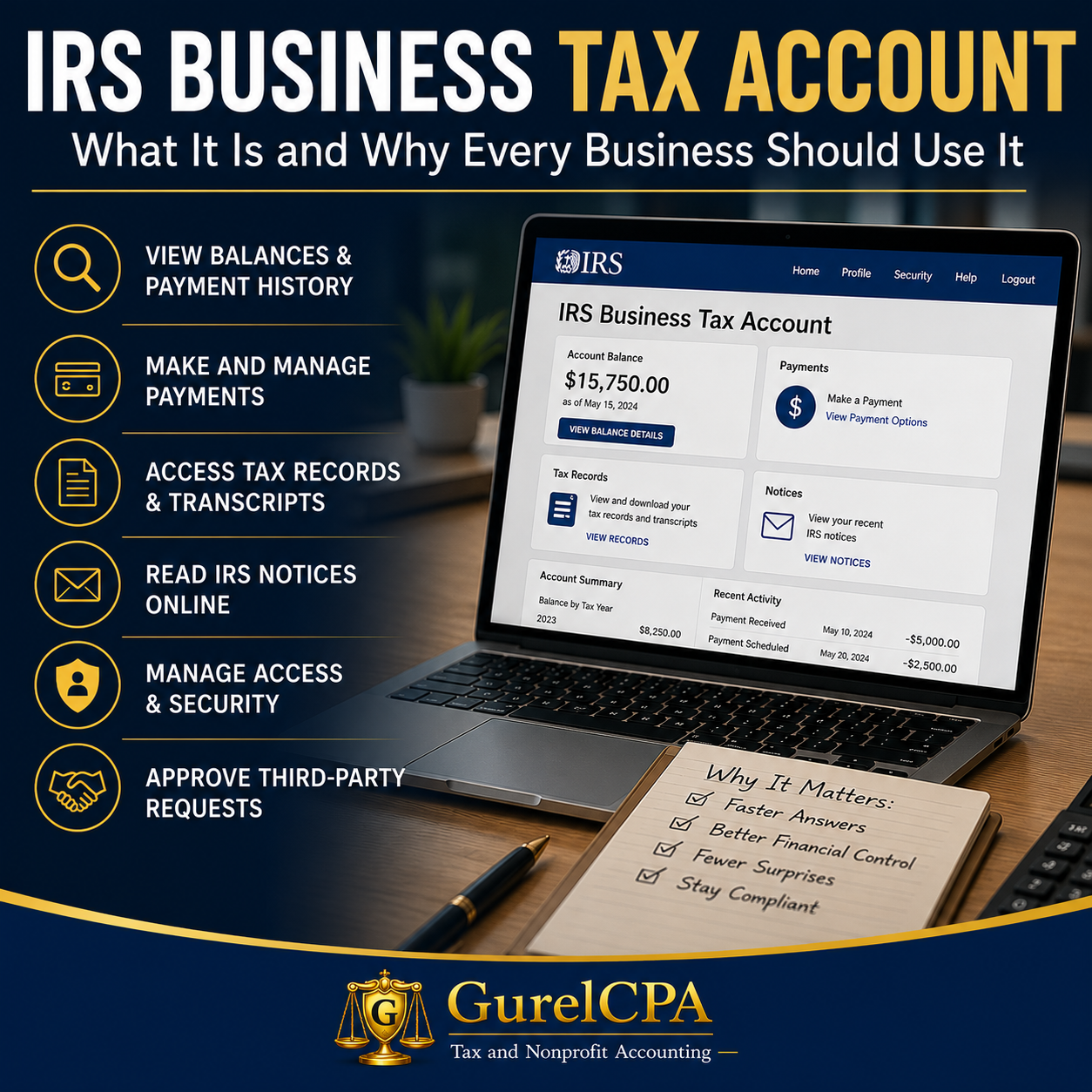
IRS Business Tax Account: What It Is and Why Every Business Should Use It
If you own a business, the IRS has quietly rolled out one of the most important tools in years: the IRS Business Tax Account.
This isn’t just another IRS webpage; it’s a secure online portal that gives you direct access to your business tax information. For many business owners, it can replace hours of phone calls, paperwork, and guesswork.
Let’s break down what it is, what it does, and why you should care.
What Is the IRS Business Tax Account?
The IRS Business Tax Account (BTA) is a self-service online platform that allows business owners and authorized users to view and manage their federal tax information in one place.
Think of it as your business’s IRS dashboard: similar to online banking, but for taxes.
What Can You Do With a Business Tax Account?
1. View Your Balance and Payment History – See what you owe, track payments, and monitor outstanding liabilities in real time.
2. Make and Manage Payments – Make federal tax deposits, pay balances, schedule future payments, and cancel payments all in one place.
3. Access Tax Records and Transcripts – Download tax return transcripts, account transcripts, and compliance reports.
4. Read IRS Notices Online – View IRS notices digitally and track correspondence without waiting for mail.
5. Manage Who Has Access – Add or remove authorized users and control access levels to your business tax data.
6. Approve Third-Party Requests – Approve or reject lender requests for tax information directly inside your account.
Why This Matters
Faster answers, better financial control, fewer surprises, and alignment with the IRS’s ongoing shift toward digital systems.
Important Limitations
The system is still evolving, and access varies depending on your business structure and role.
Bottom Line
The IRS Business Tax Account is becoming an essential tool for business owners, offering real-time visibility and improved control.
Questions? Let’s Talk!
If you’d like help setting up your IRS Business Tax Account or understanding how to use it effectively, please contact me directly. I offer a free consultation to get you started.
This article is for informational purposes only and should not be relied upon as tax advice. Please contact me directly to discuss how this applies to your individual tax situation.
You Filed Your Tax Return But Didn’t Pay: What Happens Next?
If you filed your tax return but couldn't afford to pay the balance due, you did the right thing by filing on time.
Now comes the next step.
About two months after tax season, many taxpayers begin receiving IRS balance-due notices in the mail. The most common is Notice CP14, which tells you how much you owe, including penalties and interest. For many people, opening that letter can be stressful. But receiving a balance-due notice is often the best time to take action.
First, don't ignore the notice. The IRS sends these notices because a tax return was filed showing a balance due that was not paid in full. If no action is taken, penalties and interest continue to accumulate, and the IRS collection process can become more serious.
Installment Agreements: The Most Common Solution
For many taxpayers, an IRS installment agreement is the simplest answer. An installment agreement allows you to make monthly payments over time rather than paying the entire balance immediately. Even if you cannot pay the full amount today, paying something and establishing a payment plan is often far better than doing nothing.
What If You Truly Can't Afford Payments?
If your financial situation is severe, the IRS has other programs that may help.
Currently Not Collectible Status
Taxpayers experiencing genuine financial hardship may qualify for a temporary suspension of collection activity. This doesn't erase the debt, but it can provide breathing room while you get back on your feet.

Offer in Compromise
In some situations, taxpayers may be able to settle their tax debt for less than the full amount owed. While not everyone qualifies, it can be a valuable option for taxpayers facing long-term financial hardship.
Make Sure the Notice Is Correct
Before paying, review the notice carefully. Occasionally taxpayers receive a balance-due notice after they have already paid, particularly when payments are still being processed or posted to the IRS account.
The Bottom Line
Filing your return was the first step. Now it's time to deal with the balance due.
The good news is that the IRS would much rather work with taxpayers who communicate and make arrangements than with those who ignore the problem.
If you've received an IRS balance-due notice and aren't sure whether an installment agreement, Offer in Compromise, or another relief option is right for you, contact me for a free consultation. Together we can review your situation and determine the best path forward.
The article is meant for informational purposes only. Please contact me directly to discuss how this applies to your individual tax situation.
Inherited an IRA? The IRS Is Enforcing These Required Minimum Distribution Rules
If you've been seeing articles about Required Minimum Distributions (RMDs) lately, you may be wondering whether the rules changed again.
For most retirees, the answer is no.
The age for starting RMDs remains 73 for individuals born between 1951 and 1959, and 75 for those born in 1960 or later. If you're already taking RMDs from your retirement accounts, there is probably nothing new to worry about.
The real story involves inherited IRAs.
The Surprise for Many IRA Beneficiaries
Under the SECURE Act, most non-spouse beneficiaries who inherit an IRA must withdraw the entire account within 10 years. For several years, however, the IRS delayed enforcement while it finalized the regulations.
Now those regulations are in place, and many beneficiaries are discovering that the 10-year rule may not work the way they expected.
If the original IRA owner had already begun taking RMDs before passing away, many beneficiaries must:
• Take annual distributions during years 1 through 9, and
• Completely empty the account by the end of year 10.
Many taxpayers believed they could simply wait until year ten and withdraw the entire balance. In many cases, that is no longer allowed.
Penalties Are Smaller, but Still Expensive
The SECURE 2.0 Act reduced the penalty for missed RMDs.
The old penalty was 50% of the amount that should have been withdrawn. Today, the penalty is generally 25%, and it may be reduced further if corrected quickly.
That's certainly better than before, but it can still be a costly mistake.

Why This Matters
Many inherited IRA beneficiaries have never taken a required distribution because the IRS repeatedly postponed enforcement of these rules.
Now that enforcement has begun, beneficiaries who miss required withdrawals could face penalties and unexpected tax issues.
There is also a planning opportunity. Taking distributions strategically over several years may help reduce the tax impact compared to waiting and taking large withdrawals later.
The Bottom Line
Most retirees don't need to worry about new RMD rules this year.
However, if you inherited an IRA after 2019, it may be time to take a closer look. The IRS is now enforcing inherited IRA distribution requirements that many beneficiaries have never had to follow before.
If you're unsure whether an inherited IRA requires an RMD this year, don't guess. A quick review now could prevent penalties and help you avoid unnecessary taxes later.
Questions about inherited IRAs, retirement distributions, or tax planning? Contact GurelCPA for a free consultation. We're happy to help you understand your options and stay compliant with the IRS.
This article is meant for informational purposes only and should not be relied upon as tax or legal advice. Please contact Lance W. Gurel, CPA directly to discuss your individual tax situation and inherited retirement account planning opportunities. Free consultations are available.
Just Married? It's a Good Time to Check Your Tax Withholding
Wedding planning usually focuses on venues, flowers, travel, and thank-you notes. Taxes rarely make the list.
But if you recently got married, one of the smartest financial moves you can make is reviewing your tax withholding.
A change in marital status can affect how much tax should be withheld from your paycheck, and failing to update your withholding could lead to an unexpected tax bill, or a larger refund than necessary, when you file your return.
Why Marriage Can Change Your Tax Situation
For federal tax purposes, if you are married on December 31, the IRS generally considers you married for the entire year. That means you'll typically file either Married Filing Jointly or Married Filing Separately.
Many couples benefit from filing jointly, but the amount of tax withheld from their paychecks may need adjustment, especially when both spouses work.
Update Your Form W-4
The IRS recommends that newly married couples review and update their Form W-4 with their employers.
Use the IRS Tax Withholding Estimator
The IRS Tax Withholding Estimator can help determine whether your withholding is on track by considering filing status, income, credits, deductions, and other factors.
Don't Forget to Update Social Security Records
If either spouse changes their name after marriage, updating records with the Social Security Administration should be a top priority.
The IRS matches the name and Social Security number shown on a tax return against SSA records.
If the name on the tax return does not match the name on file with Social Security, the return may be rejected when electronically filed or processing may be delayed.

Other Important Tax Updates for Newlyweds
Marriage often brings other changes that can affect your tax return, including updating addresses, reviewing beneficiary designations, evaluating filing status options, and adjusting estimated tax payments if needed.
The Bottom Line
Taking a few minutes now to update your W-4, verify your withholding, and ensure your Social Security records are current can help prevent surprises and filing problems next tax season.
If you've recently married and would like help reviewing your withholding, filing status options, or overall tax situation, contact GurelCPA. We offer a free initial consultation and would be happy to help.
The article is meant for informational purposes only. Please contact me directly to discuss how this applies to your individual tax situation.
Living Abroad? Do you need to file an FBAR?
Many U.S. citizens living outside the United States are surprised to learn that filing a tax return may not be their only reporting obligation. In addition to your federal income tax return, you may also need to file something called an FBAR.
You must file an FBAR if the combined total of your foreign financial accounts exceeded $10,000 at any time during the year.
What Is an FBAR?
FBAR stands for Foreign Bank Account Report. The official name is FinCEN Form 114, and it is filed electronically with the U.S. Treasury, not with your tax return.
It does not matter if:
• The balance only exceeded $10,000 for one day
• The funds were already taxed in another country
• You owe no U.S. income tax
If the threshold is met, the reporting requirement applies.
What Accounts Count?
Foreign financial accounts may include:
• Foreign checking and savings accounts
• Foreign investment or brokerage accounts
• Some foreign retirement accounts
• Joint accounts
• Accounts where you have signature authority
If the account is located outside the United States, it may be reportable.
Important: It’s $10,000 Combined
The $10,000 threshold applies to the total of all foreign accounts combined, not per account. If your combined balance exceeds $10,000 at any point during the year, an FBAR is generally required.
Is an FBAR a Tax?
No. The FBAR does not calculate tax and does not create tax by itself. It is strictly an informational reporting requirement.
Many expats owe little or no U.S. income tax because of the Foreign Earned Income Exclusion or Foreign Tax Credit, but the reporting obligation may still exist.

What If You Didn’t Know?
Many expats miss FBAR filings simply because they were unaware of the rule. If the failure to file was non-willful, there are compliance options available to correct past years without penalties
The Bottom Line
If you are a U.S. citizen or green card holder living abroad, it is important to determine whether FBAR reporting applies to you. If you are a U.S. taxpayer living abroad and are unsure whether you should be filing FBARs, or whether you may need to correct past filings, I invite you to contact me directly for a free initial consultation to review your situation and discuss your options.
This article is for general informational purposes only and does not constitute tax advice. FBAR requirements depend on individual facts and circumstances

IRS Identity Protection PIN: A Simple Tool to Help Prevent Tax Fraud
Identity theft continues to be one of the most common tax-related problems facing taxpayers. Criminals often use stolen personal information to file fraudulent tax returns and claim refunds before the legitimate taxpayer has a chance to file.
One of the simplest ways to help protect yourself is by obtaining an IRS Identity Protection Personal Identification Number, commonly called an IP PIN.
What Is an IP PIN?
An IP PIN is a six-digit number issued by the IRS that helps verify your identity when you file your federal tax return. Once an IP PIN is assigned to your Social Security Number, the IRS generally will not process an electronically filed tax return without the correct PIN.
Why Does It Matter?
If someone obtains your Social Security Number, they may attempt to file a fraudulent tax return and claim a refund in your name. An IP PIN helps prevent this because the fraudster would also need your current year's PIN in order to successfully file.
Who Should Consider Getting One?
An IP PIN may be especially worth considering if you:
• Have been a victim of identity theft in the past
• Have had personal information exposed in a data breach
• Want an additional layer of protection for your tax return
• Are concerned about increasing online fraud and scams
Things to Know Before You Enroll
• A new IP PIN is issued each year.
• You must use the current year's PIN when filing.
• Keep it in a safe place.
• Losing your IP PIN can delay the filing process.
• The IP PIN applies to federal tax returns.
Is an IP PIN Right for You?
For many taxpayers, obtaining an IP PIN is a simple and effective way to add another layer of security to their tax filing process. While no system can eliminate fraud entirely, an IP PIN can make it significantly more difficult for criminals to file a fraudulent tax return using your information.
Need Help?
Questions about IRS identity theft protection, tax account security, or other IRS tools? Contact me directly for a free consultation.
The article is meant for informational purposes only. Please contact me directly to discuss how this applies to your individual tax situation.
An Audit Isn’t a Character Test: It’s a Documentation Test
Many taxpayers hear the word “audit” and immediately feel anxious. They worry that an IRS audit means they have done something wrong or that their integrity is being questioned.
In reality, most audits are much less personal than people imagine.
An audit is usually not a test of your character. It is a test of your documentation.
The IRS Wants Evidence
When the IRS reviews a tax return, its primary question is simple:
Can you support the numbers reported on your return?
If you claimed business expenses, charitable contributions, mileage, home office deductions, or other tax benefits, the IRS may ask for documentation that supports those claims.
The IRS is generally looking for:
• Receipts and invoices
• Bank and credit card statements
• Mileage logs
• Payroll records
• Donation acknowledgments
• Accounting records
• Supporting schedules and workpapers
The stronger your records, the smoother the process tends to be.
Three Keys to Audit Readiness
1. Maintain Strong Records
Keep supporting documents throughout the year instead of trying to reconstruct them later.
2. Organize Documentation
Having documents is only part of the equation. The ability to quickly locate the correct records often determines how efficiently an audit proceeds.
3. Respond Promptly
IRS notices usually contain deadlines. Timely responses help prevent additional correspondence, delays, and unnecessary complications.
Good Records Reduce Stress
Many taxpayers assume that surviving an audit depends on arguing their case effectively.
More often, success comes down to being organized.
When records are readily available questions can be answered quickly, explanations become easier, and professional representation is more effective.
Good documentation turns uncertainty into confidence.
The Bottom Line
The best audit defense begins long before an IRS letter arrives.
Strong records, organized documentation, and timely responses can make the difference between a stressful experience and a manageable one.
Remember:
An audit isn't a character test. It's a paperwork test. And taxpayers who maintain good records are usually in the strongest position to succeed.
Need help responding to an IRS notice or preparing for an audit?
I help individuals, self-employed taxpayers, and small nonprofits organize records, respond to IRS inquiries, and navigate tax compliance issues with confidence.
This article is for informational purposes only and should not be considered tax or legal advice. Individual circumstances vary.
Understanding 529 Plans: A Smart Way to Save for Education
What Is a 529 Plan?
A 529 plan is a state-sponsored savings plan designed to encourage saving for education expenses. Contributions are made with after-tax dollars, but the earnings grow tax-free, and qualified withdrawals are also tax-free.
The beneficiary can be a child, grandchild, spouse, or even yourself.
Tax Benefits of a 529 Plan
The primary tax advantages include:
• Tax-free growth on investments within the account.
• Tax-free withdrawals when used for qualified education expenses.
• Potential state tax deductions or credits, depending on the state sponsoring the plan.
• No federal income tax deduction for contributions.
For many families, years of tax-free growth can result in significant savings compared to investing in a taxable account.
What Expenses Qualify?
College and University Expenses
• Tuition and fees
• Books and supplies
• Computers and related equipment
• Room and board (for eligible students)
K–12 Education
• Up to $10,000 per year may be used for tuition at public, private, or religious elementary and secondary schools.
Apprenticeship Programs
• Qualified apprenticeship expenses may qualify if the program is registered with the U.S. Department of Labor.
Student Loan Repayment
• Up to $10,000 may be used toward the beneficiary's student loans, with certain limitations.
What Happens If the Child Doesn't Go to College?
Fortunately, the account owner has options:
• Change the beneficiary to another qualifying family member.
• Keep the funds invested for future educational needs.
• Use the funds for another child's education.
• Withdraw the funds (earnings may be subject to income tax and penalties if not used for qualified expenses).
Recent law changes have also created opportunities to roll certain unused 529 funds into a Roth IRA for the beneficiary, subject to several requirements and annual contribution limits.
Who Controls the Money?
The person who establishes the account remains in control of the funds. The beneficiary does not automatically gain ownership when reaching adulthood.
This allows parents and grandparents to maintain flexibility and ensure the funds are used as intended.

Contribution Limits
529 plans generally have very high lifetime contribution limits, often exceeding $300,000 per beneficiary depending on the state plan.
Contributions may also qualify for special gift-tax averaging rules, allowing larger amounts to be contributed without triggering federal gift tax concerns.
Choosing a 529 Plan
You are not required to use your own state's plan. Many investors compare plans based on:
• Investment options
• Fees and expenses
• State tax benefits
• Historical performance
• Ease of use
The best choice depends on your family's goals and circumstances.
.
The Bottom Line
A 529 plan can be one of the most effective tools available for education savings. Tax-free growth, tax-free qualified withdrawals, and flexible beneficiary rules make these plans attractive for many families.
Starting early allows investments more time to grow and may significantly reduce the financial burden of future education costs.
If you have questions about 529 plans, education tax credits, gift tax implications, or education funding strategies, please contact GurelCPA for a free consultation.
The article is meant for informational purposes only. Please contact me directly to discuss how this applies to your individual tax situation.
Why You Should Create an IRS Online Account and How to Do It
The IRS offers taxpayers a secure online tax account that provides direct access to important tax information.
Creating an IRS online account can save time, reduce confusion, and help taxpayers stay ahead of notices, balances, and filing requirements.
For many taxpayers, this tool has become one of the most useful ways to monitor their tax situation year-round — not just during filing season.
WHAT IS AN IRS ONLINE ACCOUNT?
An IRS online account is a secure portal that allows individuals to view and manage certain federal tax information. Once established, the account gives you real-time access to data the IRS has on file for you.
This is not a filing system. Instead, it’s an information and account-management tool designed to help taxpayers understand their current standing with the IRS.
KEY BENEFITS OF AN IRS ONLINE ACCOUNT
View Your Tax Records
Taxpayers can access prior-year tax return transcripts, wage and income transcripts (W-2s, 1099s, etc.), and adjusted gross income (AGI) for prior years.
Check Balances and Payments
An IRS online account allows you to view your current balance due, see recent payments and applied credits, and monitor installment agreements.
Review IRS Notices
Many IRS notices now appear in the online account, allowing taxpayers to confirm which tax year is involved and share accurate information with their tax professional.
Make Payments or Set Up Payment Plans
Taxpayers can make secure payments, request or manage installment agreements, and view payment history directly through the account.

HOW TO CREATE AN IRS ONLINE ACCOUNT
Step 1: Visit the IRS Website
Go to IRS.gov and select the option to sign in or create an online account.
Step 2: Verify Your Identity
You will need a valid email address, a photo ID, and a smartphone or computer with a camera for identity verification.
Step 3: Create Login Credentials
Set up a username, password, and multi-factor authentication.
WHEN AN IRS ONLINE ACCOUNT IS ESPECIALLY HELPFUL
This tool is particularly helpful if you owe taxes, receive IRS notices, need prior-year transcripts quickly, want to confirm payments, or work with a tax professional.
FINAL THOUGHTS
Creating an IRS online account is one of the simplest steps taxpayers can take to stay informed and organized. If you need help reviewing information from your IRS account or responding to IRS correspondence, a tax professional can help determine next steps.
The article is meant for informational purposes only. Please contact me directly to discuss how this applies to your individual tax situation.
Hiring Your Children in Your Business: A Legitimate Tax Strategy
You may have heard people refer to hiring your children in your business as the "family payroll loophole." While the name sounds questionable, this is actually a legitimate tax strategy recognized by the IRS when done correctly.
To qualify, your child must perform real work and be paid a reasonable wage, and the business should maintain proper records.
Why Do Business Owners Do It?
• The wages are generally deductible to the business.
• The child may pay little or no federal income tax if their earnings fall within the standard deduction.
• The family may shift income from a higher tax bracket to a lower one.
Additional Payroll Tax Savings
For sole proprietorships and husband-and-wife partnerships, wages paid to children under age 18 are generally exempt from Social Security and Medicare taxes. Wages paid to children under age 21 are also generally exempt from federal unemployment tax (FUTA).
These exemptions do not generally apply to S corporations.
What Kind of Work Can Children Do?
• Filing and organizing records
• Cleaning the office
• Data entry
• Social media assistance
• Photography or website updates
• Inventory and administrative tasks
The work must be appropriate for the child's age and abilities.

Don't Forget the Roth IRA Opportunity
Because wages are earned income, a child may be eligible to contribute to a Roth IRA, giving them a head start on tax-free retirement savings.
The Bottom Line
Hiring your children can provide legitimate tax savings while teaching valuable work skills and responsibility. The key is making sure the work is real, the pay is reasonable, and the records are properly maintained.
Thinking about hiring your child in your business? Please contact me directly for a free consultation.
The article is meant for informational purposes only. Please contact me directly to discuss how this applies to your individual tax situation.
Protecting Your Personal and Financial Information Online
Simple Steps to Reduce Your Risk of Identity Theft
Every year, millions of Americans have personal information exposed through data breaches, phishing scams, stolen devices, and fraudulent websites. Once criminals obtain enough information about you, they may attempt to open credit accounts, access financial records, file fraudulent tax returns, or steal money from existing accounts.
The good news is that a few simple habits can dramatically reduce your risk.
Use Strong Passwords and Multi-Factor Authentication
Your email account is often the key to everything else. If a criminal gains access to your email, they can reset passwords for banks, credit cards, and investment accounts.
Use unique passwords for important accounts and enable multi-factor authentication (MFA) whenever available.
Monitor Your Credit Reports
Federal law allows consumers to obtain free credit reports from each major credit bureau. Review them regularly for unfamiliar accounts, addresses, or inquiries.
Consider Freezing Your Credit
A credit freeze prevents new lenders from accessing your credit report without your authorization and is one of the strongest defenses against identity theft.
Be Suspicious of Unexpected Emails and Text Messages
Never click links in unexpected messages requesting personal information, passwords, or financial details. The IRS generally initiates contact by mail, not email or text.
Keep Your Devices Updated
Enable automatic updates on computers, phones, tablets, web browsers, and antivirus software whenever possible.
Secure Your Home Wi‑Fi Network
Change default router passwords and make sure your wireless network uses WPA2 or WPA3 security.

Limit What You Share Online
Birthdates, family relationships, schools attended, pets' names, and travel plans can all be useful to identity thieves.
Back Up Important Records
Maintain secure backups of important tax records, financial documents, photographs, and business files.
Protect Tax Documents
Store tax documents securely, avoid sending sensitive information through unsecured email, and use encrypted portals whenever possible.
Properly Dispose of Old Devices
Before selling, donating, or recycling computers, phones, or tablets, perform a factory reset and remove all personal data.
The Bottom Line
Most identity theft can be prevented through a few basic habits: use strong passwords, enable MFA, monitor your credit, stay alert for scams, and protect sensitive tax information.
Need Help Protecting Your Tax Information?
If you have concerns about IRS identity theft, suspicious tax notices, or protecting sensitive tax records, contact GurelCPA for a free consultation.
The article is meant for informational purposes only. Please contact me directly to discuss how this applies to your individual tax situation.

Haven’t Filed Taxes in Years & Now You Need Your Tax Returns?
Many people who haven’t filed tax returns for years weren’t trying to avoid anything. They simply didn’t need to file… or didn’t think they did.
Then, suddenly, you’re asked: “Can you provide your last few years of tax returns?”
Why Unfiled Tax Returns Matter Now
Tax returns have become a standard financial requirement, not just an IRS obligation.
You may need them to:
• Qualify for a home loan or refinance
• Complete immigration or visa applications
• Verify income for loans, grants, or benefits
No returns = delays or denials.
Good News: You Usually Don’t Need to Go Back Forever
One of the biggest misconceptions is that you must file every missing year.
In reality:
• The IRS focus is on getting you back into compliance
• Many taxpayers can move forward by filing a limited number of recent years
• Refunds are only available for the last 3 years
The goal is to establish a recent filing history, not rebuild your entire past.
It’s usually more manageable than people expect.
What Getting Caught Up Actually Looks Like
A practical approach typically includes:
- Identifying which years need to be filed
- Reconstructing income using IRS transcripts and records
- Filing a targeted set of returns (not necessarily every year)
- Addressing any balances or confirming refunds
In many cases, taxpayers are surprised to find they don’t owe as much as expected or they were actually due refunds
Bottom Line
Unfiled tax returns may not have mattered before—but they often matter now.
Getting current isn’t just about the IRS.
It’s about removing barriers to homeownership, immigration, and financial progress.
If you need help getting caught up—or want to understand how many years you actually need to file—contact GurelCPA for a free consultation.
This article is for informational purposes only and does not constitute tax advice. Every situation is different, especially when multiple years of unfiled returns are involved.
Filed Your Tax Return, But Didn't Pay? The IRS Is Starting to Send Notices
Did you file your tax return on time but couldn't afford to pay the balance due? You're not alone.
Every year, many taxpayers file their returns by the deadline but don't have enough cash available to pay the tax they owe. Filing on time is important because it avoids the much larger failure-to-file penalty, but it does not stop the IRS from beginning its collection process.
Now that tax season has passed, the IRS is starting to send notices to taxpayers with unpaid balances.
What Happens If You Filed but Didn't Pay?
After processing your return, the IRS will send a notice showing:
• The amount of tax due
• Penalties that have been assessed
• Interest that has accrued
• The total amount currently owed
Even if you cannot pay the full balance, it's important not to ignore these notices. Interest and penalties continue to accumulate until the debt is paid in full.
The Good News: You Have Options
Installment Agreements
Many taxpayers can make monthly payments over time. The IRS will usually accept a plan that will pay off the tax debt in no more than 60 months. Setting up a payment plan can help avoid more serious collection activity. Most of the time, taxpayers can set up an installment agreement online.
Temporary Collection Relief
If paying the IRS would create a significant financial hardship, the IRS may temporarily delay collection efforts. Read our article about Offers in Compromise.

Penalty Relief
In some situations, penalties may be reduced or removed through programs such as First-Time Penalty Abatement or reasonable cause relief. Do not pay any penalties without checking first to see if they can be removed.
Don't Wait Until the Problem Gets Bigger
Many people make the mistake of setting IRS notices aside because they are uncomfortable dealing with the situation. Unfortunately, penalties and interest continue to grow, and additional notices become more serious over time.
The earlier you address an unpaid tax balance, the more options are usually available.
Need Help?
If you filed your tax return but still owe money to the IRS, don't panic—but don't ignore the notices either.
GurelCPA can help you understand your options, evaluate payment arrangements, and communicate with the IRS when necessary. Please contact me directly for a free consultation.
The article is meant for informational purposes only. Please contact me directly to discuss how this applies to your individual tax situation.
Ways to Support Nonprofits That Go Beyond the Schedule A Charitable Deduction
Many taxpayers assume the only tax benefit available for charitable giving is claiming an itemized deduction on Schedule A.
However, with today's larger standard deduction, many donors no longer itemize and may wonder whether charitable giving still provides any tax advantages.
The good news is that several charitable giving strategies can provide significant tax benefits that go beyond a traditional Schedule A deduction.
Here are three of the most powerful options to consider:
1. Qualified Charitable Distributions (QCDs)
For taxpayers age 70½ or older, a Qualified Charitable Distribution allows funds to be transferred directly from an IRA to a qualified charity.
Benefits include: exclusion from taxable income, satisfaction of Required Minimum Distributions, no need to itemize deductions, potential reduction in Social Security taxation, and possible reduction in Medicare premium surcharges.
2. Donating Appreciated Stock
Donating appreciated investments held longer than one year can allow the donor to avoid capital gains tax while helping the charity receive the full value of the asset.
3. Naming a Charity as an IRA Beneficiary
Traditional IRA assets can be heavily taxed when inherited by individuals. Naming a charity as beneficiary allows the charity to receive the funds income-tax free while potentially leaving more tax-efficient assets to family members.
Other strategies worth exploring include Donor-Advised Funds, Charitable Remainder Trusts, Charitable Gift Annuities, bunching charitable contributions, employer matching programs, certain state tax-credit programs, and deductible volunteer expenses.
Final Thoughts
Qualified Charitable Distributions, donating appreciated investments, and charitable IRA beneficiary designations are three of the most effective ways to support nonprofits while potentially improving your overall tax situation.
Please contact me directly for a free consultation if you'd like to explore tax-efficient ways to support the charitable organizations you care about.
This article is for general informational purposes only and should not be considered tax advice. Please reach out for a free consultation to discuss your individual tax situation.

Living Overseas? You May Have Until June 15, But Don’t Misunderstand This Tax Extension
If you’re a U.S. taxpayer living abroad, you automatically get extra time to file your tax return. That’s true; but it’s also one of the most misunderstood rules in U.S. tax law. And misunderstanding it can cost you money. Let’s break it down clearly.
Yes, There Is an Automatic 2-Month Extension
If you are living outside the United States on April 15, you automatically receive a 2-month extension to file your tax return, moving your filing deadline to June 15.
You qualify if:
- Your main place of business is outside the U.S. and Puerto Rico, or
- You are serving in the military outside the U.S.
No form is required to get this extension. However, when you file your return, you should include a brief statement explaining that you qualified for the automatic extension.
But Here’s the Critical Catch: This Is NOT an Extension to Pay
This is where many taxpayers get into trouble. Even if you qualify for the June 15 filing deadline: your taxes were still due April 15
If you owe money interest began accruing on April 15 and late payment penalties may also apply. In other words, the IRS gives you more time to file — but not more time to pay.
Common Mistakes Expats Make
Such as:
- Assuming “I don’t need to think about taxes until June”
- Filing late and being surprised by interest charges
- Not making an estimated payment by April 15
- Confusion between the automatic June 15 extension and the October 15 extension
Need More Time Beyond June 15?
If you’re not ready by June 15, you can still request additional time:
- File an extension (Form 4868) to move the deadline to October 15
- In limited cases, an additional extension to December 15 may be available
But again: none of these extensions give you more time to pay.
Smart Strategy for U.S. Taxpayers Abroad
If you expect to owe taxes:
- Estimate your liability before April 15
- Make a payment to reduce interest and penalties
- Use the additional time to properly apply:
- Foreign Earned Income Exclusion (FEIE)
- Foreign Tax Credit (FTC)
- Housing exclusions or deductions
Final Thought
The automatic June 15 extension is helpful — but only if you understand how it works.
Used correctly, it gives you time to prepare an accurate return.
Used incorrectly, it can quietly increase your tax bill through interest and penalties.
Questions? Let’s Talk
If you’re living abroad and unsure how this applies to your situation, I can help you navigate the rules and minimize surprises. Contact GurelCPA for a consultation and let’s make sure you’re handling your U.S. tax obligations the right way.
This article is for informational purposes only and does not constitute tax advice. Every taxpayer’s situation is unique. Please contact us directly to discuss your specific circumstances and receive personalized guidance.
New 2026 Charitable Contribution Deduction Is Important News for Nonprofit Donors
For the past few years, many taxpayers stopped receiving a direct federal tax benefit for charitable giving because they no longer itemized deductions.
After the standard deduction increased significantly, millions of taxpayers began taking the standard deduction instead of filing Schedule A. As a result, many donors effectively lost the ability to deduct charitable contributions on their federal tax returns.
That is changing beginning in 2026.
What Is Changing in 2026?
Beginning with tax year 2026:
• Single taxpayers who do not itemize may deduct up to $1,000 of qualifying charitable contributions.
• Married taxpayers filing jointly who do not itemize may deduct up to $2,000 of qualifying charitable contributions.
Why This Matters to Nonprofits
Many nonprofit donors have become accustomed to hearing:
“You probably will not receive a tax deduction unless you itemize.”
For a large percentage of taxpayers, that has been true in recent years. But beginning in 2026, many standard deduction taxpayers may once again receive at least some tax benefit from charitable giving.
This creates a strong communication opportunity for nonprofits.
Organizations may want to begin educating donors that:
• Smaller annual gifts may once again provide a federal tax deduction.
• Donors who previously stopped tracking contributions may want to keep records again.
• Year-end giving campaigns may become more effective when donors understand the deduction is available even without itemizing.
For many charities, especially smaller nonprofits, churches, and community organizations, this could become an important fundraising talking point.

Important Limitations
There are several important rules nonprofits and donors should understand.
The deduction generally applies only to:
• Cash contributions
• Made directly to qualifying charitable organizations
• By taxpayers using the standard deduction
Certain contributions do not qualify, including many gifts made to donor-advised funds or certain private foundations.
As always, donors should maintain proper documentation of their contributions.
A Potential Shift in Donor Psychology
Beginning in 2026, nonprofits may be able to reintroduce the idea that charitable giving can both support a mission and potentially reduce taxable income, even for taxpayers who do not itemize.
For organizations that rely heavily on moderate-dollar donors, this change may be worth discussing in donor newsletters, email campaigns, and fundraising conversations.
Nonprofits Should Consider Proactive Communication
This is not a massive deduction, but it is meaningful for many households. A married couple filing jointly could potentially deduct up to $2,000 of charitable contributions while still taking the standard deduction.
That may be enough to encourage:
• recurring monthly giving,
• additional year-end gifts,
• or renewed donor engagement.
Nonprofits that communicate these changes clearly and early may benefit from increased donor awareness going into 2026 and beyond. Free consultations are available if you have questions about the new charitable contribution deduction.
The article is meant for informational purposes only. Please contact me directly to discuss how this applies to your individual tax situation.
IRS Withholding Estimator: Avoid A Surprise Next Year
If you are an employee who receives a W-2, now is a good time to check your payroll withholding.
Changes like a new job, side income, or outdated withholding elections can easily throw things off. Before too much of the year has passed, use the Online IRS Withholding Estimator to keep your withholding in line with your income.
IRS Withholding Estimator
The IRS offers an online tool to help you:
- Check if you’re withholding enough
- Estimate your refund or balance due
- Adjust your Form W-4
It’s been improved over the years and is much easier to use than the old worksheets.
What Is a W-4?
The Form W-4 (Employee’s Withholding Certificate) tells your employer how much federal income tax to withhold from your paycheck.
You typically fill one out when you start a job—but many people never update it, even when their situation changes.
Updating your W-4 is how you actually fix your withholding after using the estimator.
Why Now Is the Right Time
Mid-year is a great best time to use the withholding calculator.
You now have a clear picture of your income and taxes, which makes your estimate more accurate.
What You’ll Need
- Recent pay stub
- Latest tax return
- Info on any side or other income

What to Do Next
After using the estimator, update your Form W-4 with your employer.
You can do this anytime—no need to wait.
Bottom Line
If your tax result surprised you last year, don’t ignore it.
Adjust now so next year goes more smoothly.
Questions? Let’s talk!
Please contact me to discuss how this applies to your individual tax situation. I’m always happy to help—and I offer a free consultation to get you pointed in the right direction.
The article is meant for informational purposes only. Please contact me directly to discuss how this applies to your individual tax situation.
2nd Quarterly Estimated Tax Payment for 2026 Deadline is June 15
For self-employed taxpayers, June 15 is the deadline for paying the 2nd Quarterly Estimated Tax Payment.
That is when you must pay the tax you estimate is due on the NET income you made from April through May 2026.
The IRS expects taxes to be paid throughout the year as income is earned When too little tax is paid during the year, an underpayment penalty can apply — even if the full balance is paid at filing time.
Here’s an easy formula: multiply your estimated NET income for the period by your marginal tax rate from last year’s tax return. This will give a good approximation.
And remember: if you are in a state with income tax, you need to pay Estimated Quarterly Taxes to your state, as well.
Who Commonly Needs Estimated Payments?
Estimated payments are often required for people with income such as:
• Self-employment or freelance work
• Business or rental income
• Investment or capital gains income
• Retirement withdrawals without enough withholding
• Side income in addition to regular employment
Understanding Safe Harbor Rules
The IRS provides safe harbor rules that allow taxpayers to avoid penalties if enough tax is paid during the year through withholding or estimated payments. Even if additional tax is owed at filing, meeting one of these thresholds usually prevents penalties
In general, penalties are avoided if payments equal at least:
• 90% of the current year’s total tax, or
• 100% of last year’s total tax
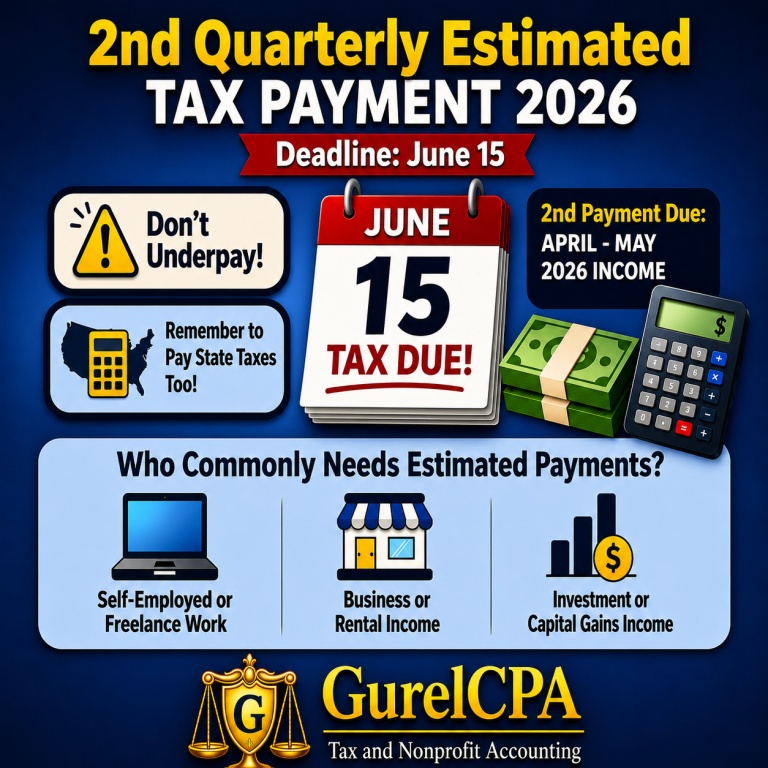
2026 Estimated Tax Payment Periods and Due Dates
Estimated taxes are paid in four installments during the year as income is earned. The payment periods do not follow equal calendar quarters, so it is important to understand how the IRS divides the year.
For the 2026 tax year, estimated payments are due on:
• April 15, 2026 — covering income earned January 1 through March 31, 2026
• June 15, 2026 — covering income earned April 1 through May 31, 2026
• September 15, 2026 — covering income earned June 1 through August 31, 2026
• January 15, 2027 — covering income earned September 1 through December 31, 2026
Withholding Can Help Too
Estimated payments aren’t the only solution. Increasing paycheck withholding can often fix the issue and is sometimes easier than making quarterly payments. Withholding is treated as if paid evenly throughout the year, even when adjustments happen later in the year.
Missing or underpaying any installment can result in penalties, even if the total tax is paid when filing the return. Reviewing income periodically during the year helps ensure payments stay on track.
This article is for general informational purposes only and should not be considered tax advice. Please reach out for a free consultation to discuss your individual tax situation.

Summer Camp, Daycare, and the Child Care Credit: What Parents Need to Know
As school lets out for the summer, many parents begin arranging childcare, summer day camps, and activity programs so they can continue working. What many taxpayers do not realize is that some of these costs may qualify for the Child and Dependent Care Credit on their tax return.
However, not every summer expense counts.
Understanding what qualifies and what does not can help families avoid mistakes and potentially reduce their tax bill.
The Child and Dependent Care Credit
The Child and Dependent Care Credit is designed to help working taxpayers offset the cost of caring for children under age 13 while the parents work or look for work. In some cases, care for a disabled spouse or dependent may also qualify.
For most taxpayers, the credit is based on a percentage of qualifying childcare expenses:
• Up to $3,000 of expenses for one qualifying child
• Up to $6,000 of expenses for two or more qualifying children
The actual credit percentage depends on income.
Summer Day Camps Generally Qualify
One of the most common misconceptions is that summer camps are never eligible for the childcare credit.
In fact, many summer day camps do qualify if the primary purpose is to provide care while the parent works. This can include:
• Traditional summer day camps
• Sports camps
• Art camps
• Science or STEM camps
• Recreation programs
• Municipal summer day programs
• Before- and after-camp care programs
The IRS specifically allows day camp expenses to count toward the Child and Dependent Care Credit.
Overnight Camps Do NOT Qualify
This is where many taxpayers get tripped up.
Even though overnight camps provide supervision and care, the IRS does not consider overnight or sleepaway camp expenses to be qualifying childcare expenses for the credit.
That means:
• Overnight sports camps do not qualify
• Sleepaway church camps do not qualify
• Multi-day overnight activity camps do not qualify
Only day camp expenses are potentially eligible.
Daycare and Babysitting Expenses
Other summer childcare arrangements may also qualify, including:
• Licensed daycare centers
• Babysitters
• Nannies
• Before- and after-school care
• Summer daycare programs
However, the care must generally be work-related. In other words, the expense must allow the taxpayer (and spouse, if married) to work or look for work.
Expenses That Usually Do NOT Qualify
Some expenses associated with children during the summer are educational or personal in nature rather than childcare expenses.
Examples that generally do not qualify include:
• Private school tuition
• Overnight camp fees
• Tutoring
• Music lessons
• Sports league fees
• Dance classes
• Food, clothing, and entertainment expenses unrelated to care
Parents should also remember that extracurricular activities do not automatically become deductible simply because they occur during work hours.
Important Requirements Taxpayers Often Miss
To claim the credit, taxpayers typically must:
• Have earned income
• Provide the care provider’s name, address, and taxpayer ID number
• File Form 2441 with their tax return
• Use the expenses so they can work or look for work
Additionally, payments to certain relatives may not qualify, including:
• Your dependent
• Your child under age 19
• The child’s other parent in many situations
Keep Good Records
Taxpayers should keep:
• Receipts
• Camp invoices
• Provider information
• Payment records
• EIN or Social Security numbers for care providers
These records can become very important if the IRS requests documentation later.
Final Thoughts
Summer childcare costs can add up quickly, and many parents are surprised to learn that some summer day camp and daycare expenses may help reduce their taxes through the Child and Dependent Care Credit.
However, the rules can be more restrictive than taxpayers expect — especially when it comes to overnight camps and educational activities.
The article is meant for informational purposes only. Contact me to discuss how this applies to your individual tax situation.
A Costly Estate Planning Surprise for Americans Married to Non-Citizens
Most married couples benefit from one of the most valuable provisions in the federal estate tax system: the unlimited marital deduction.
This rule generally allows assets to pass from one spouse to the other without federal estate tax when the first spouse dies.
However, there is an important exception that many Americans, especially those living overseas, have never heard about.
The Unlimited Marital Deduction Does Not Automatically Apply
If the surviving spouse is not a U.S. citizen, the unlimited marital deduction is generally not available unless specific planning requirements are met.
This often surprises taxpayers because the rule applies even if the non-citizen spouse:
• Has lived in the United States for many years
• Holds a green card
• Has been married to a U.S. citizen for decades
For estate tax purposes, citizenship matters.
Why Does the Rule Exist?
Congress created this exception because assets passing to a non-citizen spouse could potentially leave the U.S. tax system before estate tax is ultimately collected.
As a result, special rules were established for estates involving non-citizen spouses.
A Potential Solution: The Qualified Domestic Trust (QDOT)
One common planning tool is a Qualified Domestic Trust (QDOT).
A properly structured QDOT can allow a deceased spouse's assets to qualify for the marital deduction while preserving the government's ability to collect estate tax later.
In general, assets pass into the trust for the benefit of the surviving spouse. The spouse may receive income from the trust, while estate tax is deferred until later events occur, such as the surviving spouse's death or certain distributions of trust principal.
Because QDOTs must satisfy specific legal and tax requirements, they should be established with the assistance of a qualified estate planning attorney.

Why This Matters to Expats
Many Americans living abroad are married to foreign nationals. While most expats are familiar with tax issues such as FBAR reporting, FATCA compliance, and the Foreign Earned Income Exclusion, far fewer are aware of the estate tax rules that apply to non-citizen spouses.
As a result, families may assume that the same estate tax protections available to other married couples automatically apply to them.
They do not.
For families with significant assets, failing to address this issue could lead to unintended estate tax consequences.
Does This Affect Everyone?
Not necessarily.
Current federal estate tax exemptions remain historically high, meaning many families will never owe federal estate tax. However, this issue becomes increasingly important for taxpayers with:
• Significant investment portfolios
• Real estate holdings
• Closely held businesses
• Large retirement accounts
• Anticipated inheritances
• Estates that may exceed future exemption amounts
The Bottom Line
If you are a U.S. citizen married to a non-U.S. citizen, do not assume the unlimited marital deduction automatically applies to your estate.
The rules are different, and proper planning may be necessary to preserve valuable estate tax benefits for your family.
A review today can help identify potential issues long before they become costly problems.
If you would like to discuss how these rules may affect your overall tax and financial planning, please contact Lance W. Gurel, CPA, for a free consultation.
This article is intended for informational purposes only and should not be considered legal or tax advice. Estate planning involving non-citizen spouses can be complex and often requires coordination with a qualified estate planning attorney.
Gifting vs. Inheriting: Understanding the Tax Differences Before You Transfer Wealth
Many families assume that giving assets to children or loved ones during life is always the best strategy. In reality, gifting and inheriting assets can create very different tax consequences.
In some situations, gifting makes sense. In others, inheriting property may produce a far better tax result because of something called a “step-up in basis.”
Understanding the difference can potentially save thousands — or even hundreds of thousands — of dollars in taxes.
What Is “Basis”?
For tax purposes, “basis” generally means what someone originally paid for an asset, adjusted for certain improvements or changes over time.
Basis matters because when an asset is sold, capital gains tax is usually based on:
Selling Price – Basis = Taxable Gain
The lower the basis, the larger the taxable gain.
What Happens When You Gift an Asset?
When you gift property during your lifetime, the recipient usually receives your original basis. This is called a “carryover basis.”
Example:
Suppose you purchased stock years ago for $10,000.
Today, the stock is worth $100,000.
If you gift the stock to your child during your lifetime:
- Your child generally inherits your $10,000 basis
- If they later sell the stock for $100,000
- They may have a taxable capital gain of $90,000
Even though no tax may have been due when the gift was made, a significant capital gains tax bill could eventually result.
What Happens When Someone Inherits an Asset?
Inherited assets are often treated very differently.
In most cases, the recipient receives a “step-up in basis” to the fair market value as of the date of death.
Example:
- Original purchase price: $10,000
- Value at death: $100,000
If the child inherits the stock instead of receiving it as a lifetime gift, the child’s new basis becomes $100,000. If the stock is immediately sold for $100,000, there is no taxable capital gain.
This step-up in basis can eliminate decades of unrealized capital gains.

Common Assets Where Basis Matters
The gifting versus inheritance decision is especially important for:
- Real estate
- Stocks and mutual funds
- Rental properties
- Family cabins or vacation homes
- Businesses and partnership interests
- Collectibles and valuable property
Some families unintentionally create unnecessary taxes by gifting highly appreciated assets too early.
When Gifting Still Makes Sense
Despite the potential loss of a step-up in basis, gifting can still be beneficial in some situations.
Examples may include:
- Reducing a taxable estate for very high-net-worth families
- Helping children financially during life
- Asset protection or Medicaid planning considerations
- Transferring future appreciation out of an estate
- Annual exclusion gifting strategies
The right answer depends on the family’s financial picture, income levels, estate size, and long-term goals.
Don’t Forget About the Annual Gift Tax Exclusion
For 2026, individuals can generally give up to the annual exclusion amount of $19,000 per recipient without filing a gift tax return.
However, even gifts above the exclusion amount do not necessarily create immediate gift tax. Many gifts simply reduce a person’s lifetime estate and gift tax exemption.
Final Thoughts
Before transferring real estate, investments, or other appreciated assets to family members, it is important to understand the tax consequences of gifting versus inheriting.
In many cases, proper planning can significantly reduce future taxes and preserve more wealth for the next generation.
Please contact us directly to discuss your individual situation and whether gifting or inheritance planning strategies may be appropriate for you. Free consultations are available.
This article is intended for informational purposes only and should not be considered legal or tax advice.

How Does a Self-Employed Person Pay Themselves?
Many people start a side business and assume they can simply put themselves on payroll and receive a regular paycheck.
But for most self-employed individuals, that is not how it works.
Sole Proprietors and Single-Member LLCs
If your business operates as a sole proprietorship or a single-member LLC taxed as a sole proprietorship, the owner does not receive a W-2 paycheck from the business.
Instead, owners typically take owner draws: transfers from the business account to a personal account
These transfers are not the same as wages.
What Is the Owner Taxed On?
As a self-employed taxpayer, you are taxed on the business’s net profit, not on how much money you withdraw.
In other words, your business income minus allowable business expenses.
Example:
Suppose a business has:
• $80,000 of income
• $30,000 of deductible expenses
The business would have:
• $50,000 of net profit
The owner is taxed on the $50,000 of net income even if they only transferred part of that money to themselves personally.
What About an S Corporation Election?
If a business elects to be treated as an S corporation for tax purposes, that can change how the owner is compensated and may allow the owner to receive a W-2 paycheck.
However, that structure also creates additional tax filings, payroll requirements, and compliance responsibilities.
Don’t Confuse Cash Flow With Taxable Income
One important concept for self-employed individuals is this:
Taking money out of the business is not what determines the taxable income.
For sole proprietors and single-member LLC owners, taxable income is generally based on the business’s net earnings.
Final Thoughts
Starting a side business creates opportunities, but it also creates tax responsibilities many people do not expect.
Understanding the difference between:
• Owner draws
• Payroll
• Net profit
• Business structure
…can help self-employed individuals avoid confusion and costly mistakes later.
Are you happy with your CPA?
I help self-employed individuals, small businesses, nonprofits, and expats navigate tax compliance and planning issues, including business structure and self-employment taxation. Free consultations are available.
The article is meant for informational purposes only. Contact me to discuss how this applies to your individual tax situation.
IRS Penalty Abatement: Yes, It’s Often Possible, But You Have to Ask
Receiving a notice from the IRS that includes penalties can be unsettling. Many taxpayers assume penalties are automatic, non-negotiable, and must simply be paid. In practice, that’s often not the case.
In my experience as a CPA, the IRS is frequently more forgiving than people expect, particularly when a taxpayer has a reasonable explanation and a history of compliance.
The most important thing to understand is this: penalty relief is rarely automatic — you must ask for it, and you must ask the right way.
WHAT IS AN IRS PENALTY ABATEMENT?
A penalty abatement is a formal request asking the IRS to reduce or remove penalties assessed on a tax return or tax account. Penalty relief may be available for many common situations, including:
• Failure to file a return on time
• Failure to pay tax by the due date
• Underpayment of estimated taxes
• Accuracy-related penalties
• Late payroll tax deposits
Interest is generally not removed unless the related penalty is abated, but eliminating penalties alone can significantly reduce the total amount owed.
WHY THE IRS IS OFTEN WILLING TO GRANT PENALTY RELIEF
The IRS’s primary objective is voluntary compliance, not punishment. Penalties are intended to encourage timely and accurate filing—not to penalize taxpayers who made an honest mistake and corrected it.
In practice, the IRS often grants abatements when:
• The taxpayer has a history of filing and paying on time
• The issue resulted from circumstances beyond the taxpayer’s control
• The taxpayer acted in good faith
• The problem was corrected once it was identified
COMMON GROUNDS FOR PENALTY ABATEMENT
Reasonable Cause
This is the most common basis for relief. The IRS looks at whether the taxpayer exercised “ordinary business care and prudence.” Examples may include:
• Serious illness or death in the family
• Natural disasters or fires
• Records destroyed or unavailable
• Reliance on incorrect professional advice
• Mail, banking, or payment processing disruptions
PENALTY ABATEMENT IS A STRUCTURED IRS PROCESS
Penalty abatement requests are governed by specific IRS standards and administrative guidelines. Knowing which standard applies—and how to clearly present the facts—often makes the difference between approval and denial.
This is not a negotiation or an appeal to sympathy. It is a formal request that must be framed correctly, supported by facts, and submitted through the appropriate channels.
HOW A CPA CAN HELP
As aCPA, I assist clients by:
• Reviewing IRS notices for accuracy and scope
• Identifying which penalties are eligible for abatement
• Determining the strongest basis for relief
• Preparing and submitting formal abatement requests
• Communicating directly with the IRS on the client’s behalf
• Monitoring responses and following up when needed
In many cases, penalties can be reduced or eliminated entirely—even when taxpayers initially believed they had no options.
A FINAL WORD OF ENCOURAGEMENT
IRS penalties can feel intimidating, but they are often not the end of the story. The IRS does not automatically offer penalty relief, and many taxpayers overpay simply because they never ask.
If you’ve received an IRS notice that includes penalties, it’s worth reviewing your situation before paying more than necessary. With proper guidance and a well-supported request, penalty abatement is often achievable.
The article is meant for informational purposes only. Please contact me directly to discuss how this applies to your individual tax situation.
Gifts That Don’t Count Toward the Annual Gift Tax Exclusion
Gift Tax Fact One: Gifts do not create a tax liability for the person who receives the gift.
Gift Tax Fact Two: The gift donor MAY be liable for taxes on some gifts, but gifts below the Annual Gift Exclusion Rate (currently $19,000 for 2025 and 2026) do not incur gift tax. And the Annual Gift Tax Exclusion is per person per year.
Gift Tax Fact Three: Certain transfers aren’t treated as taxable gifts at all and don’t reduce your lifetime exemption if structured correctly, even if the gifts are more than the Annual Gift Exclusion Rate per person, such as:
Tuition Paid Directly to Schools
Unlimited amounts allowed if paid directly to a qualified school for tuition only. Does not cover books, room, board, fees, or reimbursements. Can be combined with annual exclusion and gift splitting.
Medical Expenses Paid Directly
Unlimited qualifying medical expenses paid directly to providers or insurers are excluded. Must meet IRS medical deduction rules. Reimbursements do not qualify.
Gifts to a Spouse
Unlimited gifts to a U.S. citizen spouse are tax-free under the unlimited marital deduction. Non‑citizen spouses have a special higher annual limit.

Donations to Qualified Charities
Gifts to IRS-recognized 501(c)(3) organizations are excluded from gift tax and may be income tax deductible if itemized. Gifts to individuals or non-qualified nonprofits do not qualify.
Political Contributions
Political contributions to qualified political organizations are exempt from gift tax, though they are not income‑tax deductible.
Key Takeaways:
• Structure matters — who you pay and how you pay determines tax treatment
• These categories allow powerful planning opportunities
• When structured correctly, they do not count toward the annual gift tax exclusion
Please contact me for a free consultation to see how this information applies to your individual tax situation.
Gift Tax: What Happens If the Donor Exceeds the Annual Gift Exclusion?
Gifts are not taxable to the recipient, but sometimes gifts are taxable to the donor.
A donor can give gifts up to the annual exclusion amount (currently $19,000 per recipient for 2026) to as many people as they wish EACH YEAR. But what happens if you give more?
Exceeding the Annual Exclusion Doesn’t Mean You Owe Tax
If you give more than the exclusion to any person in a year, you may need to file IRS Form 709. That does not automatically mean tax is due. Most taxpayers never pay federal gift tax.
How It Works
1. File Form 709 if you gave gifts to any one person over the annual exclusion amount
2. The excess applies against your lifetime exemption
3. No tax is due unless you exceed the lifetime exemption, currently $13.99 million.
Example:
You give $50,000 to your daughter.
$32,000 exceeds the annual exclusion.
You file Form 709 to report the $32,000.
No tax is owed unless you someday exceed your lifetime exemption.

Future Income from Gifts
While gifts are not taxable to the recipient, future income from those gifts (interest, dividends, rent, etc.) is taxable to the recipient.
Key Takeaways:
• Filing Form 709 Gift Tax Return does not necessarily mean tax is owed
• Excess gifts reduce lifetime exemption
• Most people never pay gift tax
Please contact me for a free consultation to see how this information applies to your individual tax situation.
Gifts and Gift Taxes: Do You Owe Tax on Gifts You Receive?
Giving money or property to someone can be a generous way to support family, friends, or charitable causes — but many people worry about taxes.
The good news? In the United States, the person who receives a true gift does not owe federal income tax on it, and the federal gift tax rules provide generous exclusions that make gifting easier than many people realize.
The Core Rule: Recipients Don’t Pay Tax on True Gifts
Under federal tax law, a true gift is not taxable income to the recipient. That means if someone gives you cash, property, or another valuable item purely out of generosity, you won’t owe federal income tax on it.
To be considered a true gift, the transfer must be:
• Given out of generosity, affection, or similar motives
• Not compensation for services or work performed
Example:
Your niece gives you $5,000 to help with moving expenses. You don’t owe tax on that money because it was a gift — not payment for a job or service.
Who Handles Gift Taxes?
The person who makes the gift — the donor — could potentially be responsible for paying gift tax, but never the recipient. However, most donors never actually pay gift tax because of:
• The annual gift tax exclusion
• The lifetime gift and estate tax exemption

Annual Gift Tax Exclusion
For 2026, the annual exclusion is $19,000 per recipient. Married couples can split gifts, allowing up to $38,000 per recipient per year.
You can give up to the annual exclusion amount to as many people as you wish each year without triggering gift tax liability.
Key Takeaways:
• True gifts are not taxable to the recipient
• Donors may have reporting responsibilities
• The annual exclusion is $18,000 per recipient per donor per year
The article is meant for informational purposes only. Please contact me directly to discuss how this applies to your individual tax situation.
Offer in Compromise: Can You Settle IRS Tax Debt for Less?
Owing the IRS can feel overwhelming. When taxpayers search for help, they often see advertisements promising to settle IRS debt for “pennies on the dollar.”
Sometimes that is possible. But not everyone qualifies.
The IRS does offer a legitimate program called an Offer in Compromise (OIC). In certain situations, it may allow taxpayers to settle tax debt for less than the full amount owed.
The key question is whether the IRS believes the taxpayer can realistically pay the balance in full.
What Is an Offer in Compromise?
An Offer in Compromise is an agreement between a taxpayer and the IRS to settle a tax debt for less than the total amount due.
The IRS reviews the taxpayer’s overall financial condition, including income, assets, monthly living expenses, equity in property, and future earning potential.
The IRS generally accepts an Offer in Compromise only when it believes the full debt is unlikely to be collected within the legal collection period.
The IRS Looks at More Than Monthly Income
Many taxpayers assume they qualify simply because they cannot currently afford to pay the IRS. But the IRS looks far beyond monthly cash flow.
The IRS may review bank accounts, retirement accounts, vehicles, investments, real estate equity, business assets, and future income potential. A taxpayer with low income but substantial assets may still not qualify.
Many Offers Are Rejected
An Offer in Compromise is not automatically available simply because taxes are owed.
Applications are commonly denied when taxpayers have unfiled tax returns, fail to stay current on estimated payments, have the ability to pay through an installment agreement, fail to fully disclose financial information, or possess significant asset equity.
Before applying, taxpayers should understand that the IRS carefully reviews financial records and supporting documentation.
Compliance Still Matters
To qualify for an Offer in Compromise, taxpayers generally must be current with required tax filings and ongoing tax obligations.
Even after acceptance, future compliance remains critical. Creating new tax debt can default the agreement and place the taxpayer back into collections.

Beware of Aggressive Advertising
Many national tax resolution companies aggressively market Offer in Compromise services using unrealistic promises.
Unfortunately, some taxpayers pay large upfront fees only to discover they never qualified in the first place.
A realistic evaluation of the taxpayer’s financial condition is essential before pursuing an Offer in Compromise.
Other IRS Resolution Options May Exist
An Offer in Compromise is only one possible IRS resolution strategy.
Depending on the situation, alternatives may include installment agreements, Currently Not Collectible status, penalty relief requests, partial payment installment agreements, or broader tax compliance planning.
In many situations, another resolution option may be more practical and cost-effective.
Final Thoughts
Ignoring IRS tax debt rarely improves the situation. But not every taxpayer needs an Offer in Compromise.
The best solution depends on the taxpayer’s income, assets, compliance history, and long-term financial condition.
Understanding your actual options before taking action can help avoid costly mistakes and unrealistic expectations.
Need Help With IRS Tax Debt?
If you are dealing with IRS collection notices, installment agreements, or possible Offer in Compromise issues, professional guidance may help you understand your options before making important financial decisions. Contact GurelCPA for a free initial consultation.
This article is for general informational purposes only and should not be considered legal or tax advice. Every tax situation is different. Consult directly with a qualified tax professional regarding your specific circumstances.

Nonprofit Form 990 Extension: Don’t Miss This Important IRS Deadline Relief Option
Many nonprofit organizations know they must file Form 990, Form 990-EZ, or Form 990-PF each year. What many organizations do not realize is that the IRS allows an automatic extension of time to file.
For calendar-year nonprofits, Form 990 filings are generally due May 15. However, organizations that need additional time can usually obtain an automatic 6-month extension by filing IRS Form 8868 before the original due date.
This extension can be extremely valuable for nonprofits that are still finalizing bookkeeping, gathering donor and grant information, reconciling accounts, or waiting for year-end financial statements.
Use the extra time to sharpen up your statements on Program Accomplishments
Most 990 and 990-EZ submissions that I review are lacking in one key area: they have failed to put the time into making full and complete explanations of their Program Accomplishments. This is the place to show how your actions match your mission statement, so donors and grantors can see that your mission AND actions match their values.
A rushed Form 990 often leads to mistakes, weak program descriptions, missing disclosures, or incomplete reporting. Since Form 990 filings are public documents reviewed by donors, grantors, foundations, journalists, and charity rating organizations, accuracy and presentation matter.
The extension applies to the filing deadline itself. It does not extend payment deadlines for any unrelated business income tax that may be due.
Form 990-N Postcard Return
One important exception is Form 990-N, also known as the e-Postcard.
The IRS does not allow extensions for Form 990-N filings.
Take Away
Nonprofits should remember that failing to file required Form 990-series returns for three consecutive years can result in automatic revocation of tax-exempt status.
Filing an extension is not a sign of failure. It can be a smart compliance decision that provides time to prepare a more accurate and more effective public-facing return.
If your nonprofit needs assistance with Form 990 compliance, Form 990-EZ preparation, or improving how your organization presents its mission and accomplishments on its public filings, consult a qualified CPA before the deadline.
This article is for general informational purposes only and should not be considered tax or legal advice. Every nonprofit organization’s situation is different. Contact GurelCPA for a free consultation regarding your nonprofit tax compliance and Form 990 filing needs.
How to Pay an IRS Balance Due Using IRS Direct Pay
A Step-by-Step Guide for Paying 2025 Form 1040 Taxes Online
If you owe additional federal tax for your 2025 Form 1040 return, IRS Direct Pay is one of the easiest and safest ways to pay online.
The system allows taxpayers to pay directly from a checking or savings account without creating an IRS account or paying processing fees.
Step 1: Go to IRS Direct Pay
Visit IRS.gov Direct Pay and click “Make a Payment.” The IRS will display an authorization screen. Click “Continue.”
Step 2: Select the Reason for Payment
For most taxpayers paying tax owed on a filed return, select:
• Balance Due
Step 3: Select the Return Type
On the next screen, choose:
• Income Tax – Form 1040
Step 4: Select the Tax Year
For taxes owed on a 2025 individual return filed in 2026, select:
• 2025
Choosing the wrong year is one of the most common payment mistakes.
Step 5: Verify Your Identity
The IRS will ask for information from a previously filed tax return, including:
• Name
• Social Security number
• Date of birth
• Filing status
• Address from a prior return
Use the address exactly as it appeared on your previously filed return.
Step 6: Enter Bank Information
Enter:
• Routing number
• Bank account number
• Checking or savings account type
• Payment amount
• Payment date

Step 7: Review Everything Carefully
Before submitting, review:
• Payment type
• Tax year
• Payment amount
• Bank information
Even small errors can create posting delays or IRS notices.
Step 8: Submit the Payment
Click “Submit” to authorize the payment. After submission, the IRS provides a confirmation number and payment summary. Save or print this page for your records.
Common Mistakes to Avoid
- Selecting the wrong tax year
- Choosing the wrong payment type
- Entering incorrect bank information
- Failing to save the confirmation number
Final Thoughts
IRS Direct Pay is often the fastest and lowest-cost way to pay a federal tax balance online. Carefully selecting the correct payment type, tax year, and bank information can help avoid unnecessary delays and IRS correspondence.
Questions? Let’s Talk!
If you owe the IRS, received a notice, or need help understanding payment options or installment agreements, please contact GurelCPA.com for a free consultation.
This article is provided for informational purposes only and should not be considered tax or legal advice. Please contact me directly to discuss your specific situation.
10 Types of Income the IRS May Not Tax
Smart Tax Planning Opportunities Many People Overlook
Most people assume the IRS taxes every dollar that comes in.
Not true.
The tax code includes several types of income that may be partially or completely free from federal income tax when the rules are followed correctly. Some are designed to encourage retirement savings. Others reward long-term investing, homeownership, or healthcare planning.
Here are 10 examples of income the IRS may not touch and why they matter.
1. Qualified Roth IRA Withdrawals
Qualified withdrawals from a Roth IRA are generally tax free because contributions were made with after-tax dollars.
If IRS holding period and age requirements are met, both the original contributions and the investment growth may come out tax free.
For many retirees, Roth accounts create valuable tax-free retirement income and flexibility.
2. 0% Long-Term Capital Gains
Not all investment gains are taxed at 15% or 20%.
Some taxpayers qualify for a 0% federal tax rate on long-term capital gains if their taxable income stays below certain thresholds.
This can create major planning opportunities for retirees and lower-income investors.
3. Gain From the Sale of Your Home
Many homeowners can exclude substantial profit from taxation when selling a primary residence.
Current rules generally allow exclusion of:
• Up to $250,000 for single filers
• Up to $500,000 for many married couples filing jointly
To qualify, taxpayers generally must have owned and lived in the home for at least two of the previous five years.
4. Municipal Bond Interest
Interest earned from many municipal bonds is exempt from federal income tax.
In some cases, it may also be exempt from state income tax.
Because of this favorable treatment, municipal bonds are often attractive to higher-income taxpayers seeking tax-efficient income.
5. Health Savings Account (HSA) Withdrawals
Qualified HSA withdrawals used for eligible medical expenses are generally tax free.
HSAs are especially powerful because they may offer:
• Tax-deductible contributions
• Tax-free growth
• Tax-free qualified withdrawals
Very few accounts receive this kind of triple tax advantage.
6. Life Insurance Death Benefits
Life insurance proceeds paid to beneficiaries are generally income-tax free.
While large estates can involve estate tax considerations, most beneficiaries do not owe federal income tax on life insurance death benefits they receive.

7. Gifts and Inheritances
Receiving a gift or inheritance usually does not create taxable income for the recipient.
There can be reporting requirements or future tax consequences depending on the asset involved, but inherited cash or property itself is often not taxable income.
8. Qualified Scholarships
Some scholarships are tax free when used for qualified education expenses such as:
• Tuition
• Required fees
• Required books and supplies
Amounts used for room and board generally do not qualify.
9. Some Social Security Benefits
Not all Social Security income is taxable.
Depending on total income levels, some retirees may pay tax on none, part, or up to 85% of their benefits.
For taxpayers with modest retirement income, a significant portion of Social Security may effectively be tax free.
10. Employer-Provided Health Insurance
Most employer-paid health insurance benefits are not treated as taxable income to employees.
This is one of the largest tax-free financial benefits many workers receive every year.
“Tax Free” Does Not Always Mean “No Tax Impact”
One important warning: tax-free income can still affect other parts of a tax return.
Some tax-advantaged income may:
• Increase Medicare premiums
• Affect taxation of Social Security
• Impact deductions or credits
• Change overall tax planning strategies
That is why good tax planning involves looking at the entire picture, not just one transaction.
Final Thoughts
The tax code is complicated, but it also creates opportunities.
Understanding how Roth withdrawals, 0% capital gains, home sale exclusions, HSAs, and other tax-favored income work may help taxpayers legally reduce taxes and improve long-term financial flexibility.
Strategic tax planning is often less about how much you make and more about how your income is structured.
This article is for general informational purposes only and should not be considered tax, legal, or financial advice. Tax laws are complex and frequently change. Every taxpayer’s situation is different. If you would like help evaluating tax-efficient income strategies or retirement planning opportunities, please contact GurelCPA for a free consultation.
Estimated Taxes: A Common Problem for Self-Employed and Overseas Taxpayers
Many taxpayers are surprised to learn that taxes generally must be paid throughout the year, not just when the tax return is filed. If too little tax is paid through withholding or estimated tax payments, the IRS may assess penalties even if a refund is later due.
Estimated taxes commonly apply to:
• Self-employment income
• Investment income
• Rental income
• Capital gains
• Partnership or S corporation income
• Retirement income with insufficient withholding
According to the IRS, individuals generally need to make estimated tax payments if they expect to owe at least $1,000 when their tax return is filed.
A Common Issue for Self-Employed Taxpayers
One of the most common tax problems we see is taxpayers having a strong year financially but failing to increase tax payments during the year.
This often happens with:
• Independent contractors and gig workers
• Small business owners
• Taxpayers selling investments
• Retirees taking larger IRA withdrawals
By tax season, the taxpayer may owe both a large balance due and IRS underpayment penalties.
This article is for general informational purposes only and does not constitute tax advice. Every situation is different

Overseas Taxpayers Often Face This Problem Too
Americans living overseas can run into estimated tax problems as well.
Many expats do not have enough U.S. tax withholding because they work for foreign employers, operate foreign businesses, or receive foreign income without withholding attached. Even taxpayers who qualify for the Foreign Earned Income Exclusion may still have filing requirements and, in some situations, estimated tax obligations.
Foreign investment income, rental income, self-employment income, and U.S.-source income can all create estimated tax exposure for Americans abroad.
Estimated Tax Penalties
Generally, many taxpayers can avoid penalties if they:
• Owe less than $1,000 after withholding and credits, OR
• Pay at least 90% of the current year tax liability, OR
• Pay 100% of the prior year tax liability (subject to certain higher-income rules)
Final Thoughts
Estimated taxes are one of the most overlooked areas of tax compliance, especially for self-employed individuals, retirees, investors, and Americans living overseas.
If your income changed significantly during the year, it may be worth reviewing your estimated tax situation before penalties accumulate.
This article is based in part on information published by the Internal Revenue Service regarding estimated taxes and underpayment penalties.
Questions about estimated taxes, quarterly payments, or overseas tax filing requirements?
I offer a free consultation to review your situation and determine the best course of action.
Optimizing Your Form 990/990-EZ
Help Donors See Your Mission Clearly!
Many nonprofit organizations file Form 990-EZ or Form 990 every year and assume the job is finished once the return is accepted by the IRS. From a compliance standpoint, that’s true.
But has your organization optimized this chance to tell the world about your accomplishments? Review last year’s filing and see what you think.
A review of public Form 990 filings on platforms like GuideStar and the IRS website shows a common issue: the program accomplishments section is missing, minimal, or dramatically underdeveloped, even for organizations doing meaningful work.
Filing the Form Isn’t the Same as Using It Well
Form 990 filings are public documents. For donors, grantors, journalists, and prospective board members, they are often the first source of information about an organization.
Yet many filings include:
• Blank or one-sentence program descriptions
• Generic language that could apply to any nonprofit
• No clear explanation of impact or scale
• Little connection between spending and mission
When this happens, the organization loses one of its most credible opportunities to explain its work.
The Cost of Under-Describing Program Accomplishments
The program accomplishments section is one of the few places where a nonprofit can clearly describe, at length, in its own words:
• What it actually did during the year
• Who benefited from that work
• How resources were used
• Why the work mattered
When that section is underdeveloped, the organization loses:
• Visibility on public nonprofit platforms
• Credibility with donors and grantors
• Control over its public narrative
The work still happened — but the public record doesn’t reflect it.

A Small Change Can Create Outsized Impact
Improving program accomplishment descriptions isn’t about marketing language or exaggeration. It’s about accurately and clearly describing real work in the most trusted document a nonprofit files.
For many organizations, modest improvements to this section can significantly improve how the organization is understood by the public.
This Lost Value Is Already Public Information
Past Form 990 filings are part of the public record. Anyone researching the organization can see how programs were described and whether accomplishments appear thoughtful, intentional, and complete.
A Quick Review Can Be Eye-Opening
If you’d like a second set of eyes on your organization’s past filing before preparing the next one, I offer a free consultation to discuss whether your Form 990 is fully reflecting the value your organization delivers.
This article is provided for general informational purposes only and should not be considered tax advice. Each organization’s circumstances are unique.

Check Before You Give: Look Beyond the Numbers
Does the mission of this charitable organization match your personal values?
If you make charitable donations, the IRS has a simple but powerful message: “Check Before You Give.”
Most people hear that and think it means confirming whether an organization is legitimate, and that’s certainly part of it.
But if you stop there, you’re missing the bigger opportunity. The real value is in understanding what the organization does with its resources.
Start with the IRS Tool
The IRS provides a public database called Tax Exempt Organization Search (TEOS). This tool allows you to:
- Confirm that an organization is recognized as tax-exempt
- Verify that contributions are deductible
- Access filed Forms 990 or 990-EZ
Don’t Just Verify—Read the Story
When you pull up a nonprofit’s Form 990 or 990-EZ, you’re not just looking at compliance paperwork. You’re looking at a public-facing narrative of the organization.
Focus on:
- Mission Statement – What is the organization trying to accomplish?
- Program Accomplishments (Part III) – What did they actually do this year?
- Schedule O – Additional explanations and details
This is where you can see whether the organization aligns with your values.
Be Careful with “Overhead” Judgments
There’s a common misconception that a “good” charity must spend a certain percentage of its funds on programs versus administration.
That approach can be misleading.
Different types of organizations operate in different ways:
- Startup nonprofits may have higher administrative costs early on
- Advocacy organizations may not fit neatly into “program expense” categories
- Grantmaking organizations distribute funds rather than operate programs directly
There is no universal percentage that defines a “good” charity.
Instead, focus on clarity, consistency, and impact in their reporting.
Use Independent Sources for Additional Perspective
In addition to IRS data, several private organizations provide insights and summaries, including GuideStar (Candid), Charity Navigator, and ProPublica Nonprofit Explorer.
These platforms can help you:
- View multiple years of filings
- Compare organizations
- See how information is presented to the public
A Better Way to Give
Before you donate, take a few minutes to ask:
- Does this organization clearly explain what it does?
- Do its accomplishments match its mission?
- Does its reporting feel thoughtful and transparent?
Those answers will tell you far more than any single percentage can.
Final Thought
The IRS says “Check Before You Give.” That’s good advice—but don’t just check for legitimacy. Take the extra step and understand the story behind the organization. That’s how you give with confidence.
This article is for informational purposes only and should not be considered tax advice. Every situation is different. If you have questions about charitable giving or nonprofit reporting, contact GurelCPA directly for a free consultation.
Is Someone Using Your Social Security Number? What to Do If Your Tax Return Was Rejected by the IRS.
Each tax season, some taxpayers hit a frustrating problem.
You file your return, and it gets rejected.
The IRS says a return has already been filed using your Social Security number.
This situation usually comes down to one of two causes, and knowing which one applies is critical.
Why the IRS Rejects Returns for Duplicate Social Security Numbers
You Were Claimed as a Dependent
This is the most common reason.
If someone else claimed you as a dependent, the IRS system will reject your return if you try to file independently.
What to know:
- This is often a misunderstanding of dependency rules
- You can still file by mailing your return
- The IRS may follow up with both parties for clarification
- The person who claimed you can file an amended return to remove you, after which you can file your return electronically
Tax-Related Identity Theft
If you should not be claimed as a dependent, this is the more serious issue.
It may mean someone used your Social Security number to file a fraudulent tax return.
This type of identity theft is often discovered only after your return is rejected.
What to Do If Your Tax Return Is Rejected
If you are not a dependent and your return was rejected:
- File your tax return by mail so the IRS can review it
- Complete Form 14039, Identity Theft Affidavit
- Watch for IRS notices and respond promptly

How to Prevent Tax Identity Theft: Get an IP PIN
The best long-term protection is an Identity Protection PIN, or IP PIN, issued by the Internal Revenue Service.
What Is an IP PIN?
An IP PIN is a six-digit number required to file your federal tax return.
Without it, a return cannot be filed using your Social Security number.
Why an IP PIN Matters
- Stops fraudulent tax returns before they are accepted
- Protects your IRS account year after year
- Reduces the risk of rejected returns
Who Should Get an IP PIN
- Anyone whose return was rejected due to duplicate SSN use
- Anyone concerned about identity theft
- Anyone who wants stronger protection going forward
Final Thoughts
A rejected return is not something to ignore.
It may be a simple dependency issue, or it may be identity theft.
Either way, taking action now and securing an IP PIN can prevent bigger problems later.
Need Help?
If your return was rejected and you are not sure why, or you want help protecting your IRS account, I can help.
Questions? Let’s Talk!
I offer a free consultation to review your situation and help you move forward with confidence.
Please contact GurelCPA, Tax and Nonprofit Accounting directly to discuss your specific circumstances and schedule your free consultation.
This article is for informational purposes only and should not be considered tax advice. Every situation is different.

What to Do If You Don’t Receive Your W-2
Each January, employers are required to send employees a Form W-2, which reports wages earned and taxes withheld during the prior year. Employers must furnish W-2s by January 31 of the year following the tax year. Most taxpayers receive their W-2s without issue, but delays and missing forms do happen, especially if you changed jobs, moved, or worked for multiple employers.
If you haven’t received your W-2 by early February, here’s what to do.
Step 1: Contact Your Employer
Your first step should always be to contact your employer or former employer directly.
Ask whether the W-2 was issued, whether it was mailed or made available electronically, and whether the employer has your correct mailing address or email.
In many cases, the issue is simply an outdated address or a payroll processing delay.
Step 2: Check Your Payroll or HR Portal
Many employers deliver W-2s electronically through payroll platforms such as ADP, Paychex, or Workday.
If you had online access during employment, log in to your payroll or HR portal and look for a section labeled Tax Documents or Year-End Forms.
Download and save a copy for your records.
Step 3: Contact the IRS (If Necessary)
If you are unable to obtain your W-2 after contacting your employer, the IRS can assist. You may contact the IRS after February 15. Be prepared to provide your identifying information, your employer’s contact details, dates of employment, and an estimate of wages and withholding based on your records. The IRS may contact your employer on your behalf and advise you on next steps.
What If the W-2 Is Wrong When You Receive It?
If you receive a W-2 that contains errors, such as incorrect wages, withholding amounts, or Social Security number, request a corrected W-2 (Form W-2c) from your employer. Do not file your tax return until the corrected form is issued.
Filing Without a W-2 (Form 4852) — and Why You Should Be Careful
If all reasonable efforts fail, you may be able to file your tax return using Form 4852, Substitute for Form W-2. This form allows you to report wages and withholding based on your own records, such as final pay stubs or bank deposit information.
This option should be used only as a last resort. Filing with estimated or reconstructed numbers increases the likelihood of IRS notices, refund delays, and the need to file an amended return later.
Important Disclaimer
This article is intended for general informational purposes only and should not be considered tax, legal, or accounting advice. Tax situations vary widely based on individual facts and circumstances. Please schedule a free consultation regarding your specific situation before taking action.

Late W-2 After You Filed? Best Practice: Wait for an IRS Notice
It’s April 30. You’ve already filed your tax return. Then it happens—your employer sends a late Form W-2.
Sometimes it’s a real number. Other times, it’s something surprisingly small—like $11 of wages that were missed due to a payroll error.
So what is the IRS expecting you to do?
The Technical Rule: Amend Your Return
From a strict compliance standpoint, the IRS expects taxpayers to report all income.
If you receive a missing W-2 after filing, the official step is to file an amended return using Form 1040-X.
There is no formal “small amount” exception in the rules.
The Reality: Materiality Matters
In practice, not all errors are treated equally.
For example:
- $11 of additional wages might result in $1–$3 of additional tax
- The IRS matching system may do nothing or send a small notice later
The IRS uses automated matching, but very small discrepancies are not always pursued.
What Most Taxpayers Actually Do
For very small amounts like this, most taxpayers—and many tax professionals—take a practical approach:
- Do not amend the return
- Wait to see if the IRS sends a notice
- Pay any small balance if and when it arises
This avoids unnecessary paperwork for a negligible tax difference
When You Should Consider Amending
There are situations where filing an amended return still makes sense:
- The late W-2 includes federal or state withholding
- The additional income is more than minimal
- You are already filing an amendment for another reason
- You prefer complete technical accuracy and a clean record
One Important Detail: Withholding
If the late W-2 shows withholding, that’s worth a closer look.
The IRS will see the income either way, but you don’t get credit for withholding unless it’s reported on your return.
Bottom Line
IRS expectation: File an amended return
Real-world approach: For very small amounts, many taxpayers wait
For something like $11 of income, the cost of amending often outweighs the benefit.
Questions? Let’s Talk!
Every situation is different. If you’ve received a late W-2 or have questions about whether to amend your return, contact GurelCPA directly. We’re happy to review your situation and offer a free consultation to help you make the right call.
This article is for general informational purposes only and does not constitute tax advice.
ITIN Renewal Rules: Avoid This Common Filing Problem
Many taxpayers don’t realize that ITINs expire—until the IRS delays their return or denies a credit.
If you file with an expired ITIN, it can lead to processing delays, lost credits, and IRS notices.
Here’s what you need to know to avoid problems.
Do ITINs Expire?
Yes it does.
An Individual Taxpayer Identification Number (ITIN) expires if it is not used on a federal tax return for three consecutive years.
Example:
If your ITIN was last used on a 2021 return and not used again, it may now be expired.
What Happens If You File With an Expired ITIN?
The IRS will still process your return—but with limitations.
You may experience:
- Delays in processing your tax return
- Denial of certain tax credits
- An IRS notice requesting renewal
What About Dependents’ ITINs?
If you claim dependents, their ITINs must also be valid.
If a dependent’s ITIN is expired:
- Credits like the Child Tax Credit may be denied
- You may receive an IRS notice
How Do You Renew an ITIN?
To renew an ITIN, file Form W-7 (Application for IRS Individual Taxpayer Identification Number).
You will also need:
- Supporting identification documents (such as a passport), or
- Certified copies from the issuing agency
When Should You Renew Your ITIN?
Best practice:
Renew before filing your tax return if you think your ITIN may be expired.
Why this matters:
- Prevents delays
- Preserves eligibility for credits
- Avoids IRS notices
Can You Renew an ITIN With Your Tax Return?
Yes—but it’s not ideal.
If you submit a renewal with your return:
- The IRS will process both together
- Your return will likely be delayed
Common ITIN Renewal Mistakes
- Waiting until after filing to renew
- Forgetting to renew dependents’ ITINs
- Submitting incomplete documentation
- Assuming the ITIN is still active
Key Takeaways
- ITINs expire after 3 years of non-use
- Filing with an expired ITIN can delay your return and reduce benefits
- Dependents’ ITINs must also be valid
- Renew early to avoid problems
If you’re unsure whether your ITIN is still valid, or want help renewing it correctly.
I offer a free consultation to review your situation and help you avoid delays and lost credits.
This article is for general informational purposes only and does not constitute tax advice. ITIN renewal and eligibility rules can vary depending on your situation.
What Is an ITIN? Tax Rules, Refunds, and Credits for ITIN Holders
If you don’t have a Social Security Number but still need to file U.S. taxes, you may need an ITIN.
Here’s what ITIN holders need to know about filing requirements, tax refunds, and which credits are available (and not available).
What Is an ITIN?
An Individual Taxpayer Identification Number (ITIN) is a tax processing number issued by the Internal Revenue Service.
It is used by individuals who:
- Are not eligible for a Social Security Number, and
- Still have a U.S. tax filing requirement
An ITIN is for tax purposes only. It does not authorize work and does not provide immigration status.
Who Needs an ITIN?
Common ITIN filers include:
- Nonresident aliens with U.S. income
- Resident aliens (for tax purposes) without work authorization
- Spouses or dependents of U.S. taxpayers
Do ITIN Holders Have to File Taxes?
Yes—if they meet IRS filing requirements.
ITIN holders may need to file:
- Form 1040 (resident taxpayers)
- Form 1040-NR (nonresidents)
If classified as a U.S. tax resident, they are taxed on worldwide income.
Can ITIN Holders Get a Tax Refund?
Yes.
ITIN holders can:
- File a tax return
- Reconcile taxes owed
- Receive a refund if too much tax was withheld
What Tax Credits Can ITIN Holders Claim?
Some credits are available—but many require a Social Security Number.
Credits ITIN Holders May Qualify For:
- Child Tax Credit (limited eligibility)
- Credit for Other Dependents
- American Opportunity Credit
What Credits Require a Social Security Number?
These major tax benefits are not available to ITIN-only taxpayers:
- Earned Income Tax Credit
- Refundable Child Tax Credit (in most cases)
- Recovery Rebate Credit (stimulus payments)
For the Child Tax Credit:
- The child must have a valid SSN
- The taxpayer may use an ITIN, but rules are limited
ITIN vs. Social Security Number
A Social Security Number (SSN) generally indicates:
- U.S. citizenship, or
- Authorization to work in the U.S.
An ITIN:
- Is only for tax reporting
- Does not authorize employment
- Does not change immigration status
Why Does the IRS Issue ITINs?
To ensure individuals with U.S. tax obligations can file returns and pay taxes, even without a Social Security Number.
Key Takeaways for ITIN Filers
- You can file a tax return with an ITIN
- You may be eligible for a refund
- Some tax credits are limited or unavailable
- Residency rules determine how you are taxed
If you have questions about ITIN filing, refunds, or credit eligibility, I offer a free consultation to review your situation and help you move forward with confidence.
This article is for general informational purposes only and does not constitute tax advice. ITIN filings often involve complex residency and eligibility rules.
Why Tax Refunds Are Bigger in 2026 (And Why They May Not Be Next Year)
Tax refunds are trending higher in 2026—and people are noticing.
Searches for “large refunds 2026” are spiking, and many taxpayers are even asking if this is some kind of stimulus.
It’s not—but there are clear reasons refunds are larger this year, and those reasons may not stick around.
Why Refunds Are Higher This Year
• Temporary tax law changes increasing credits and eligibility
• Higher withholding during 2025 (many taxpayers overpaid without realizing it)
• Inflation adjustments lowering overall tax liability
• Increased awareness driven by media coverage and social sharing
Is This a Stimulus?
No. A tax refund is simply money you already paid in.
If your refund is larger, it usually means you overpaid during the year or qualified for additional credits.
Why This May Not Repeat in 2027
• Withholding gets corrected (less overpayment)
• One-time or temporary tax benefits may not continue
• Income patterns normalize (bonuses, job changes, etc.)
A large refund this year does not mean you should expect the same result next year.
Is a Big Refund Actually a Good Thing?
Not always. A large refund often means you gave the IRS an interest-free loan.
Many taxpayers are better off with:
• More take-home pay during the year
• A smaller refund (or breaking even)
• Better control over cash flow
Action Steps: What to Do Now
1. Compare your 2025 and 2024 tax returns
2. Identify whether your refund increase came from withholding, credits, or both
3. Review and update your W-4 if needed
4. Plan ahead so you’re not surprised next year
Understanding why your refund changed is the key to better tax planning going forward.
This article is for informational purposes only and should not be considered tax advice. Please contact GurelCPA directly for personalized guidance.
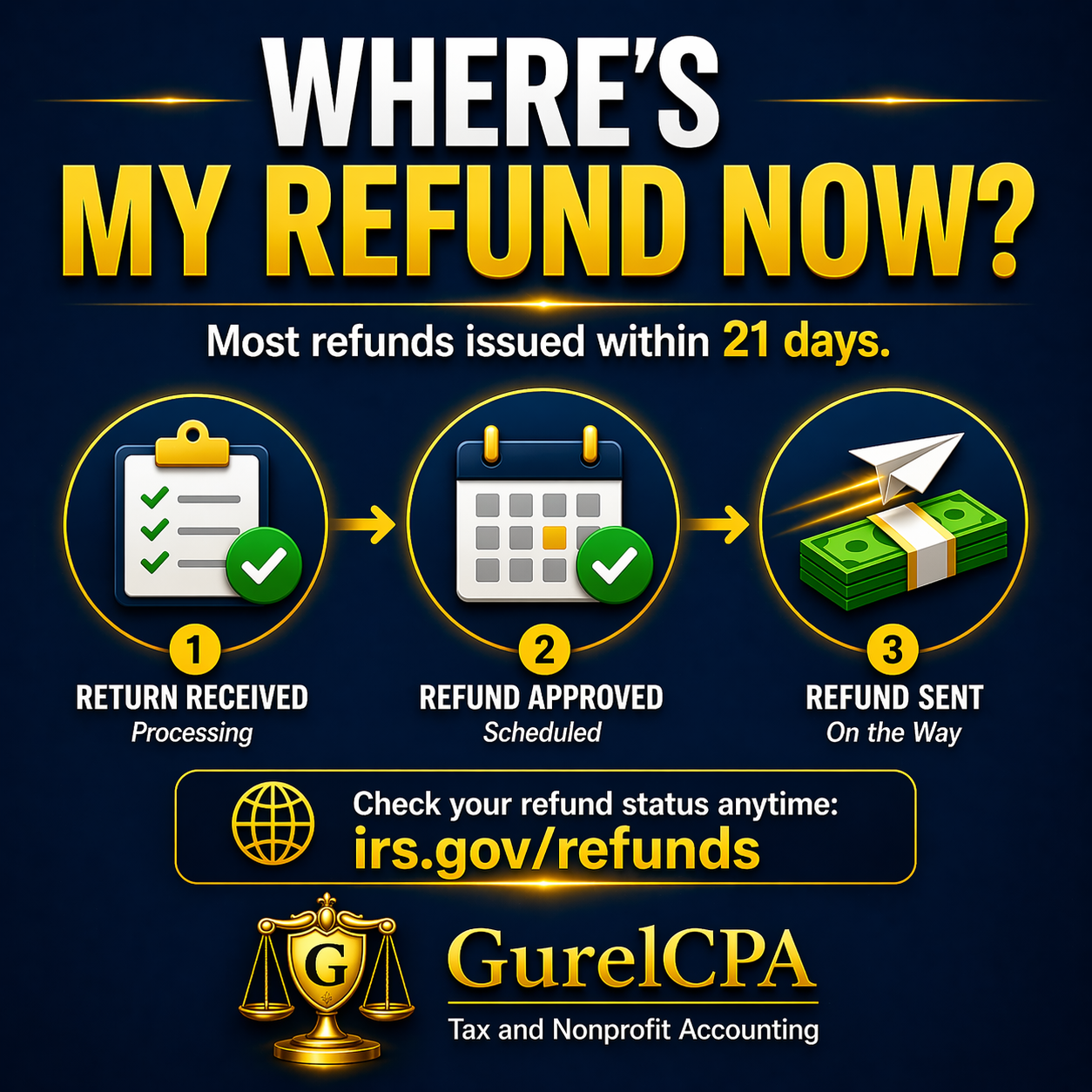
Where’s My Refund? What Taxpayers Need to Know Right Now (2026 Update)
If you’re still waiting on your tax refund, you’re not alone. “Where’s my refund?” remains one of the most searched tax questions after filing season—and for good reason.
The IRS continues to process millions of returns, and while most refunds are issued on time, delays are more common than many taxpayers expect.
Here’s what to know right now.
How the IRS “Where’s My Refund?” Tool Really Works
The IRS refund tracker updates once per day (usually overnight) and shows one of three statuses:
- Return Received — Your return is in the system and being processed
- Refund Approved — Your refund has been finalized and scheduled
- Refund Sent — The IRS has issued your refund
If you chose direct deposit, funds typically arrive within a few business days after the “sent” status.
How Long Should a Refund Take in 2026?
- 21 days is still the standard timeline for most electronically filed returns
- Many refunds arrive faster—but not all
- Paper-filed returns take significantly longer
If you’re within 21 days of e-filing, the IRS will not take action on your inquiry.
Why Refund Delays Are More Common Than You Think
- Errors or missing information
- Identity verification reviews
- EIC or Additional Child Tax Credit claims
- Income mismatches with IRS records
- Bank account or direct deposit issues
Watch for IRS Letters
If the IRS needs additional information, they will contact you by mail.
- Identity verification requests
- Requests to confirm income or credits
- Notices about refund adjustments
What If Your Refund Amount Changes?
- Credit recalculations
- Math corrections
- Marketplace Premium Tax Credit reconciliation
- Offsets for past-due debts
A Common Misunderstanding in 2026
Refund amounts may change due to income, withholding, credits, or reconciliation items. A refund is not a bonus—it is your own money being returned.
When Should You Be Concerned?
- Less than 21 days since e-file → Wait
- Status says 'still processing' → Wait
- You receive an IRS letter → Act promptly
- Refund amount changes → Review carefully
The Bottom Line
Refund delays are frustrating—but often normal. If something doesn’t look right, it’s worth taking a closer look.
This article is for informational purposes only and does not constitute tax advice. Every situation is different. Please contact us directly to discuss your specific facts and circumstances. We offer a free consultation to help you move forward with confidence.
You Filed Your Taxes, Now What? 5 Next Steps
Filing your tax return is a big milestone—but it’s not the finish line.
In fact, what you do after you file can affect your refund, your risk of IRS issues, and even your taxes next year.
Here are five smart next steps most people miss after filing their taxes:
1. Track Your Refund (and Know What’s Normal)
If you’re expecting a refund, don’t just wait—track it. The IRS “Where’s My Refund?” tool is updated daily and can show if your return is received, approved, or sent.
Most refunds take up to 21 days, but delays are common due to identity verification, errors, or manual review. If it’s been more than 3–4 weeks, it may be time to look deeper.
2. Confirm Your Payment Went Through
If you owed taxes, verify that your payment actually processed. Check your bank account and IRS online account. Errors or duplicate payments can happen—especially with auto-withdrawals.
3. Watch Your Mail (and Email) for IRS Notices
The IRS may send identity verification letters, notices, or requests for additional information. Do not ignore IRS mail—even small issues are easier to fix early.
4. Save the Right Documents (Not Everything)
Keep your filed tax return (PDF), W-2s, 1099s, and key deduction records. The IRS accepts digital copies, so scanned PDFs are fine. Most records should be kept for at least 3 years.

5. Adjust for Next Year (This Is the Big One)
If your refund was too big—or you owed more than expected—it may be time to adjust withholding or plan for estimated payments. Planning now helps avoid surprises next year.
Final Thought
Filing your taxes is important—but what you do next can matter just as much. A few steps now can prevent issues, reduce stress, and put you in a better position for next year.
Need Help Reviewing Your Situation?
If you’re not sure whether everything was handled correctly—or want to plan ahead for next year—I’m happy to help.
Contact GurelCPA for a free consultation and let’s make sure you’re on the right track.
This article is for informational purposes only and should not be considered tax advice. Every situation is different. Please contact us directly for guidance specific to your circumstances
IRS Launches “Tax Debt Help” Tool — What to Do If You Owe
If you owe the IRS and aren’t sure what to do next, a new tool can help you evaluate your options — before taking action.
The IRS recently released its Tax Debt Help tool, which walks taxpayers through possible solutions based on their situation — without requiring personal information.
Why Acting Early Matters
Delaying can get expensive:
• Failure-to-pay penalty: 0.5% per month (up to 25%)
• Failure-to-file penalty: 5% per month
• Interest: compounds daily
File your return even if you can’t pay.
What the Tool Does
• Helps you understand IRS payment options
• Guides you based on your financial situation
• Lets you explore privately (no SSN required)
It’s a starting point, not a solution.
Your Main Options
Short-Term Plan (≤180 days)
• No setup fee
• Balance under $100,000
Installment Agreement
• Monthly payments over time
• Typically under $50,000
Offer in Compromise
• Settle for less (if qualified)
Hardship Status
• Temporary pause on collections

Key Requirement
All tax returns must be filed first.
Bottom Line
The new IRS tool makes it easier to understand your options — but choosing the right strategy still matters.
The wrong approach can cost more in interest and delay resolution.
Tax Debt Tool Link: https://www.irs.gov/payments/get-help-with-tax-debt
Need Help?
If you owe the IRS and want to handle it the right way the first time, let’s talk.
Free consultation available.
This article is for informational purposes only and does not constitute tax advice.
Every situation is different. Please contact us directly to discuss your specific facts and circumstances.

Is the IRS Holding Your Refund?
If you’ve already filed your tax return and are waiting for your refund, you’re not alone in asking: “Why is it taking so long?” or “Did I do something wrong?”
The truth is, not all delays are the same—and in 2026, more refunds are being reviewed, adjusted, or even reduced than many taxpayers expect.
Here are the most common reasons the IRS may be holding your refund—and what you should do about it.
1. Refund Offsets (Your Refund Was Applied to a Debt)
This is one of the most surprising and frustrating situations. Even if your return is processed quickly, your refund may be reduced or completely taken through a process called an offset.
What Is a Refund Offset?
A refund offset happens when the government uses your tax refund to pay certain outstanding debts.
Common reasons include:
- Past-due federal or state taxes
- Student loan debt (in default)
- Child support arrears
- Other federal debts
Instead of receiving your refund, it is applied to the balance you owe.
How You’ll Know
If your refund is offset, you will typically receive a notice explaining:
- The amount of the original refund
- The amount applied to the debt
- The agency that received the payment
Important Tip: the IRS does not control all offsets. If you disagree, you must contact the agency that received the funds.
2. Bank or Direct Deposit Issues
Sometimes the delay isn’t the IRS: it’s the delivery.
Common issues:
- Incorrect bank account or routing number
- Closed or inactive account
- Name mismatch on the account
If direct deposit fails, the IRS may eventually issue a paper check, but this will add weeks.
Is the IRS Holding Your Refund? Continued
3. Amended or Complex Returns
If you filed an amended return (Form 1040-X) or a complex return, processing times increase significantly.
Amended returns can take 12–16 weeks or longer.
4. Errors or Missing Information
Simple issues can slow things down:
- Math errors
- Missing forms
- Incorrect Social Security numbers
- Filing status inconsistencies
The IRS may correct the return or request clarification.
5. Identity Verification Is Required
The IRS may require identity verification before releasing your refund.
Common letters:
- 5071C
- 4883C
Until completed, your refund will not be issued.
6. Your Return Is Under IRS Review
The IRS may pause refunds for additional review due to mismatches, credits, or unusual changes.
What Should You Do Right Now?
- Check Where’s My Refund
- Watch your mail
- Respond promptly
- Don’t file a second return
Need Help Figuring It Out?
If your refund is delayed, reduced, or offset, I can help you understand what’s happening.
Questions? Let’s Talk. Free consultation available.
This article is for informational purposes only and should not be considered tax advice. Please contact GurelCPA directly for personalized guidance.
U.S. Tax Filing When You’re Affected by Armed Conflict
What Americans Overseas Need to Know
The United States taxes its citizens on their worldwide income, regardless of where they live.
Even during times of political instability or armed conflict, most Americans overseas must still file a U.S. tax return. However, the IRS does recognize that conflicts and emergencies can disrupt normal life, and there are special rules and relief provisions that may apply.
Americans Overseas Still Have Filing Requirements
If you are a U.S. citizen or resident alien living abroad, you generally must file a federal income tax return if your income exceeds the normal filing thresholds.
This applies even if:
• You live in a country experiencing armed conflict
• Your income is earned entirely outside the United States
• You plan to exclude income using the Foreign Earned Income Exclusion (FEIE) or claim a Foreign Tax Credit
In most cases, the IRS still requires a return to be filed in order to claim those benefits.
Automatic Filing Extensions for Americans Abroad
Americans living outside the United States automatically receive a two‑month extension to file their tax return.
Instead of the usual April 15 deadline, taxpayers abroad typically have until June 15 to file. Interest still accrues on unpaid tax after April 15, but the filing deadline itself is extended.
Additional extensions can be requested if needed.
Questions? Let’s Talk.
If you have questions about U.S. tax filing requirements while living abroad or during periods of political instability or armed conflict, please contact us for a free consultation to discuss your specific situation.
This article is for informational purposes only and should not be considered tax advice. Every taxpayer’s situation is unique, especially for Americans living overseas.

Special IRS Relief for Conflict Zones
When armed conflicts significantly disrupt a region, the IRS sometimes announces special tax relief for affected taxpayers.
This relief may include:
• Extended filing deadlines
• Extended payment deadlines
• Waiver of certain penalties
• Additional time for compliance with reporting requirements
Each situation is different, and relief is usually announced on a case‑by‑case basis.
Combat Zone Rules for Military Personnel
Separate rules apply to members of the U.S. Armed Forces serving in designated combat zones.
Military personnel may receive:
• Extended tax filing deadlines
• Exclusion of certain combat pay from taxable income
• Suspension of certain IRS deadlines during deployment
These provisions are designed specifically for active military service members and typically do not apply to civilians living in the same region.
If Conflict Has Disrupted Your Records
In many conflict situations, taxpayers may lose access to financial records, bank statements, or employment documents.
If this happens, the IRS generally allows taxpayers to:
• Reconstruct income records
• Request copies from financial institutions
• File amended returns later if necessary
The most important step is to stay compliant with filing requirements whenever possible.
New $6,000 Senior Deduction Offers Major Tax Relief for Older Americans
A significant change in federal tax law is set to benefit many Americans age 65 and older beginning with the 2025 tax year (filed in 2026). A new federal deduction of up to $6,000 is now available to qualifying seniors, potentially reducing taxable income and overall tax liability.
What is the $6000 Senior Deduction?
Eligible taxpayers age 65 or older may claim an additional federal deduction of up to $6,000 on their income tax return. This deduction is available in addition to the standard deduction or itemized deductions.
Who Qualifies?
• Taxpayers who are age 65 or older by the end of the tax year
• Married couples may qualify for up to $12,000 if both spouses are age 65 or older
• Must have a valid Social Security number
• Subject to income phase‑out limits

Income Phase-Outs
The deduction begins to phase-out based on modified adjusted gross income (MAGI):
• Single filers: phase‑out begins at $75,000
• Married filing jointly: phase‑out begins at $150,000
Higher‑income taxpayers may see a reduced or eliminated benefit.
Why This Matters
This deduction may significantly lower taxable income for seniors and, in some cases, reduce the amount of Social Security benefits subject to tax. It may also help retirees stay in a lower tax bracket.
Questions? Let's Talk!
The article is meant for informational purposes only. Please contact me directly to discuss how this applies to your individual tax situation.

More Languages, Better Access: Tax Help with the IRS Alternative Media Center
Most taxpayers think of the IRS as forms, deadlines, and notices—but not accessibility.
What many people don’t realize is that the IRS has an entire division dedicated to making tax information easier to understand and more widely available: the Alternative Media Center (AMC).
For taxpayers who need or prefer information in different formats or languages, this resource can be incredibly valuable.
WHAT IS THE IRS ALTERNATIVE MEDIA CENTER?
The IRS Alternative Media Center is designed to make tax information accessible to a broader audience.
It provides tax forms, publications, and educational materials in multiple formats and languages, helping taxpayers who may have visual impairments, language barriers, or different learning preferences.
The goal is simple: make sure everyone has access to the information they need to meet their tax obligations.
WHAT TYPES OF MATERIALS ARE AVAILABLE?
The AMC offers IRS forms and publications in alternative formats, including:
- Text-only versions
- Braille-ready files
- Large print documents
- Accessible PDFs
- Browser-friendly HTML formats
These formats are designed to work with assistive technologies such as screen readers and voice recognition software.
Taxpayers can also request IRS notices in formats such as Braille, large print, audio, or electronic delivery by submitting Form 9000 (Alternative Media Preference).
WHAT ABOUT DIFFERENT LANGUAGES?
The IRS continues to expand access for multilingual taxpayers.
Many materials are available in:
- Spanish
- Chinese (Simplified and Traditional)
- Korean
- Vietnamese
- Russian
- Haitian Creole
And more languages continue to be added over time.
IRS VIDEOS AND VISUAL CONTENT
The IRS also produces educational videos, including a library of American Sign Language (ASL) content covering topics like tax credits, refunds, identity protection, and filing requirements.
WHO SHOULD BE PAYING ATTENTION TO THIS?
This resource can be useful for:
- Taxpayers who prefer information in their native language
- Seniors who benefit from large print materials
- Individuals who learn better through video or audio
- Nonprofits serving diverse communities
- Tax professionals working with multilingual clients
WHY THIS MATTERS
Clear and understandable information leads to better decisions—and fewer mistakes.
For nonprofits, international taxpayers, and underserved communities, this can make a meaningful difference.
HOW TO ACCESS THESE RESOURCES
Taxpayers can download materials from IRS.gov, request alternative formats, set preferences for future notices, or contact the IRS Accessibility Helpline.
This article is for informational purposes only. Please contact me directly to discuss how this applies to your individual tax situation. I offer a free consultation and would be happy to help.

What Does "Automatic" Really Mean?
You do not need to file a specific form or call the IRS to "prove" you deserve the extra time. That isn't the case here.
- No Paperwork Required: The IRS computer systems automatically identify taxpayers located in the covered disaster area and apply filing and payment relief.
- Payment is Included: Unlike a standard extension (which only gives you more time to file), a disaster extension typically applies to both filing and payment. This means you have until May 1 to pay any balance due without facing late fees.
- Applies to Estimates & IRAs: This relief also extends to your 2026 first-quarter estimated tax payments and your 2025 contributions to IRAs and Health Savings Accounts (HSAs).
Why You Shouldn't Rush
If you live in one of these counties, rushing to meet the April 15th date can lead to overlooked deductions or simple data-entry errors.
With the new tax provisions affecting tips and overtime this year, taking that extra time can ensure your return is accurate and your refund is maximized.
The Bottom Line
Don't let the April 15th calendar date cause unnecessary stress if you reside in a disaster-declared zone. You have the legal right to that extra time—use it to ensure your filing is handled correctly.
The article is meant for informational purposes only. Please contact me directly to discuss how this applies to your individual tax situation.
You Already Have an Automatic IRS Extension if you live in an IRS Disaster Zone
As the April 15th deadline approaches, the annual "tax panic" is in full swing. However, for many taxpayers in Washington, Montana, and Alaska, there is a good chance you are rushing unnecessarily.
Due to recent federal disaster declarations, the IRS has granted automatic extensions to millions of taxpayers. If you live or own a business in a designated county, your deadline has already been pushed back to May 1, 2026.
The most important thing to understand? You do not have to be "personally" impacted by the disaster to qualify. If your address of record is in a covered county, the extension is yours automatically.
Is Your County on the List?
The IRS provides this relief to entire regions to ensure that the community has time to recover without the added stress of a tax deadline. Below are the areas currently granted an automatic extension to May 1, 2026:
State Covered Counties & Regions
Washington:
17 Counties, including King, Pierce, Snohomish, Skagit, and Whatcom
Montana:
Carbon and Stillwater Counties, plus the Blackfeet Indian Reservation
Alaska:
Specific regions designated following the remnants of Typhoon Halong
Not sure if your specific location is covered?
We stay on top of every IRS notice so you don't have to. At Gurelcpa.com, we can verify your status and help you navigate the nuances of disaster-related tax relief.
Stop the rush and reach out to us today for a clear, professional guidance.
The IRS Is Targeting FBAR Non-Filers and Technology is Helping Them
Many taxpayers assume that if no tax is due, there is nothing to worry about. That assumption can be costly when it comes to the FBAR.
The Foreign Bank Account Report (FinCEN Form 114) is not a tax return. There is no tax calculated and no payment submitted. It is simply an information report. But the penalties for failing to file can be significant, and the IRS has made FBAR non-filers an explicit enforcement priority.
Why the FBAR Exists
The FBAR requirement comes from the Bank Secrecy Act and is designed to combat money laundering, terrorist financing, tax evasion, and other illicit financial activity.
It gives the U.S. government visibility into foreign financial accounts held by U.S. persons.
If your foreign accounts exceed $10,000 in total at any point during the year even for one day, an FBAR is required.
The IRS Has Publicly Elevated FBAR Enforcement
In recent compliance strategy announcements, the IRS has specifically identified offshore reporting and FBAR non-filers as focus areas.
With increased funding and renewed attention to high-balance foreign accounts, offshore compliance is now part of the IRS’s active enforcement agenda.
This article is for informational purposes only and does not constitute tax advice. Every taxpayer’s situation is unique. Contact me directly to discuss your specific circumstances.

Technology Has Changed the Risk
Foreign financial institutions report account data under FATCA. International information-sharing agreements are widespread. The IRS uses advanced data analytics to identify mismatches and potential non-filers.
In many cases, the government already has access to the underlying account information.
The Penalties and the Six-Year Lookback
There is a six-year statute of limitations for assessing FBAR penalties. That means the government can review up to six years of potential non-compliance.
Penalties can apply even when the failure was non-willful. Willful violations carry much more severe consequences.
The filing itself is generally straightforward. The penalties are not.
There Is a Way to Correct Past Non-Filing
Questions? Let’s Talk.
If you have foreign accounts and want to ensure you are fully compliant — or need to file back FBARs — contact me for a confidential strategy call to determine the best path forward.
What About Self-Employed Retirement Plans?
If you are self-employed, certain plans allow contributions after year-end:
- SEP-IRA: Contributions can typically be made up to the tax filing deadline, including extensions.
- Solo 401(k): Employee deferrals must be elected by year-end, but employer contributions can be made up to the filing deadline.
Contribution Limits Still Apply
Even though you have extra time, the annual contribution limits do not change.
Important: Designate the Correct Tax Year
When making a contribution between January 1 and April 15, you must tell the custodian which year the contribution is for.
Why This Matters
This strategy can be especially valuable if:
- Your income was higher than expected last year
- You owe more tax than anticipated
- You want to boost retirement savings while reducing taxes
Final Thought
Too often, taxpayers assume tax planning ends on December 31. In reality, there’s still a window of opportunity—and IRA contributions are one of the easiest ways to take advantage of it.
Questions? Let’s Talk.
Please contact me directly to discuss how this applies to your individual tax situation. I offer a free consultation to review your options and help you make the most of available tax strategies.
Still Time to Lower Your Taxes: IRA Contributions Before April 15
Many taxpayers think the opportunity to reduce last year’s tax bill ended on December 31. That’s not always true.
If you haven’t fully funded your retirement account, you may still have time to make a contribution up to April 15 and have it count for the prior tax year.
That’s one of the most overlooked tax planning opportunities available.
How It Works
The IRS allows certain retirement contributions made between January 1 and April 15 to be designated for the previous tax year.
For example: A contribution made on March 20 can still count as a prior-year IRA contribution—as long as you clearly designate it that way with your financial institution.
This can:
- Reduce your taxable income (Traditional IRA)
- Increase tax-free retirement savings (Roth IRA)
- Potentially improve eligibility for other tax benefits
Which Retirement Accounts Qualify?
This rule primarily applies to Individual Retirement Accounts (IRAs):
Eligible:
- Traditional IRA
- Roth IRA
Not Eligible:
- Employer plans like 401(k), 403(b), 457 plans
The article is meant for informational purposes only. Please contact me directly to discuss how this applies to your individual tax situation.

What You Need to Do (Now)
If you’ve been relying on paper checks, this is your next step:
• Set up direct deposit (routing number, account number, account type)
• Provide accurate information when filing
• Double-check everything before submitting your return
No Bank Account?
You still need an electronic option. Consider a basic checking account or a prepaid debit card that accepts direct deposit.
The Bottom Line
Paper refund checks are no longer something you can rely on.
If you want your refund faster, more securely, and without delays—you must use direct deposit.
Questions? Let’s Talk
If you’re unsure how to set up direct deposit, I can help.
Please contact me directly to discuss your specific tax situation. I offer a free consultation.
IRS Has Ended Most Paper Refund Checks, Your Action is Required
If you’ve been receiving your tax refund by paper check, this is important:
The Internal Revenue Service has effectively moved away from issuing paper refund checks in most situations.
Today, direct deposit is the standard—and in most cases, expected—method for receiving your refund.
If you have not already made this change, you need to take action now to avoid delays or complications.
What This Means for You
If you file your tax return without direct deposit information, you may run into real problems:
1. Your Refund May Be Delayed
Electronic refunds are processed quickly. Returns without direct deposit can face additional handling—and slower processing.
2. Paper Checks Are Now Limited
Paper checks are no longer the default option. They are generally issued only in limited exception situations, not by choice.
3. Higher Risk of Issues
If a check is issued, it can be lost, stolen, sent to an outdated address, and take weeks—or longer—to resolve.
The article is meant for informational purposes only. Please contact me directly to discuss how this applies to your individual tax situation.

What Happens If You Don’t Pay?
If you wait until you file your tax return in April of the following year, you may owe an underpayment penalty.
This is essentially interest charged by the IRS for paying too late—even if you file and pay in full.
How to Avoid the Penalty
You can generally avoid penalties if you pay:
- At least 90% of your current year tax, or
- 100% of your prior year tax (110% for higher-income taxpayers)
A Simple Rule of Thumb
Looking for a suggestion of where to start. For most self-employed/gig workers, a good guide is 25% to 30% of their net income for taxes.
This isn’t exact, but it’s a good starting point.
This article is for informational purposes only and does not constitute tax advice. Every taxpayer’s situation is unique.
Gig Workers: Do You Need to Make Quarterly Tax Payments?
If you’re new to self-employment, there’s one issue that catches almost everyone off guard: no taxes are being withheld from your income.
But the IRS wants to start collecting the tax bill that you are accumulating throughout the year as you owe it. It’s like they think, “Once you owe it, it’s ours.”
That means it’s up to you to pay your taxes throughout the year.
Why Quarterly Payments Matter
When you work for an employer, taxes are withheld automatically. As a self-employed person: no automatic withholding.
You are responsible for paying your own taxes as you earn income.
What Are Quarterly Estimated Payments?
The IRS expects you to pay taxes throughout the year, not just in April. These payments are typically due the last day of April. June, September, and January (following year)
They cover what you owe for Income tax and Self-employment tax (Social Secuity & Medicare - 15.3%)
Bottom Line
If you’re earning income without withholding, you likely need to make quarterly payments.
Questions? Let’s Talk.
Please contact me directly to discuss how this applies to your individual tax situation. I offer a free consultation to help you get started the right way.
The Part That Surprises Most Gig Workers: Self-Employment Tax
In addition to income tax, you also pay self-employment tax. This covers Social Security and Medicare. The rate is 15.3% on your net business income.
This is separate from your regular income tax. When you work for an employer, they pay half of these taxes for you. When you’re self-employed, you pay both halves.
How Profit Is Calculated
Here’s a simple example:
- You earn: $50,000
- You have expenses: $20,000
- Your net income: $30,000
You are taxed on $30,000, not $50,000.
Where That Profit Shows Up
Your net income from Schedule C flows directly into your Form 1040. It becomes part of your total taxable income, just like wages from a job.
Why Expenses Matter
Your business expenses directly reduce the amount of income you are taxed on. So, the more accurately you track and report your expenses, the lower your taxable income may be.
We’ll go into detail on what counts as a business expense in a follow-up article—but for now, just know: expenses reduce your profit, and your profit is what gets taxed.
Gig Workers: You’re Taxed on Net Profit, Not Gross Income
If you’re new to self-employment—whether driving, freelancing, consulting, or selling online—your taxes work very differently from a traditional job.
One of the most important things to understand is you are not taxed on your total income. You are taxed on your profit.
Schedule C: Where Your Business Income Is Reported
Most gig workers report their business activity on Schedule C, which is filed with your individual tax return (Form 1040).
On Schedule C, you report your total income (what you were paid) and your business expenses. The difference between those two is your net income, also called your profit.
The Bottom Line
You’re taxed on what you keep—not what you earn.
But you are responsible for Income tax and Self-employment tax (15.3%). And both are based on your net income.
Questions? Let’s Talk
Starting out as a gig worker can feel overwhelming, but getting the basics right makes a big difference.
Please contact me directly to discuss how this applies to your individual tax situation. I offer a free consultation to help you get started the right way.
The article is meant for informational purposes only. Please contact me directly to discuss how this applies to your individual tax situation.

Retirement Income Is Fully Taxable Under Standard Rules
Distributions from retirement accounts are treated the same way they would be in the U.S.:
- Traditional IRA and 401(k) withdrawals are generally taxable
- Pension income is typically taxable
- Required Minimum Distributions (RMDs) still apply
There is no special exclusion simply because you live overseas.
Important: This Income Does NOT Qualify for the Foreign Earned Income Exclusion
The Foreign Earned Income Exclusion (FEIE) applies only to earned income, such as wages and self-employment income.
It does not apply to Social Security, pensions, IRA or 401(k) distributions, or investment income. If you are retired, FEIE generally does nothing to reduce your U.S. tax liability
Common Misconception
“I live overseas now, so my retirement income isn’t taxable in the U.S.”
This is incorrect. Your U.S. tax obligations on retirement income remain largely unchanged.
Questions? Let’s Talk.
If you’re living abroad — or planning to — and want clarity on how your retirement income will be taxed, I can help you understand your obligations and avoid surprises.
Contact GurelCPA for a tax strategy session; let’s make sure your retirement tax strategy is handled correctly.
Living Abroad in Retirement? Your U.S. Taxes Don't Change
Many U.S. taxpayers assume that once they move overseas — especially in retirement — their U.S. tax obligations will decrease or even disappear.
Unfortunately, that’s not how it works.
If you’re a U.S. citizen living abroad, your retirement income and Social Security are generally taxed the same as if you were living in the United States.
U.S. Taxes Follow You — Even in Retirement
That means the following are still subject to U.S. tax rules:
- Social Security benefits
- Pension income
- IRA distributions
- 401(k) withdrawals
Living overseas does not change how these types of income are taxed by the U.S.
Social Security Is Still Taxable
Many retirees are surprised to learn that Social Security benefits can still be taxable — even while living abroad.
The same rules apply as if you were living in the U.S. Depending on your total income, up to 85% of your Social Security benefits may be taxable
Your location does not change this calculation.
Bottom Line
- U.S. citizens abroad are taxed on retirement income just like U.S. residents
- Social Security may still be taxable (up to 85%)
- Retirement distributions remain taxable under standard rules
- The Foreign Earned Income Exclusion does not apply
This article is for informational purposes only and does not constitute tax advice. Every taxpayer’s situation is unique. Please contact GurelCPA directly to discuss your specific circumstances and receive personalized guidance.
Charity Bunching: A Smart Tax Strategy for Charitable Donors
Many taxpayers give to nonprofits every year because they believe in supporting organizations whose missions match their values. What many people do not realize is that the timing of those donations can affect the tax benefit they receive.
For 2026, changes to the standard deduction, charitable contribution rules, the SALT deduction and the enhanced deduction for seniors make charitable planning especially important. A strategy called “charity bunching” can still help some taxpayers make their giving more tax-efficient.
What Is Charity Bunching?
Charity bunching means concentrating two or more years of charitable contributions into a single tax year. The goal is to push itemized deductions high enough to exceed the standard deduction in the bunching year, then take the standard deduction in one or more following years.
The strategy does not necessarily mean giving less to charity. It changes when the contribution is made for tax purposes.
The 2026 Standard Deduction Is Higher
For 2026, the basic standard deduction is:
- $16,100 for single filers and married individuals filing separately
- $32,200 for married couples filing jointly
- $24,150 for heads of household
Taxpayers generally compare these amounts with their allowable itemized deductions, including state and local taxes, mortgage interest, charitable contributions and certain medical expenses.
A New Charitable Deduction for Taxpayers Who Do Not Itemize
Beginning in 2026, taxpayers who take the standard deduction may still be able to deduct qualifying cash charitable contributions of up to $1,000, or $2,000 for married couples filing jointly.
That is an important change. It means that saying charitable contributions provide no federal tax benefit to a non-itemizer is no longer generally accurate. However, the new deduction is limited. Taxpayers who give substantially more than $1,000 or $2,000 may still benefit from planning that allows them to itemize in selected years.
The $40,400 SALT Cap Changes the Calculation
The federal deduction for state and local taxes, commonly called the SALT deduction, is capped at $40,400 for 2026 ($20,200 for married taxpayers filing separately), subject to an income-based limitation.
For taxpayers with substantial state income, sales or property taxes, the higher SALT cap may make it easier to reach the itemizing threshold. For others, particularly taxpayers with modest SALT deductions or little mortgage interest, bunching charitable contributions may still be necessary before itemizing produces a meaningful benefit.
There Is Also a New 0.5% AGI Floor for Itemized Charitable Contributions
Beginning in 2026, taxpayers who itemize generally deduct charitable contributions only to the extent their contributions exceed 0.5% of adjusted gross income (AGI).
For example, if a taxpayer has $100,000 of AGI, the 0.5% floor is $500. This new floor is another reason the timing and size of charitable contributions can matter. Concentrating contributions into one year may help produce a larger usable deduction than spreading the same giving evenly over several years.
Example: A Married Couple
Suppose a married couple has $18,000 of deductible state and local taxes, $7,000 of mortgage interest and normally gives $5,000 to charity each year.
Before applying the new charitable contribution floor, their deductions total $30,000. Their 2026 standard deduction is $32,200, so they would generally use the standard deduction instead of itemizing. If their cash gifts qualify, they may also receive up to the $2,000 non-itemizer charitable deduction.

Now suppose they bunch two years of giving and contribute $10,000 in one year. Their deductions before applying the 0.5% AGI charitable floor would total $35,000. Depending on their AGI and other limitations, itemizing may now produce a larger deduction than taking the standard deduction.
The exact benefit must be calculated using the taxpayer’s actual AGI because of the new 0.5% charitable contribution floor.
What About the $6,000 Senior Deduction?
Taxpayers age 65 or older may qualify for a separate enhanced senior deduction of up to $6,000 per eligible individual for 2025 through 2028. A married couple in which both spouses qualify could receive up to $12,000.
The deduction begins to phase out when modified adjusted gross income exceeds $75,000 for a single taxpayer or $150,000 for a married couple filing jointly.
An important distinction is that the enhanced senior deduction is available to qualifying taxpayers whether they itemize or take the standard deduction. Therefore, it should not simply be added to the standard deduction when deciding whether itemized deductions exceed the standard deduction.
For senior donors, the bunching decision should instead compare the standard deduction plus any available non-itemizer charitable deduction with allowable itemized deductions. The separate senior deduction can then be considered in the overall tax calculation.
Using a Donor-Advised Fund
One practical concern with bunching is that nonprofits often depend on steady annual support. A donor-advised fund (DAF) can help separate the timing of the tax deduction from the timing of grants to charities.
A donor might contribute several years of planned charitable giving to a donor-advised fund in the bunching year, subject to the applicable tax rules, and then recommend grants from the fund to favorite nonprofits over the following years.
This can allow the donor to maintain regular support for nonprofits while concentrating the charitable contribution for tax purposes.
Who Should Consider Charity Bunching in 2026?
Charity bunching may be worth examining for taxpayers who:
- Give regularly to qualified charitable organizations
- Have itemized deductions that are relatively close to the standard deduction
- Have moderate SALT and mortgage-interest deductions
- Expect unusually high income or deductions in a particular year
- Want to use a donor-advised fund to maintain regular charitable support
It may be less useful for taxpayers who already itemize by a wide margin every year, or whose giving is small enough that the new non-itemizer charitable deduction provides most of the available benefit.
Final Thoughts
Charity bunching remains a useful planning strategy in 2026, but the calculation has changed. The new deduction for charitable contributions by non-itemizers, the higher standard deduction, the $40,400 SALT cap, the 0.5% AGI floor for itemized charitable contributions and the enhanced senior deduction all need to be considered together.
For regular donors, the question is no longer simply whether to itemize. The better question may be: Which years should I itemize, which years should I take the standard deduction, and when should I make my charitable contributions to get the greatest tax benefit while supporting the organizations I care about?
The article is meant for informational purposes only. Please contact me directly to discuss how this applies to your individual tax situation.
New to the United States?
Understanding the Basics of the U.S. Tax System
Moving to the United States can involve many adjustments, including learning how the U.S. tax system works. Many new residents are surprised to learn that the U.S. tax system operates differently than the systems used in many other countries.
The goal of this article is to explain some of the basic ideas behind U.S. taxes so that new residents can avoid confusion and stay compliant with the law.
The U.S. Tax System Relies on Self-Reporting
One of the biggest differences in the United States is that the tax system largely relies on self-reporting.
Taxpayers are generally responsible for reporting their income and determining their tax liability by filing a tax return. Employers and other payers may withhold taxes and report payments to the government, but taxpayers are still responsible for making sure their return is complete and accurate.
Whether an individual is required to file depends on factors such as tax residency, income, filing status, age, and the type of income received.
First Determine Your U.S. Tax Residency
For someone who is not a U.S. citizen, one of the first questions is whether the person is considered a resident or nonresident for U.S. tax purposes. Immigration status and tax residency are related, but they are not always the same.
Generally, a noncitizen is treated as a U.S. resident for federal tax purposes if the person meets either the green card test or the substantial presence test. Special rules, exceptions, tax treaties, and first-year or dual-status rules may also apply.
U.S. Tax Residents Generally Report Worldwide Income
U.S. citizens and resident aliens generally must report income from sources both inside and outside the United States. Nonresident aliens are subject to different rules and generally are taxed on certain U.S.-source income and income effectively connected with a U.S. trade or business.
For a U.S. citizen or resident alien, reportable foreign income can include:
- wages or self-employment income earned outside the United States
- rental income from property located abroad
- interest earned on foreign bank accounts
- dividends and other investment income from foreign sources
Foreign tax credits, exclusions, tax treaties, and other provisions may help prevent or reduce double taxation, but separate reporting requirements can still apply.
Foreign Accounts and Assets May Have Separate Reporting Requirements
A foreign bank account itself is not income. However, interest or other income earned through the account may have to be reported on a U.S. income tax return.
Foreign financial accounts and other foreign assets may also create separate reporting requirements. Depending on the facts, these can include the Foreign Bank Account Report (FBAR) and Form 8938, Statement of Specified Foreign Financial Assets. These reporting rules are separate from the requirement to report taxable income.

Filing a Tax Return
U.S. citizens and resident aliens generally use Form 1040 to file an individual federal income tax return. A nonresident alien who has a U.S. filing requirement generally uses Form 1040-NR.
For most calendar-year individual taxpayers filing Form 1040, the regular federal income tax return deadline is generally April 15. If the date falls on a weekend or legal holiday, the deadline may move to the next business day. Different filing deadlines and special rules can apply to nonresident aliens and taxpayers in other circumstances.
Having taxes withheld from wages does not necessarily eliminate the need to file a tax return.
Identification Numbers for Tax Filing
A taxpayer who files a U.S. tax return generally needs a valid taxpayer identification number.
Social Security Number (SSN)
An SSN is issued by the Social Security Administration and is generally available to U.S. citizens and certain noncitizens who are authorized to work in the United States.
Individual Taxpayer Identification Number (ITIN)
An ITIN is issued by the IRS to certain individuals who have a federal tax purpose but are not eligible for an SSN.
An ITIN allows an individual to comply with federal tax filing requirements, but it does not authorize employment or change a person's immigration status.
Keep Good Records
Keeping accurate records can make filing taxes much easier. Important records may include:
- wage statements, such as Form W-2
- forms reporting other income, such as Forms 1099
- records supporting deductible expenses or tax credits
- documentation of foreign income
- records relating to foreign financial accounts or assets, when applicable
Good recordkeeping can also make it easier to respond if the IRS asks questions about a tax return.
Please Share This Information
Most of the people who read this article may already understand the basics of the U.S. tax system. However, many people in our communities may still be learning how it works.
If you know someone who recently moved to the United States, or someone who may not be familiar with the U.S. tax system, please consider sharing this article with them. A little information at the right time can help someone avoid confusion, mistakes, or bad advice during tax season.
Questions? Let's Talk!
The article is meant for informational purposes only. Please contact me directly to discuss how this applies to your individual tax situation.

Does your Form 990 Tell Your Story?
For calendar-year filers, May 15 is the filing deadline for Form 990 and Form 990-EZ. And for many nonprofit organizations, filing the annual information return is treated as a compliance exercise. The form gets completed, submitted to the IRS, and filed away until next year.
But here is something many nonprofit leaders overlook: once filed, your organization’s Form 990 or Form 990-EZ becomes a public document available to donors, grantors, journalists, and the general public.
These filings are searchable directly through the IRS website and are also widely available through third-party nonprofit databases. That means your filing is not just a regulatory requirement. It is also one of the most visible public representations of your organization.
And for many nonprofits, that opportunity is not being fully used.
Many Filings Leave Important Information Undeveloped
As a CPA who works with nonprofit organizations, I regularly review publicly available Form 990 filings.
Many organizations are doing outstanding work in their communities. However, their filings often do not fully reflect the scope or impact of their programs.
Some common issues include:
• Mission statements that are very brief or generic
• Minimal descriptions of program accomplishments
• Important activities summarized in only a sentence or two
• Checklist questions answered incorrectly or inconsistently
• Financial information that does not clearly align with the organization’s financial statements
None of these issues usually indicate wrongdoing. In most cases, they simply reflect the fact that the Form 990 is treated as a compliance task rather than a strategic communication tool.
The Program Accomplishments Section Matters
One of the most important parts of the filing is Part III — Program Service Accomplishments.
This section gives an organization the opportunity to explain:
• What programs it operates
• Who benefits from those programs
• What outcomes or impact those programs produce
• How resources are being used to fulfill the mission
When this section is underdeveloped, readers are left with little understanding of the organization’s real work.
A thoughtful description, on the other hand, can clearly demonstrate impact and strengthen credibility with donors and grantors.
Your Form 990 Is Part of Your Public Profile
Today, nonprofit filings are widely available online and frequently reviewed by people researching organizations.
In addition to being searchable through the IRS website, Form 990 filings are also available through nonprofit databases such as Candid (formerly GuideStar), ProPublica’s Nonprofit Explorer, and Charity Navigator.
For many people researching a nonprofit, the Form 990 is one of the first documents they review.
A clear and informative filing can strengthen confidence in the organization.
A sparse or incomplete filing can leave important questions unanswered for donors, grantors, and the public.
A Good Time to Review Your Filing
As many organizations begin preparing their next Form 990 filing, this can be a useful time to take a fresh look at last year’s return.
Consider asking:
• Does our mission statement clearly describe what we do?
• Do our program descriptions accurately reflect the scope of our work?
• Are we communicating outcomes and impact effectively?
• Were the checklist questions answered carefully and completely?
• Does the financial information presented align with the organization’s financial statements?
A careful review before the next filing can help ensure the organization’s public record reflects the work it is truly doing.
From Compliance to Communication
For nonprofit organizations, transparency builds trust.
Your Form 990 is not just a required filing — it is also a chance to explain your mission, your programs, and your impact.
When prepared thoughtfully, it can serve as a valuable part of your organization’s public narrative.
Final Thoughts
If your organization files Form 990 or Form 990-EZ each year, it may be worth reviewing whether your filings fully communicate the scope and impact of your work. Also, don't forget the May 15, 2026 filing deadline.
Sometimes a few improvements in how information is presented can make a meaningful difference in how the organization is understood by donors, grantors, and the public.
If you would like assistance reviewing your organization’s Form 990 or Form 990-EZ filing, you are welcome to contact us for a free consultation.
This article is for informational purposes only and does not constitute tax or legal advice. Nonprofit reporting requirements vary depending on an organization’s structure and activities.
State and Local Tax (SALT) Deduction Increased to $40,000
What the New SALT deduction Limit Means for Taxpayers
One of the most significant recent changes to federal tax law is the increase in the State and Local Tax (SALT) deduction limit. Beginning with tax year 2025, the maximum SALT deduction increased to $40,000 per tax return for taxpayers who itemize deductions. Married taxpayers filing separately are limited to $20,000.
Income Limits Still Apply
For higher‑income taxpayers, the SALT deduction begins to phase down once income exceeds approximately $500,000.
As income rises further, the deduction gradually declines, potentially returning to the prior $10,000 limit.
Because of this phase‑out, the largest benefits will generally go to taxpayers below the highest income brackets.
This article is for informational purposes only and should not be considered tax advice.
What the Limit Used to Be Under the Tax Cuts and Jobs Act of 2017
The SALT deduction was capped at $10,000 per return ($5,000 for married filing separately).
This cap applied to the combined total of: state income taxes, local income taxes, and property taxes on real estate.
For taxpayers in states with higher income taxes or high property values, the $10,000 cap significantly reduced the benefit of itemizing deductions. The new legislation raises the cap to $40,000, effectively quadrupling the previous limit
Planning Opportunities
The increased SALT deduction may affect several tax planning decisions, including:
• Whether to itemize deductions
• Timing of state tax payments
• Planning for property tax payments
• Evaluating pass‑through entity tax elections for business owners
Because the new SALT rules interact with other federal tax provisions, taxpayers may benefit from reviewing their situation with a tax professional.
Who Benefits the Most?
The taxpayers most likely to benefit from the higher SALT deduction include:
• Homeowners with significant property taxes
• Taxpayers living in states with higher state income taxes
• Households whose itemized deductions exceed the standard deduction
Many taxpayers will still claim the standard deduction, which means the SALT deduction will not affect their return.
However, taxpayers who already itemize—particularly homeowners in higher‑tax areas—may see a meaningful reduction in their federal taxable income.
If you have questions about how the SALT deduction affects your tax return or your long‑term tax planning, please contact us at GurelCPA to schedule a free consultation to discuss your specific situation.
U.S. Tax Filing When You’re Affected by Armed Conflict
What Americans Overseas Need to Know
The United States taxes its citizens on their worldwide income, regardless of where they live.
Even during times of political instability or armed conflict, most Americans overseas must still file a U.S. tax return. However, the IRS does recognize that conflicts and emergencies can disrupt normal life, and there are special rules and relief provisions that may apply.
Americans Overseas Still Have Filing Requirements
If you are a U.S. citizen or resident alien living abroad, you generally must file a federal income tax return if your income exceeds the normal filing thresholds.
This applies even if:
• You live in a country experiencing armed conflict
• Your income is earned entirely outside the United States
• You plan to exclude income using the Foreign Earned Income Exclusion (FEIE) or claim a Foreign Tax Credit
In most cases, the IRS still requires a return to be filed in order to claim those benefits.
Automatic Filing Extensions for Americans Abroad
Americans living outside the United States automatically receive a two‑month extension to file their tax return.
Instead of the usual April 15 deadline, taxpayers abroad typically have until June 15 to file. Interest still accrues on unpaid tax after April 15, but the filing deadline itself is extended.
Additional extensions can be requested if needed.
Questions? Let’s Talk.
If you have questions about U.S. tax filing requirements while living abroad or during periods of political instability or armed conflict, please contact us for a free consultation to discuss your specific situation.
This article is for informational purposes only and should not be considered tax advice. Every taxpayer’s situation is unique, especially for Americans living overseas.
Special IRS Relief for Conflict Zones
When armed conflicts significantly disrupt a region, the IRS sometimes announces special tax relief for affected taxpayers.
This relief may include:
• Extended filing deadlines
• Extended payment deadlines
• Waiver of certain penalties
• Additional time for compliance with reporting requirements
Each situation is different, and relief is usually announced on a case‑by‑case basis.
Combat Zone Rules for Military Personnel
Separate rules apply to members of the U.S. Armed Forces serving in designated combat zones.
Military personnel may receive:
• Extended tax filing deadlines
• Exclusion of certain combat pay from taxable income
• Suspension of certain IRS deadlines during deployment
These provisions are designed specifically for active military service members and typically do not apply to civilians living in the same region.
If Conflict Has Disrupted Your Records
In many conflict situations, taxpayers may lose access to financial records, bank statements, or employment documents.
If this happens, the IRS generally allows taxpayers to:
• Reconstruct income records
• Request copies from financial institutions
• File amended returns later if necessary
The most important step is to stay compliant with filing requirements whenever possible.
Bona Fide Residence vs. Physical Presence:
How Do You Qualify for the Foreign Earned Income Exclusion?
Living overseas does not automatically qualify you for the Foreign Earned Income Exclusion (FEIE). To qualify, you generally must have foreign earned income, have your tax home in a foreign country, and meet either the Bona Fide Residence Test or the Physical Presence Test.
For 2026, the maximum FEIE is $132,900 per qualifying person. If you qualify for only part of the year, the maximum exclusion is generally prorated based on your qualifying days.
First Requirement: A Foreign Tax Home
Before either residence test matters, your tax home generally must be in a foreign country during your qualifying period. Your tax home is usually your regular or principal place of business, employment, or post of duty. Maintaining a home in the United States does not automatically disqualify you, but your family, economic, and personal ties can affect whether your abode remains in the United States.
Bona Fide Residence Test
The Bona Fide Residence Test focuses on whether you have established a genuine residence in a foreign country for an uninterrupted period that includes an entire tax year. For a calendar-year taxpayer, that means January 1 through December 31.
This is a facts-and-circumstances test. The IRS may consider the nature and length of your stay, your intention, your housing, family and community ties, and other evidence showing whether the foreign country has become your residence. A particular foreign resident or work visa is not specifically required under U.S. tax law, although you still must comply with the laws of the foreign country.
This test is often most relevant to long-term expatriates who establish an ongoing life and residence abroad. Brief or temporary trips to the United States do not necessarily end bona fide residence if you intend to return to your foreign residence without unreasonable delay.
Physical Presence Test
The Physical Presence Test is primarily a day-count test. You must be physically present in one or more foreign countries for at least 330 full days during any period of 12 consecutive months.
The 330 days do not have to be consecutive, and the 12-month period does not have to match the calendar year. This test is often useful for contractors, digital nomads, and taxpayers on temporary overseas assignments. Careful travel records are important because partial days and time spent outside a foreign country can affect the count.

Foreign Housing Exclusion or Deduction
Qualifying taxpayers may also be able to exclude or deduct certain foreign housing costs. The foreign housing exclusion generally applies to qualifying housing costs paid with employer-provided amounts, while self-employed taxpayers may qualify for a foreign housing deduction for costs paid from self-employment earnings.
Potential qualifying housing expenses can include:
- Rent
- Utilities other than telephone charges
- Property insurance
- Residential parking
- Certain occupancy taxes
For 2026, the base housing amount for a taxpayer qualifying for the full year is $21,264. The general maximum housing-expense limitation is $39,870, although the IRS allows higher limits for certain high-cost foreign locations. The housing exclusion is calculated before the FEIE, so the two benefits do not simply stack as separate unlimited exclusions.
Important for the Self-Employed: FEIE Does Not Eliminate Self-Employment Tax
This is an important distinction for Americans operating a business or working independently overseas. The FEIE can reduce regular U.S. income tax on qualifying foreign earned self-employment income, but the excluded income generally remains subject to U.S. self-employment tax. A totalization agreement with another country may affect Social Security coverage in some situations, but that is a separate analysis.
Claiming the Exclusion
The FEIE and the foreign housing exclusion or deduction are generally calculated on Form 2555 and filed with Form 1040. Choosing the FEIE can also affect other parts of the return. For example, you generally cannot claim a foreign tax credit for foreign taxes attributable to income you exclude, and special rules apply when calculating tax on income that remains taxable.
Why This Matters
A taxpayer can live abroad and still fail to qualify because the foreign tax home requirement is not met. Others may qualify but use the wrong residence test, miscount travel days, overlook housing benefits, or fail to document their foreign residence and travel carefully.
If you are living or working overseas, whether permanently or temporarily, we can review your situation to determine whether you qualify, which test applies, and whether the foreign housing exclusion or deduction may provide additional tax savings.
Questions? Let’s Talk.
The article is meant for informational purposes only. Please contact me directly to discuss how this applies to your individual tax situation.
What Counts as “Earned Income” for the Foreign Earned Income Exclusion?
Many U.S. taxpayers living abroad assume that if they qualify for the Foreign Earned Income Exclusion (FEIE), all of their income is excluded.
That is not correct.
The FEIE applies only to qualifying foreign earned income. Investment income, retirement income, and capital gains generally do not qualify. Understanding the distinction can prevent costly mistakes.
What Is Earned Income?
For FEIE purposes, earned income generally means compensation for personal services you perform in a foreign country. Examples include:
- Wages and salaries
- Bonuses and commissions
- Professional fees
- Tips
Business and self-employment income can also qualify, but special rules determine how much of business profit is treated as earned income.
Where You Perform the Work Matters
The source of earned income is generally determined by where you perform the services, not by where your employer is located or where you are paid. For example, compensation for work performed in France can be foreign earned income even if the employer is in the United States and the pay is deposited into a U.S. bank account.
What Is Not Earned Income?
The following types of income generally do not qualify for the Foreign Earned Income Exclusion:
- Interest from bank accounts and other investments
- Dividends from stocks and mutual funds
- Capital gains from stock, cryptocurrency, or real estate sales
- Social Security benefits
- IRA and 401(k) distributions
- Pension and annuity income
Living overseas does not convert passive or retirement income into earned income.
Rental Income Requires a Closer Look
Rental income should not automatically be treated as either earned or unearned income for FEIE purposes. The IRS classifies rents as variable income. Depending on the facts and the services you provide, rental income may be earned income, unearned income, or partly both.

Qualifying for the FEIE
Having foreign earned income by itself is not enough. To claim the FEIE, you must have a tax home in a foreign country and meet either the bona fide residence test or the physical presence test.
For 2026, the maximum Foreign Earned Income Exclusion is $132,900 per qualifying individual. The actual exclusion may be lower depending on the amount of foreign earned income and the portion of the year for which you qualify.
A Simple Example:
Assume a qualifying taxpayer living and working abroad earns:
- $110,000 in foreign wages
- $20,000 in dividends
- $15,000 in capital gains
The $110,000 of wages may qualify for the Foreign Earned Income Exclusion. The dividends and capital gains do not qualify for the FEIE and remain subject to the normal U.S. tax rules.
One Important Point for Self-Employed Taxpayers
A qualifying self-employed taxpayer may claim the FEIE on qualifying foreign earned self-employment income. However, the FEIE generally reduces regular U.S. income tax, not self-employment tax. A Social Security totalization agreement may affect the self-employment tax result in some countries.
The Bottom Line
The FEIE is based on income from services performed in a foreign country. It does not provide a blanket exclusion for all income simply because a U.S. taxpayer lives abroad.
The distinction between earned, unearned, and variable income can be especially important for taxpayers who have a combination of wages, self-employment income, investments, retirement income, or rental activity.
The article is meant for informational purposes only. Please contact me directly to discuss how this applies to your individual tax situation.
No Tax on Social Security: Really?
What’s Real and What’s Hype?
You may have seen headlines claiming there is now “No Tax on Social Security.” Sorry, but the IRS formula for taxing Social Security benefits has not changed. However, other recent tax changes may reduce overall taxes for some retirees, which can make it feel like Social Security is no longer being taxed.
The Key Point: Social Security Tax Rules Did Not Change
Social Security benefits are taxed under a formula that has existed for decades. Benefits become taxable depending on a taxpayer’s combined income, which includes Adjusted Gross Income, Nontaxable interest, and One-half of Social Security benefits.
If combined income exceeds certain thresholds, up to 85% of benefits can become taxable income. Those thresholds have not changed, and the formula itself remains in place today.
So Why Are People Hearing “No Tax on Social Security”?
Recent tax legislation created a new additional deduction of up to $6,000 for many taxpayers age 65 and older. The deduction is based on age, not on whether you receive Social Security benefits. Under current law, it is scheduled to apply only for tax years 2025 through 2028, and it begins to phase out for higher-income taxpayers.
The new senior deduction does not change the formula used to determine whether your Social Security benefits are taxable. Instead, it reduces your overall taxable income after that calculation is made. For many retirees, this results in a lower overall federal tax bill even though the Social Security tax rules themselves remain unchanged.
In other words, Congress did not repeal the tax on Social Security benefits. Instead, it created a new deduction that often reduces, and in some cases may eliminate, the federal income tax many seniors ultimately owe.
Who Will Actually See a Difference?
Many retirees already pay little or no federal income tax on their Social Security benefits. Those who rely primarily on Social Security and have only modest additional income often fall below the taxation thresholds already. For these households, recent tax changes may not significantly alter their situation because they already owed little or no tax.

The biggest impact is often felt by retirees whose income is just high enough to make part of their benefits taxable. For this middle-income group, tax relief provisions may lower overall taxable income enough to reduce their total tax bill, sometimes significantly.
Higher-income retirees, whose overall income remains well above the taxation thresholds, will generally continue to see much of their Social Security benefits treated as taxable income, although they may still receive some benefit before the deduction phases out.
Remember that even under current law, no more than 85% of your Social Security benefits can ever become taxable income. That does not mean an 85% tax rate. It simply means that up to 85% of your benefits may be included in taxable income and then taxed at your normal income tax rate.
The Reality Behind the Headlines
The phrase “No Tax on Social Security” oversimplifies what actually happened.
In practice: Social Security taxation rules remain unchanged.
Bottom Line
• Social Security taxation rules did not change.
• The new senior deduction may reduce your overall federal tax bill.
• The deduction is temporary under current law (2025–2028).
• The deduction phases out for higher-income taxpayers.
• Many seniors will pay less federal tax, but Social Security itself was not made tax-free.
This article is provided for general informational purposes only and should not be considered tax advice. Each taxpayer’s situation is unique. Please contact me directly to discuss how these rules apply to your individual tax situation and to schedule your free consultation.

Foreign Earned Income Exclusion vs. Foreign Tax Credit
For U.S. taxpayers living or working outside the United States, foreign income does not mean freedom from U.S. taxes. The U.S. tax system taxes citizens and resident aliens on worldwide income, regardless of where they live. Fortunately, the Internal Revenue Code provides two powerful tools to reduce or eliminate double taxation:
• The Foreign Earned Income Exclusion (FEIE)
• The Foreign Tax Credit (FTC)
While both are designed to prevent double taxation, they operate in fundamentally different ways — and choosing the wrong one can cost taxpayers thousands of dollars in unnecessary tax over time. Understanding the distinction between these two strategies is essential for proper international tax planning.
What Is the Foreign Earned Income Exclusion (FEIE)?
The Foreign Earned Income Exclusion allows qualifying taxpayers to exclude a portion of their foreign earned income from U.S. taxation entirely.
Key features of the FEIE include:
• Applies only to earned income (wages, salary, self-employment income)
• Does not apply to passive income (interest, dividends, rental income, capital gains)
• Requires meeting either a Bona fide residence test, or a Physical presence test
• Must be affirmatively elected by filing Form 2555
• For 2026, qualifying taxpayers may exclude up to $132,900 of foreign earned income. The exclusion amount is adjusted annually for inflation.
If a taxpayer qualifies, they may exclude foreign earned income from U.S. taxable income, reducing federal income tax. However, the FEIE generally does not eliminate U.S. self-employment tax unless a Totalization Agreement provides relief. This is one of the most commonly misunderstood aspects of the FEIE.
The Foreign Housing Exclusion and Deduction
Taxpayers who qualify for the Foreign Earned Income Exclusion may also qualify for the Foreign Housing Exclusion or Foreign Housing Deduction. These provisions allow certain qualified housing expenses incurred while living abroad to receive additional favorable tax treatment.
Depending on where a taxpayer lives, the housing benefit can substantially increase the overall tax savings beyond the basic Foreign Earned Income Exclusion. Both benefits are generally claimed on Form 2555.
When the FEIE Is Often More Advantageous
The FEIE is typically beneficial when:
• The taxpayer lives in a low-tax or no-tax country
• Foreign taxes paid are minimal or zero
• Income is primarily earned income
• The taxpayer wants to reduce adjusted gross income (AGI) for purposes such as: student loan repayment calculations, ACA subsidy calculations, Child Tax Credit thresholds, or phase-outs of deductions and credits
What Is the Foreign Tax Credit (FTC)?
The Foreign Tax Credit provides a dollar-for-dollar credit against U.S. tax for income taxes paid to a foreign country.
Key features of the FTC include:
• Applies to both earned income and passive income
• Claimed using Form 1116
• Credit is limited to the portion of U.S. tax attributable to foreign income
• Excess credits can often be carried forward for up to 10 years
• Works best when foreign tax rates are equal to or higher than U.S. tax rates
Rather than excluding income, the FTC allows the income to remain taxable in the U.S. but offsets U.S. tax liability with foreign taxes already paid.
You Cannot Double-Dip
Although taxpayers may qualify for both the Foreign Earned Income Exclusion and the Foreign Tax Credit, the same income generally cannot receive both benefits.
Foreign taxes paid on income excluded under the Foreign Earned Income Exclusion generally cannot also be claimed as a Foreign Tax Credit. However, foreign taxes paid on income exceeding the exclusion amount may still qualify for the credit. Determining the most advantageous combination often requires careful planning.
When the Foreign Tax Credit Is Often More Advantageous
The FTC is typically beneficial when:
• The taxpayer lives in a high-tax country
• Foreign tax rates exceed U.S. tax rates
• The taxpayer has passive income (investments, dividends, rental income)
• Long-term tax efficiency is a priority
• Retirement planning is a consideration
• Medicare tax and Social Security tax planning matter
In many high-tax jurisdictions, the Foreign Tax Credit often produces superior long-term results because unused foreign tax credits may generally be carried forward for up to ten years. By contrast, income excluded under the FEIE generally provides no future tax benefit once used.
A strategy that minimizes tax this year is not always the strategy that minimizes taxes over many years.
Common Mistakes
• Assuming that living outside the United States eliminates the requirement to file a U.S. tax return.
• Choosing the FEIE when the FTC would produce better long-term results.
• Believing the FEIE eliminates self-employment tax.
• Overlooking the Foreign Housing Exclusion or Housing Deduction.
• Forgetting that separate international reporting requirements, such as the FBAR and FATCA, may still apply.
Why the Wrong Choice Can Cost Thousands
Many taxpayers assume the Foreign Earned Income Exclusion is automatically the better choice because it excludes income from U.S. taxation. In reality, taxpayers living in higher-tax countries often achieve greater long-term tax savings by claiming the Foreign Tax Credit instead.
Choosing the right strategy requires looking beyond the current year's tax return and considering future income, retirement planning, and foreign tax credit carryovers.
Final Thoughts
The Foreign Earned Income Exclusion and the Foreign Tax Credit are both valuable tools for reducing double taxation, but they serve different purposes. There is no universal "best" choice. The right strategy depends on where you live, your foreign tax rate, your sources of income, and your long-term financial goals.
A decision that produces the lowest tax bill this year may not provide the greatest savings over the next five or ten years. Careful planning before filing a return can often save taxpayers thousands of dollars over time.
The article is intended for informational purposes only. Professional guidance is essential when making international tax planning decisions.