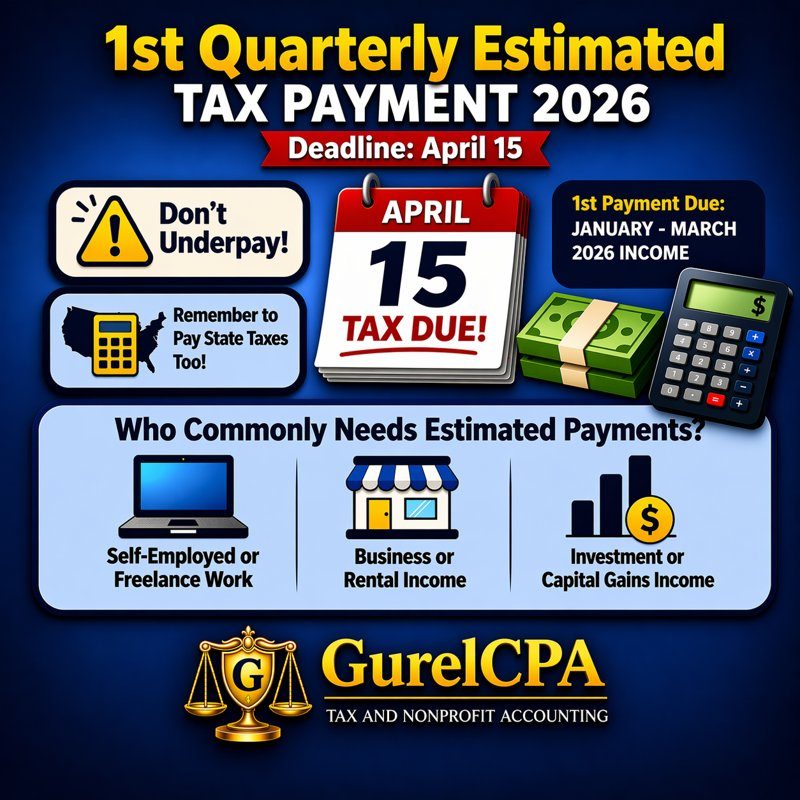
1st Quarterly Estimated Tax Payment for 2026 Deadline is April 15
We all know April 15 is the deadline for filing income tax returns and paying tax on 2025 income.
But for self-employed taxpayers, April 15 is also the deadline for paying the 1st Quarterly Estimated Tax Payment. It is when you must pay the tax you estimate is due on the NET income you made from January through March 2026.
The IRS expects taxes to be paid throughout the year as income is earned
When too little tax is paid during the year, an underpayment penalty can apply — even if the full balance is paid at filing time.
Here’s an easy formula: multiply your estimated NET income for the period by your marginal tax rate from last year’s tax return. This will give a good approximation
And remember: if you are in a state with income tax, you need to pay Estimated Quarterly Taxes to your state, as well.
Who Commonly Needs Estimated Payments?
Estimated payments are often required for people with income such as:
• Self-employment or freelance work
• Business or rental income
• Investment or capital gains income
• Retirement withdrawals without enough withholding
• Side income in addition to regular employment
This article is for general informational purposes only and should not be considered tax advice. Please reach out for a free consultation to discuss your individual tax situation.
Understanding Safe Harbor Rules
The IRS provides safe harbor rules that allow taxpayers to avoid penalties if enough tax is paid during the year through withholding or estimated payments. Even if additional tax is owed at filing, meeting one of these thresholds usually prevents penalties
In general, penalties are avoided if payments equal at least:
• 90% of the current year’s total tax, or
• 100% of last year’s total tax
2026 Estimated Tax Payment Periods and Due Dates
Estimated taxes are paid in four installments during the year as income is earned. The payment periods do not follow equal calendar quarters, so it is important to understand how the IRS divides the year.
For the 2026 tax year, estimated payments are due on:
• April 15, 2026 — covering income earned January 1 through March 31, 2026
• June 15, 2026 — covering income earned April 1 through May 31, 2026
• September 15, 2026 — covering income earned June 1 through August 31, 2026
• January 15, 2027 — covering income earned September 1 through December 31, 2026
Withholding Can Help Too
Estimated payments aren’t the only solution. Increasing paycheck withholding can often fix the issue and is sometimes easier than making quarterly payments. Withholding is treated as if paid evenly throughout the year, even when adjustments happen later in the year.
Missing or underpaying any installment can result in penalties, even if the total tax is paid when filing the return. Reviewing income periodically during the year helps ensure payments stay on track.