Gifting vs. Inheriting: Understanding the Tax Differences Before You Transfer Wealth
Many families assume that giving assets to children or loved ones during life is always the best strategy. In reality, gifting and inheriting assets can create very different tax consequences.
In some situations, gifting makes sense. In others, inheriting property may produce a far better tax result because of something called a “step-up in basis.”
Understanding the difference can potentially save thousands — or even hundreds of thousands — of dollars in taxes.
What Is “Basis”?
For tax purposes, “basis” generally means what someone originally paid for an asset, adjusted for certain improvements or changes over time.
Basis matters because when an asset is sold, capital gains tax is usually based on:
Selling Price – Basis = Taxable Gain
The lower the basis, the larger the taxable gain.
What Happens When You Gift an Asset?
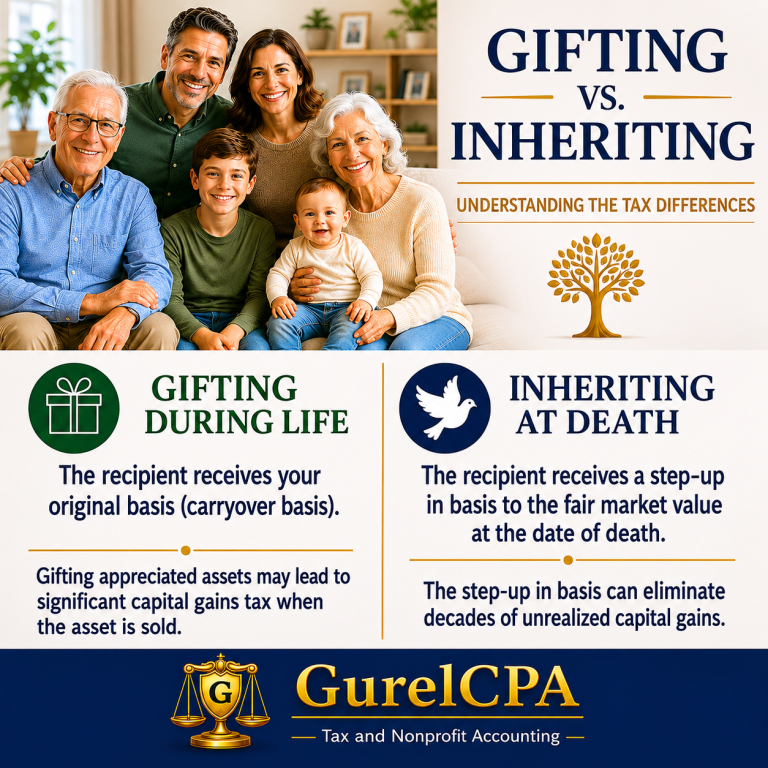
When you gift property during your lifetime, the recipient usually receives your original basis. This is called a “carryover basis.”
Example:
Suppose you purchased stock years ago for $10,000.
Today, the stock is worth $100,000.
If you gift the stock to your child during your lifetime:
- Your child generally inherits your $10,000 basis
- If they later sell the stock for $100,000
- They may have a taxable capital gain of $90,000
Even though no tax may have been due when the gift was made, a significant capital gains tax bill could eventually result.
What Happens When Someone Inherits an Asset?
Inherited assets are often treated very differently.
In most cases, the recipient receives a “step-up in basis” to the fair market value as of the date of death.
Example:
- Original purchase price: $10,000
- Value at death: $100,000
If the child inherits the stock instead of receiving it as a lifetime gift, the child’s new basis becomes $100,000. If the stock is immediately sold for $100,000, there is no taxable capital gain.
This step-up in basis can eliminate decades of unrealized capital gains.
Common Assets Where Basis Matters
The gifting versus inheritance decision is especially important for:
- Real estate
- Stocks and mutual funds
- Rental properties
- Family cabins or vacation homes
- Businesses and partnership interests
- Collectibles and valuable property
Some families unintentionally create unnecessary taxes by gifting highly appreciated assets too early.
When Gifting Still Makes Sense
Despite the potential loss of a step-up in basis, gifting can still be beneficial in some situations.
Examples may include:
- Reducing a taxable estate for very high-net-worth families
- Helping children financially during life
- Asset protection or Medicaid planning considerations
- Transferring future appreciation out of an estate
- Annual exclusion gifting strategies
The right answer depends on the family’s financial picture, income levels, estate size, and long-term goals.
Don’t Forget About the Annual Gift Tax Exclusion
For 2026, individuals can generally give up to the annual exclusion amount of $19,000 per recipient without filing a gift tax return.
However, even gifts above the exclusion amount do not necessarily create immediate gift tax. Many gifts simply reduce a person’s lifetime estate and gift tax exemption.
Final Thoughts
Before transferring real estate, investments, or other appreciated assets to family members, it is important to understand the tax consequences of gifting versus inheriting.
In many cases, proper planning can significantly reduce future taxes and preserve more wealth for the next generation.
Please contact us directly to discuss your individual situation and whether gifting or inheritance planning strategies may be appropriate for you. Free consultations are available.
This article is intended for informational purposes only and should not be considered legal or tax advice.