Ways to Support Nonprofits That Go Beyond the Schedule A Charitable Deduction
Many taxpayers assume the only tax benefit available for charitable giving is claiming an itemized deduction on Schedule A.
However, with today's larger standard deduction, many donors no longer itemize and may wonder whether charitable giving still provides any tax advantages.
The good news is that several charitable giving strategies can provide significant tax benefits that go beyond a traditional Schedule A deduction.
Here are three of the most powerful options to consider:
1. Qualified Charitable Distributions (QCDs)
For taxpayers age 70½ or older, a Qualified Charitable Distribution allows funds to be transferred directly from an IRA to a qualified charity.
Benefits include: exclusion from taxable income, satisfaction of Required Minimum Distributions, no need to itemize deductions, potential reduction in Social Security taxation, and possible reduction in Medicare premium surcharges.
2. Donating Appreciated Stock
Donating appreciated investments held longer than one year can allow the donor to avoid capital gains tax while helping the charity receive the full value of the asset.
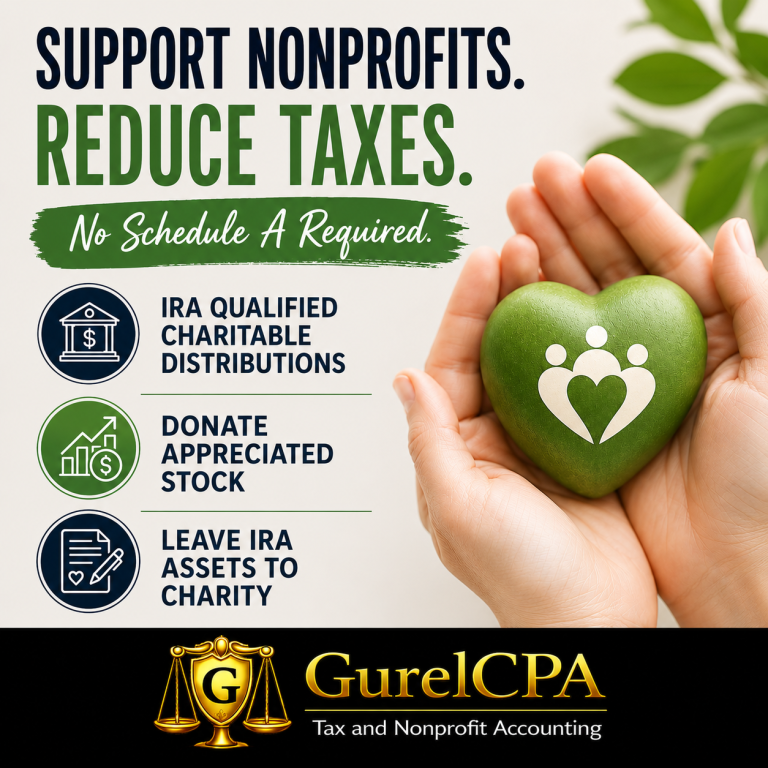
3. Naming a Charity as an IRA Beneficiary
Traditional IRA assets can be heavily taxed when inherited by individuals. Naming a charity as beneficiary allows the charity to receive the funds income-tax free while potentially leaving more tax-efficient assets to family members.
Other strategies worth exploring include Donor-Advised Funds, Charitable Remainder Trusts, Charitable Gift Annuities, bunching charitable contributions, employer matching programs, certain state tax-credit programs, and deductible volunteer expenses.
Final Thoughts
Qualified Charitable Distributions, donating appreciated investments, and charitable IRA beneficiary designations are three of the most effective ways to support nonprofits while potentially improving your overall tax situation.
Please contact me directly for a free consultation if you'd like to explore tax-efficient ways to support the charitable organizations you care about.
This article is for general informational purposes only and should not be considered tax advice. Please reach out for a free consultation to discuss your individual tax situation.