Who Is Your Registered Agent, and Why Does It Matter?
An often-overlooked business requirement that can protect your company, especially when you operate from another state or another country.
When you establish a limited liability company (LLC), corporation, or nonprofit corporation, one of the first questions on the registration paperwork is: Who will serve as your registered agent?
Many business owners give this question little thought. They list themselves, a business partner, or perhaps a friend or family member. But the registered agent serves an important legal function, and choosing the right person or service can help protect your organization from unnecessary complications.
What Does a Registered Agent Do?
A registered agent is the individual or business designated to receive certain official legal documents on behalf of a company or nonprofit corporation. These documents may include:
- Notices that the organization has been sued
- Summonses, subpoenas, and other legal documents
- Official communications from state agencies
- Certain compliance notices and other time-sensitive correspondence
The registered agent receives these documents and promptly notifies the organization so that appropriate action can be taken. Think of the agent as a dependable point of contact between your organization and the legal system.
The registered agent does not manage the organization, make business decisions, or assume responsibility for its debts or legal obligations.
Why Is a Registered Agent Required?
States require LLCs, corporations, and nonprofit corporations to designate and maintain a registered agent. The purpose is straightforward: There must be a reliable way to deliver legal notices, even when owners or officers are unavailable, traveling, or living elsewhere.
A registered agent must have a physical street address in the state where the organization is registered and be available to receive documents during normal business hours. A post office box or ordinary virtual mailbox will not satisfy this requirement. An organization operating in multiple states may need a registered agent in each state where it is required to register.
Nonprofit Organizations Need Registered Agents, Too
Registered agents are not just for commercial businesses. Most nonprofit organizations are established as nonprofit corporations under state law. Like for-profit corporations, they are generally required to designate and maintain a registered agent in the state where they are incorporated.
This requirement applies even when the organization has received tax-exempt status from the IRS under Section 501(c)(3).
For small nonprofits, the registered agent is often a founder, board president, treasurer, or another volunteer. That arrangement can work, but it can also create problems.
Nonprofit board members change. Volunteers move away. Officers retire or resign. Sometimes an organization continues operating for years without realizing that its registered agent information is outdated.
An outside registered agent can provide continuity as leadership changes and help ensure that important legal notices reach the organization’s current leadership. This is particularly valuable for small nonprofits that do not maintain a permanent office or paid administrative staff.
A nonprofit’s registered agent should remain dependable even when its board members and volunteers change.
The registered agent requirement is separate from IRS tax-exempt status, charitable solicitation registration, and annual state reporting obligations. Each deserves attention as part of responsible nonprofit management.
Can You Be Your Own Registered Agent?
In many states, yes. An eligible business owner, officer, or other individual may serve as the registered agent, although qualifications vary by state. For someone who works from a permanent office and is consistently available during normal business hours, this arrangement may work well.
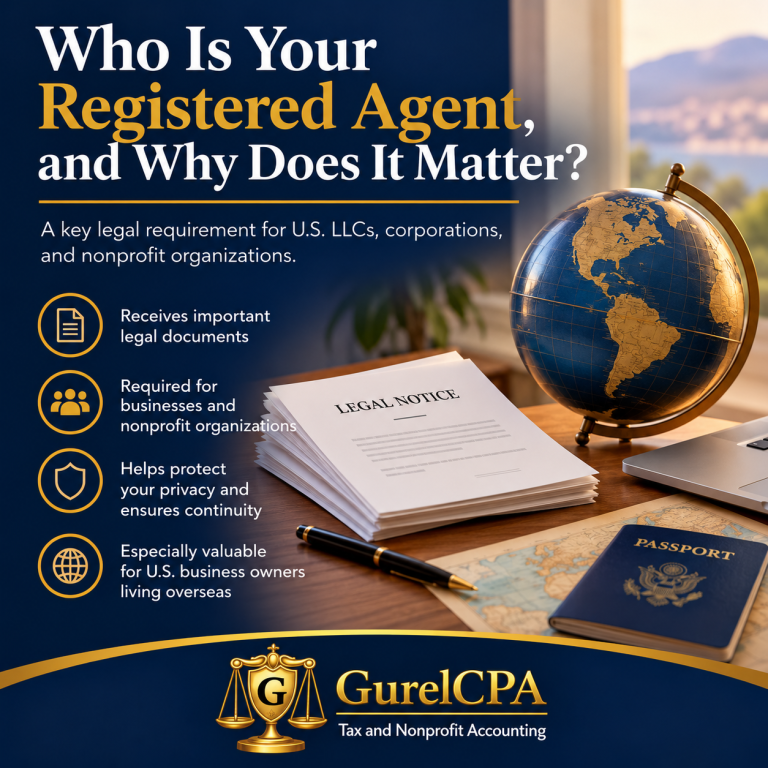
But consider the disadvantages:
- Availability. If you travel frequently, work irregular hours, or are away from your office, important documents could arrive when you are unavailable.
- Privacy. Registered agent names and addresses are generally public. If you work from home, serving as your own agent may make your home address publicly available.
- Continuity. Businesses change locations, and nonprofit leadership changes. A dependable outside agent can provide continuity.
- Professional handling. Legal notices require prompt attention. A professional agent should have procedures for receiving and forwarding documents.
Why This Matters Even More for Business Owners Living Overseas
Consider an American who moves to Portugal but continues operating a U.S. LLC. Or an entrepreneur living in India who establishes a U.S. company to serve American customers. Or a U.S. citizen who retires overseas but maintains a small consulting business in the United States.
These owners may be thousands of miles away from the state where their companies are registered. They may work in different time zones, maintain foreign mailing addresses, or return to the United States only occasionally.
A registered agent located in the appropriate state provides a reliable place where official legal documents can be delivered. For someone operating internationally, that reliability can be especially valuable.
However, having a registered agent does not automatically establish a business office for tax purposes, satisfy every state registration requirement, or determine where a company is subject to taxation. Those are separate matters.
What Happens If You Don’t Have a Registered Agent?
Failing to maintain a properly designated registered agent can create serious problems. Depending on state law, consequences may include:
- Penalties or loss of good standing with the state
- Administrative dissolution or revocation of authority to do business
- Missed legal notices and court deadlines
- The possibility of a default judgment if a lawsuit goes unanswered
Simply failing to receive a notice does not necessarily protect an organization from legal consequences. Maintaining accurate registered agent information is more than an administrative formality.
What Should You Look for in a Registered Agent?
A good registered agent should be dependable, accessible, and familiar with the importance of legal correspondence. Before selecting someone, consider whether the agent:
- Meets the legal requirements of the state and maintains a qualifying physical address
- Is available during required business hours
- Has a reliable system for notifying you when documents arrive
- Can promptly forward documents, including to owners living overseas
- Clearly explains the services provided and the annual cost
A registered agent is not automatically your attorney, accountant, bookkeeper, or general mail-handling service. Nor does the appointment necessarily include preparing annual reports or other state filings. Those responsibilities should be addressed separately.
A Small Decision That Can Prevent Big Problems
Selecting a registered agent may seem like a minor detail when forming a business or nonprofit. But a reliable agent can provide continuity, protect personal privacy, and help ensure that important legal documents reach the people who need to act on them.
For organizations operating across state lines or internationally, that peace of mind can be particularly worthwhile.
GurelCPA also offers registered agent services for qualifying organizations. Contact us if you would like to discuss whether we would be appropriate registered agent for your organization.
The article is meant for informational purposes only. Please contact me directly to discuss how this applies to your individual tax situation.