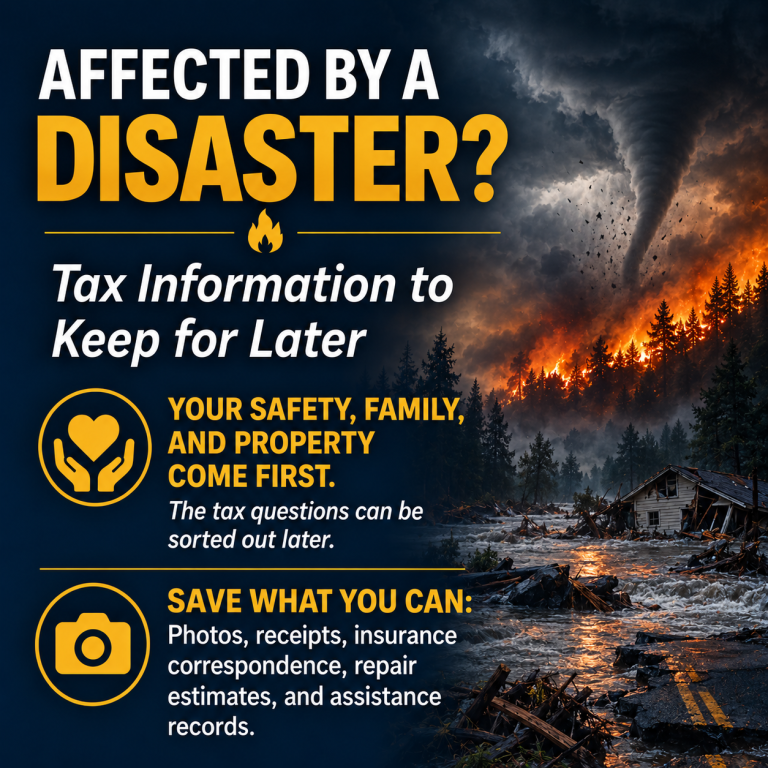
Affected by a Disaster?
Tax Information to Keep for Later
The Washington wildfires are a timely example of how quickly a disaster can disrupt ordinary life. The same is true after a flood, severe storm, hurricane, tornado, earthquake, mudslide, or other sudden destructive event. Safety, housing, family, and recovery come first. Taxes can wait.
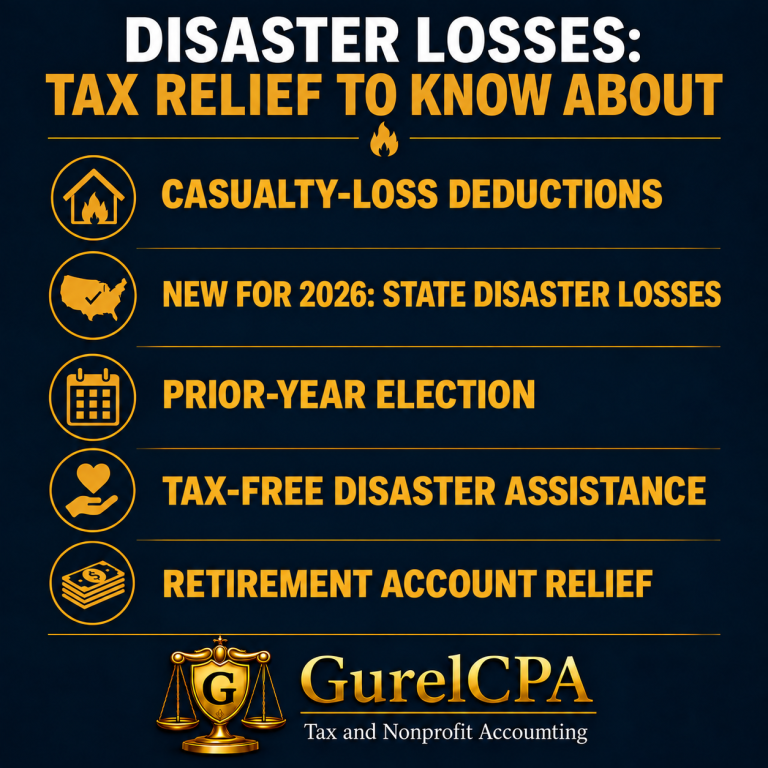
There are, however, a few records worth saving when it is practical. Tax relief after a disaster can extend beyond postponed filing deadlines. A casualty-loss deduction, tax-free disaster assistance, a prior-year loss election, or special retirement-plan provisions may eventually become important. Good records make those questions easier to answer later.
Save What You Can, When You Can
Do not put yourself at risk to collect paperwork or photograph damaged property. When conditions are safe, preserve whatever information is reasonably available. Useful records may include photographs and videos, insurance correspondence, repair estimates, receipts, contractor invoices, appraisals, inventories of damaged belongings, government or charitable assistance records, and documents showing what the property originally cost.
For a home or other real property, keep purchase records, settlement statements, records of improvements, prior appraisals, property-tax assessments, and insurance documents. For vehicles and personal belongings, older photographs, purchase confirmations, credit-card statements, manuals, registrations, and online account histories may help establish ownership, condition, and value.
Lost Records Can Often Be Reconstructed
Disasters sometimes destroy the very records needed to document a loss. That does not mean the tax issue is hopeless. Records may be reconstructed from banks, credit-card companies, employers, insurance companies, contractors, county property offices, vehicle records, email accounts, cloud storage, and photographs provided by family or friends.
The goal is to create the best reasonable record of what existed before the disaster, what happened to it, what the property cost, and what insurance or other assistance was received. Keep notes explaining how estimates were developed and where replacement information came from.
Keep a Separate File for Insurance and Other Assistance
Insurance proceeds, government grants, charitable assistance, employer payments, legal settlements, and other recovery payments can affect the tax result. Save documents showing who made each payment, the amount, the date received, and what the payment was intended to cover.
Do not assume that every disaster payment is taxable. Certain qualified disaster relief payments for necessary personal, family, living, funeral, home-repair, or household-replacement expenses may be excluded from income when the requirements are met. At the same time, do not assume that every payment is tax-free. Payments for lost wages, business income, property damage, living expenses, or emotional distress may follow different rules.
The Disaster Declaration Can Change the Tax Treatment
One of the most important questions is what type of disaster declaration applies to the taxpayer's location. Different provisions may depend on a state disaster declaration, a federal disaster declaration, or a federally declared major disaster. Covered areas can also be expanded after an initial announcement.
Beginning in 2026, certain personal casualty and theft losses attributable to a state-declared disaster may qualify for a federal deduction even without a presidential disaster declaration. These losses are generally subject to a $100 reduction for each casualty and the limitation based on 10% of adjusted gross income.
A federal declaration may provide additional options. In qualifying circumstances, an eligible federal disaster loss may be claimed in the year of the disaster or elected on the preceding year's return. The prior-year election can sometimes produce a refund sooner, but both years should be compared before the choice is made.
Property Damage Does Not Automatically Equal a Tax Deduction
A casualty loss generally involves property damage, destruction, or loss caused by a sudden, unexpected, or unusual event. Fires, floods, severe storms, hurricanes, tornadoes, and earthquakes are common examples.
The deductible amount is not necessarily the replacement cost or the amount spent on repairs. Tax rules may consider the property's adjusted basis, the decrease in fair market value, applicable statutory limitations, and insurance or other reimbursements. A taxpayer generally cannot deduct the portion of a loss that has been reimbursed or for which reimbursement is reasonably expected.
Deadline Relief and Loss Relief Are Different
The current Washington wildfire relief illustrates the distinction. Eligible taxpayers throughout covered counties may receive postponed federal deadlines automatically based on their address. They do not have to prove that their own property was damaged to receive that deadline relief.
A casualty-loss deduction or special disaster retirement distribution generally requires more. The taxpayer must meet the requirements of the particular provision and usually must show an actual loss or economic harm. Community-wide deadline relief can therefore apply to many people who will never claim a casualty loss.
Retirement Accounts May Offer Special Disaster Options
People who sustain an economic loss from certain federally declared major disasters may qualify for special retirement-plan or IRA rules. A qualified individual may generally designate up to $22,000 of eligible distributions for a particular disaster as qualified disaster recovery distributions.
Qualifying distributions can avoid the usual 10% additional tax on early distributions. The taxable income can generally be spread over three years, and qualifying amounts may generally be repaid to an eligible retirement plan within three years. These rules have specific residence, declaration, timing, and economic-loss requirements.
A Simple Recordkeeping Plan
Create one paper or electronic folder for the disaster and keep copies of photographs, insurance claims, assistance applications, payment records, repair estimates, invoices, receipts, property records, and correspondence. Maintain a simple dated log of important events, including evacuation, displacement, property inspections, insurance contacts, repairs, and assistance received.
Keep original records when possible, but back them up electronically. Do not email documents containing Social Security numbers or other sensitive information unless a secure method is being used.
For Anyone Affected by a Disaster
If you are dealing with a wildfire or another disaster, focus first on safety, family, housing, and recovery. Save the records you can without adding to the burden of the moment. The tax questions can be addressed when conditions are more stable.
When that time comes, verify the declaration that covered your location and review the property loss, insurance recovery, disaster assistance, and other facts together. Do not assume that assistance is taxable, and do not assume that property damage automatically creates a deduction.
GurelCPA can help review the documentation and determine which disaster and casualty-loss provisions may apply.
The article is meant for informational purposes only. Please contact me directly to discuss how this applies to your individual tax situation.