Moving Assets Overseas
Many Americans assume that taxes on moving assets overseas only apply if they give up their U.S. citizenship. That's not true.
The United States has several different tax rules that can apply when money, investments, businesses, or other assets are transferred outside the United States. Understanding the difference can help you avoid an unexpected tax bill.
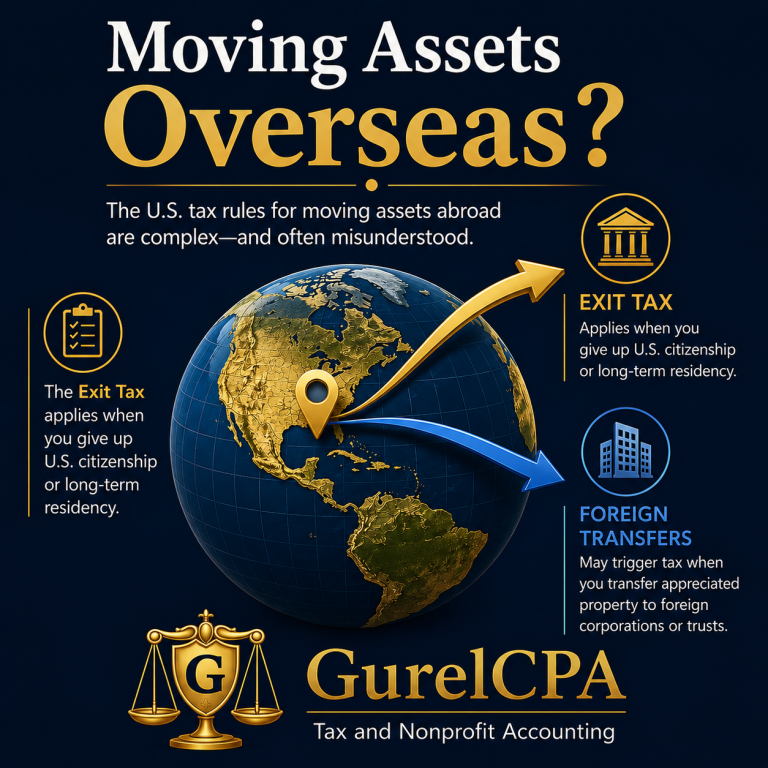
The Exit Tax
The best-known international tax rule is the U.S. Exit Tax.
The exit tax generally applies only to U.S. citizens or long-term green card holders who formally expatriate and meet the definition of a covered expatriate.
Instead of waiting until assets are sold, the IRS generally treats covered assets as though they were sold immediately before expatriation. Any taxable gain may become taxable even though the assets were never actually sold.
For most taxpayers, this rule never comes into play because they never give up their U.S. citizenship or permanent residency.
A Different Set of Rules: Transferring Assets to Foreign Corporations
Suppose you own appreciated stock, real estate, or business assets and decide to contribute them to a corporation you establish overseas.
You might assume the transaction qualifies as a tax-free corporate contribution similar to what often happens when property is transferred into a newly formed U.S. corporation.
Not necessarily.
Under Internal Revenue Code Section 367, Congress created special rules that often override the normal tax-free treatment for transfers of property to foreign corporations. In many situations, appreciated property transferred to a foreign corporation is treated as though it had been sold, causing immediate recognition of taxable gain.
In other words, you do not have to expatriate for tax to be triggered.
Example
Assume you own stock worth $2 million with a cost basis of $500,000.
You form a corporation outside the United States and contribute the stock to that company.
Even though you received stock in exchange and did not receive cash, the IRS may require you to recognize the $1.5 million built-in gain immediately under the international transfer rules.
Foreign Trusts Have Their Own Rules
Foreign trusts are another area where taxpayers often make incorrect assumptions.
Transfers of property to foreign trusts may trigger immediate tax consequences and often require significant IRS reporting.
Loans between the trust and beneficiaries, distributions from the trust, and ownership of foreign trust assets are all governed by separate provisions of the Internal Revenue Code.
These rules are entirely different from the Exit Tax.
International Reporting Can Be Just as Important
Even when no immediate tax is due, transferring assets overseas may create reporting obligations.
- Form 926 (Transfers to Foreign Corporations)
- Form 3520 (Foreign Trusts and Certain Foreign Gifts)
- Form 5471 (Foreign Corporations)
- Form 8938 (Specified Foreign Financial Assets)
- FBAR (FinCEN Form 114)
Failure to file these forms can result in substantial penalties, even if no tax is ultimately owed.
Why These Rules Exist
Congress has long been concerned that appreciated assets could otherwise be transferred outside the U.S. tax system before gain is recognized.
As a result, the international tax rules are generally much stricter than comparable transactions involving domestic corporations.
The Bottom Line
There is no single 'foreign transfer tax' in the Internal Revenue Code.
Instead, there are several different tax systems that may apply depending on the transaction:
- Exit Tax - Applies to certain individuals who give up U.S. citizenship or long-term permanent residency.
- IRC Section 367 - May trigger tax when appreciated property is transferred to foreign corporations.
- Foreign Trust Rules - Govern transfers involving foreign trusts.
- International Reporting Rules - May require extensive IRS reporting even when no tax is immediately due.
If you are considering moving assets, starting a foreign business, creating a foreign trust, or relocating overseas, professional planning before the transaction can often prevent expensive surprises later.
The article is meant for informational purposes only. Please contact me directly to discuss how this applies to your individual tax situation. I offer a free initial consultation, and I work with U.S. taxpayers living both in the United States and abroad.