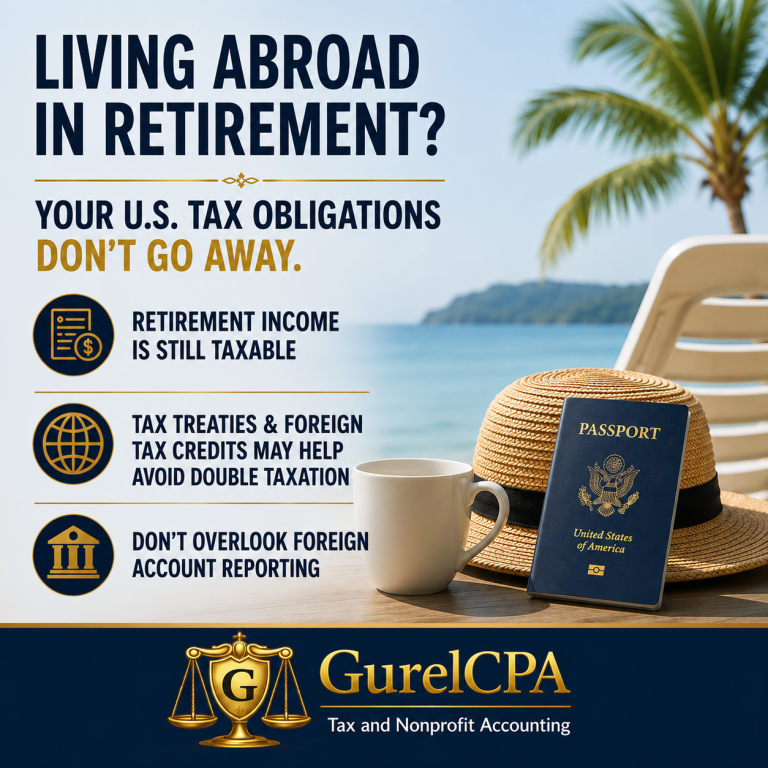
Living Abroad in Retirement?
Your U.S. Tax Obligations Don't Go Away
Many Americans dream of spending retirement overseas. Lower living costs, a different climate, or simply the chance to experience another country can make an international retirement attractive.
But moving abroad does not, by itself, end your U.S. tax obligations. If you are a U.S. citizen or resident alien, the United States taxes you on your worldwide income regardless of where you live
U.S. Taxes Generally Follow You Overseas
For a U.S. taxpayer living abroad, the basic federal income tax rules generally remain the same. Retirement income that may be taxable by the United States includes:
- Social Security benefits
- Pension and annuity income
- Traditional IRA distributions
- 401(k) and other retirement-plan distributions
- Interest, dividends, capital gains, and other investment income
Living outside the United States does not create a general exclusion for these types of income. However, tax treaties and foreign tax credits can sometimes change the ultimate tax result.
Social Security Is Still Be Taxable
U.S. Social Security benefits can be taxable even when you live abroad. Under the regular U.S. rules, the taxable portion depends on your filing status and other income. Up to 85% of your Social Security benefits can be included in taxable income.
There is an important exception: certain U.S. income tax treaties may change how Social Security is taxed. In some treaty countries, U.S. Social Security benefits may be exempt from U.S. tax when they are taxed by the country of residence. The applicable treaty must be reviewed for the country where you live.
Retirement Distributions Remain Subject to U.S. Rules
Traditional IRA, 401(k), pension, and similar retirement distributions generally remain subject to the same U.S. tax rules that would apply if you lived in the United States.
Required Minimum Distribution (RMD) rules also continue to apply while you are overseas. Under current law, the applicable RMD age is generally 73 for individuals who reach age 73 before 2033, with age 75 applying to later birth cohorts under SECURE 2.0. The precise rule depends on your birth year and the type of retirement account.
The Foreign Earned Income Exclusion Does Not Cover Retirement Income
The Foreign Earned Income Exclusion (FEIE) is frequently misunderstood. It applies to qualifying earned income, such as wages or self-employment income earned while working abroad. It does not provide an exclusion for Social Security, pensions, IRA or 401(k) distributions, or investment income.
For someone who is fully retired and no longer earning wages or self-employment income, the FEIE will not reduce the U.S. tax on retirement income.
Tax Treaties Can Make a Difference
The United States has income tax treaties with many countries. Depending on the treaty, certain types of retirement income may receive special treatment. A treaty may affect pensions, Social Security, annuities, or other income, but the rules vary substantially by country.
The country of residence and the applicable treaty provisions matter.
Foreign Tax Credits May Help Prevent Double Taxation
Living abroad can also mean becoming subject to income tax in your country of residence. If the same income is taxed by both the foreign country and the United States, you may be eligible to claim a foreign tax credit on your U.S. return for qualifying foreign income taxes.
The foreign tax credit can be an important part of retirement tax planning because it may reduce or eliminate double taxation. The availability and amount of the credit depend on the type and source of income, the foreign tax paid, and other limitations.
Do Not Forget Foreign Account Reporting
Retiring overseas often means opening local bank, investment, or other financial accounts. These accounts can create U.S. reporting obligations separate from the income tax return.
For example, a U.S. person generally must file FinCEN Form 114, commonly called the FBAR, if the aggregate value of foreign financial accounts exceeds $10,000 at any time during the calendar year. The requirement applies even if the accounts produce no taxable income.
Depending on the value and type of foreign assets, Form 8938, Statement of Specified Foreign Financial Assets, or other international information returns may also be required.
The Bottom Line
Moving overseas changes many things about retirement, but it does not automatically end your U.S. tax responsibilities. U.S. citizens and resident aliens generally remain subject to U.S. tax on worldwide income, including retirement and investment income.
At the same time, the final tax result may be affected by the country where you live, an applicable U.S. tax treaty, foreign taxes you pay, and foreign tax credits available on your U.S. return. Foreign financial accounts can also bring additional reporting requirements.
If you are already retired abroad or considering an overseas retirement, reviewing these issues before making major financial decisions can help you understand both your U.S. filing obligations and the opportunities available to avoid unnecessary double taxation.
Questions About Retiring Abroad?
If you are living abroad or planning an international retirement, I would be happy to discuss how the U.S. tax rules apply to your particular situation.
The article is meant for informational purposes only. Please contact me directly to discuss how this applies to your individual tax situation.