Five Mistakes That Can Cost a Nonprofit Its 501(c)(3) Status
Receiving IRS recognition as a 501(c)(3) charitable organization is a major milestone. Unfortunately, some nonprofit leaders assume that once tax-exempt status has been granted, it lasts forever.
It doesn't.
The IRS expects tax-exempt organizations to continue operating in accordance with federal tax law. Organizations that fail to do so can lose their tax-exempt status, creating serious financial and legal consequences.
Here are five of the most common reasons nonprofits lose their 501(c)(3) status.
1. Failing to File Annual IRS Returns
This is by far the most common reason organizations lose their exemption.
Even very small nonprofits must file an annual return with the IRS. Organizations with gross receipts normally under $50,000 generally file Form 990-N (the e-Postcard), while larger organizations may file Form 990-EZ or Form 990.
If a nonprofit fails to file the required return for three consecutive years, the IRS automatically revokes its tax-exempt status by law.
Many organizations don't discover the problem until donors begin asking why contributions are no longer deductible.
2. Providing Excessive Benefits to Insiders
A nonprofit exists to serve its charitable mission—not to enrich its officers, directors, founders, or key employees.
Paying unreasonable compensation, making below-market loans, or allowing insiders to receive special financial benefits can result in IRS penalties and, in severe cases, jeopardize the organization's exemption.
Board members should always document compensation decisions and ensure transactions are fair and reasonable.
3. Becoming Too Political
A 501(c)(3) organization may educate the public about issues, but it may not participate in political campaigns or endorse candidates for public office.
Even well-intentioned actions—such as using the organization's social media accounts or facilities to support a candidate—can create problems.
Some lobbying is permitted within limits, but direct political campaign activity is prohibited..
4. Drifting Away From the Charitable Mission
The IRS granted exemption because the organization agreed to operate for specific charitable, educational, religious, scientific, or other exempt purposes.
If the organization begins operating primarily for purposes outside that mission, its exempt status may be challenged.
Boards should periodically review programs and activities to ensure they continue advancing the organization's stated exempt purpose.
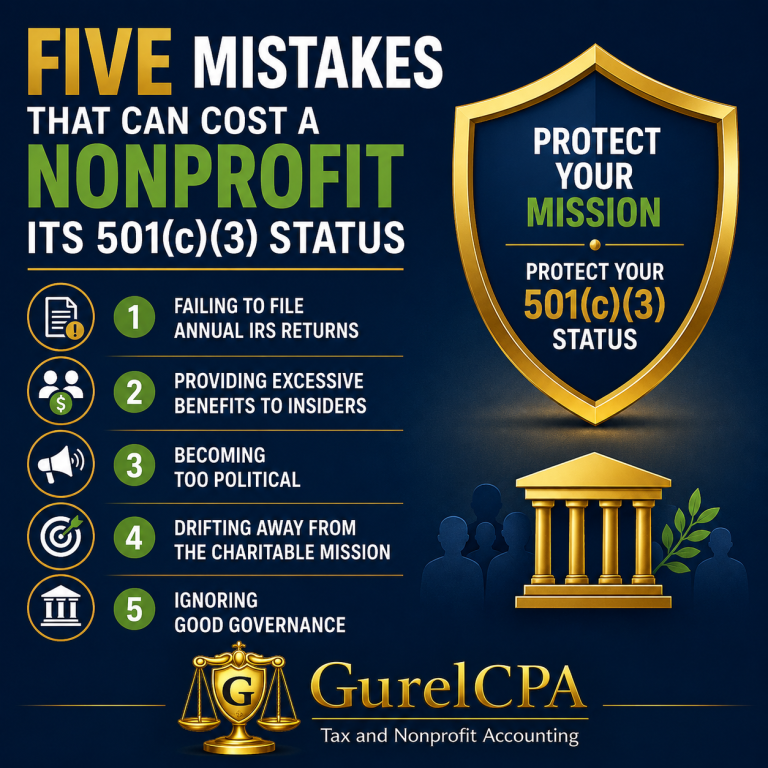
5. Ignoring Good Governance
Poor governance alone doesn't automatically revoke tax-exempt status, but weak oversight often leads to larger compliance problems.
Examples include:
- Board meetings that are never documented
- Failure to maintain financial records
- Conflicts of interest that are not disclosed
- Lack of oversight over finances
- Failure to adopt or follow basic governance policies
Good governance demonstrates that a nonprofit is being operated responsibly and in the public interest.
What Happens If Exempt Status Is Revoked?
Losing tax-exempt status can have significant consequences, including:
- Donations may no longer be tax deductible.
- The organization may become subject to federal income tax.
- Grant opportunities may disappear.
- Public confidence can be damaged.
- The organization must apply for reinstatement, which can be time-consuming and costly.
Fortunately, many of these problems are entirely preventable with good compliance practices.
A Final Thought
Most nonprofits don't lose their exemption because of fraud or intentional misconduct. More often, they lose it because volunteer board members simply weren't aware of the rules.
A periodic compliance review can help identify potential issues before they become serious problems.
The article is meant for informational purposes only. Please contact me directly to discuss how this applies to your individual tax situation.