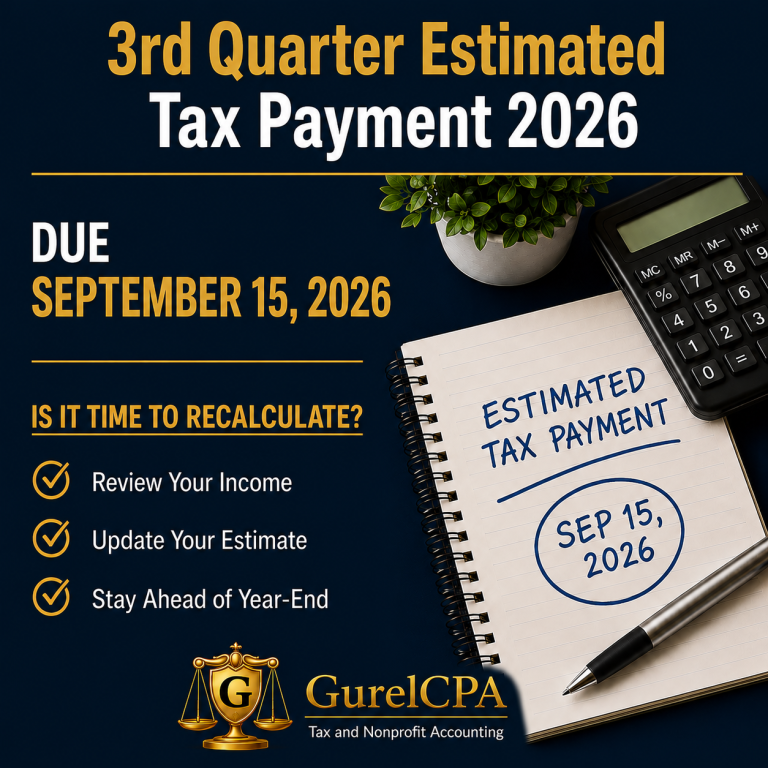
3rd Quarter Estimated Taxes Are Due September 15:
Is It Time to Recalculate?
For most individual taxpayers who make quarterly estimated tax payments, the third 2026 payment is due September 15, 2026. But this deadline can be more than a reminder to send the same amount you paid in April and June. It is also a good time to ask whether the estimates you started the year with still reflect what is actually happening in 2026.
By late summer, many taxpayers have a much clearer picture of their income than they did at the beginning of the year. Business profits may be higher or lower than expected. Investments may have produced significant gains. Retirement distributions, rental income, bonuses, interest, dividends, or other income may have changed.
A midyear review can help determine whether the remaining estimated payments should be adjusted.
Who Needs to Make Estimated Tax Payments?
Estimated tax payments are used to pay tax on income that is not subject to sufficient federal withholding. This commonly includes self-employment income, interest, dividends, rental income, capital gains, and other income received without adequate withholding.
This can affect self-employed individuals, sole proprietors and LLC owners, S corporation shareholders, partners, retirees, investors, and Americans living abroad. Even taxpayers who receive wages or retirement income may need estimated payments if their withholding is not enough to cover their total expected tax.
The $1,000 Rule
Generally, an individual will face an underpayment penalty if the tax owed after subtracting withholding and refundable credits is $1,000 or more and sufficient tax has not been paid during the year.
That does not mean every taxpayer who will owe $1,000 at filing automatically owes a penalty. The estimated tax rules include safe harbors that can help taxpayers avoid an underpayment penalty.
Understanding the Estimated Tax Safe Harbors
The goal is to pay enough during the year through withholding and estimated payments to satisfy the federal safe-harbor rules. Generally, this means paying at least 90% of the tax ultimately shown on the current-year return or 100% of the tax shown on the prior-year return, whichever required annual payment is smaller.
For higher-income taxpayers, the prior-year safe harbor generally increases from 100% to 110% when prior-year adjusted gross income exceeds $150,000 for married taxpayers or $75,000 for taxpayers filing separately.
These rules are important because an estimated tax payment does not necessarily have to equal the taxpayer's final tax liability. A taxpayer can satisfy a safe harbor and avoid an estimated tax penalty while still owing additional tax when the return is filed.
Why Now Is a Good Time to Recalculate
Estimated tax calculations are estimates. The IRS specifically recognizes that changes in income, deductions, adjustments, or credits during the year may require taxpayers to refigure their estimated tax.
Consider whether anything significant has changed since your 2026 estimates were originally prepared. Examples include a substantial increase or decrease in business income, the sale of stocks or other investments, a large capital gain, changes in rental income, a retirement distribution, a change in wages or withholding, new self-employment income, or a significant change in deductions or tax credits.
If the original estimate is now too low, increasing the September and January payments will reduce the risk of an underpayment penalty and an unexpectedly large balance due at tax time. If the original estimate is too high, recalculating may prevent unnecessarily sending money to the IRS months before it is actually due.
A Large Capital Gain Can Change the Picture Quickly
One of the most common reasons to revisit estimated taxes is a significant capital gain. Selling stock, investment property, cryptocurrency, or another appreciated asset can create a tax liability that was not included when the year's original estimated payments were calculated.
The timing matters as well as the amount. If a large gain occurs later in the year, the annualized income method may help demonstrate that the related income was not received during earlier payment periods.
Withholding Can Also Be Part of the Solution
Estimated payments are not the only way to address a projected shortfall. Taxpayers who receive wages, pensions, or other payments subject to federal withholding may increase withholding for the remainder of the year.
This can be particularly useful because federal income tax withholding is generally treated as having been paid evenly throughout the year for estimated tax penalty purposes, even when the withholding actually occurs later in the year. Depending on the circumstances, increasing withholding can therefore be an effective year-end planning tool.
The 2026 Estimated Tax Payment Schedule
For calendar-year individual taxpayers, the regular 2026 estimated tax installment dates are April 15, 2026; June 15, 2026; September 15, 2026; and January 15, 2027.
The September 15 deadline means there is still time to review 2026 income and tax payments before the third installment is due, and there will still be another opportunity to make adjustments before the final installment in January.
A September Tax Checkup
A useful third-quarter review can include year-to-date business or self-employment income, investment sales and capital gains, retirement distributions, rental income, partnership or S corporation income, federal withholding, estimated payments already made, and major changes in deductions or credits.
For business owners and self-employed taxpayers, having reasonably current financial records can make this review much more useful. By September, year-to-date results often provide a much better basis for estimating the full year's income than the assumptions available at the beginning of the year.
The Bottom Line
The September 15 estimated tax deadline should be viewed as more than another payment date. It is an opportunity to look at what has actually happened during 2026 and determine whether your tax plan needs to be adjusted before the year is over.
If your income, investments, business results, withholding, or other circumstances have changed significantly, this may be a good time to recalculate your estimated tax payments and consider year-end tax planning.
If you would like me to review your 2026 estimated tax situation before the September 15 payment deadline, please contact me directly for a free consultation.
The article is meant for informational purposes only. Please contact me directly to discuss how this applies to your individual tax situation.