Estimated Taxes: Are You Paying Enough, or Too Much?
Estimated tax planning is not simply about avoiding an IRS penalty. The goal is to pay enough tax during the year to cover your obligation without unnecessarily sending the IRS more money than you need to.
That balance can be especially important for self-employed individuals, business owners, investors, retirees, and Americans living overseas because their income and withholding may change significantly during the year.
Are You Paying Enough?
If your income increases but your withholding or estimated payments do not, you can arrive at tax season with a large balance due and possibly an underpayment penalty. Common causes include higher business income, capital gains, rental income, larger retirement distributions, or income that has little or no federal tax withholding.
For many taxpayers, the IRS safe-harbor rules provide a useful starting point. Generally, taxpayers can avoid an estimated tax penalty if they owe less than $1,000 after withholding and refundable credits, or if their withholding and credits cover at least 90% of the current year's tax or 100% of the prior year's tax. For certain higher-income taxpayers, the prior-year safe harbor increases to 110%.
But Are You Paying Too Much?
Paying more than necessary can create a different problem. A large refund may be welcome at tax time, but it can also mean that money was sent to the government months earlier than necessary instead of remaining available for your business, investments, savings, or household expenses.
The objective should not be the largest possible refund. It should be reasonable tax payments based on your actual circumstances.
Estimated Taxes Should Be Reviewed During the Year
Last year's numbers are useful, but they may not reflect what is happening this year. If income rises or falls, investments are sold, retirement distributions change, or withholding changes, estimated payments may need to be adjusted.
A midyear or later-year tax projection can help answer the practical question: Are you on track to pay enough, but not substantially more than necessary?
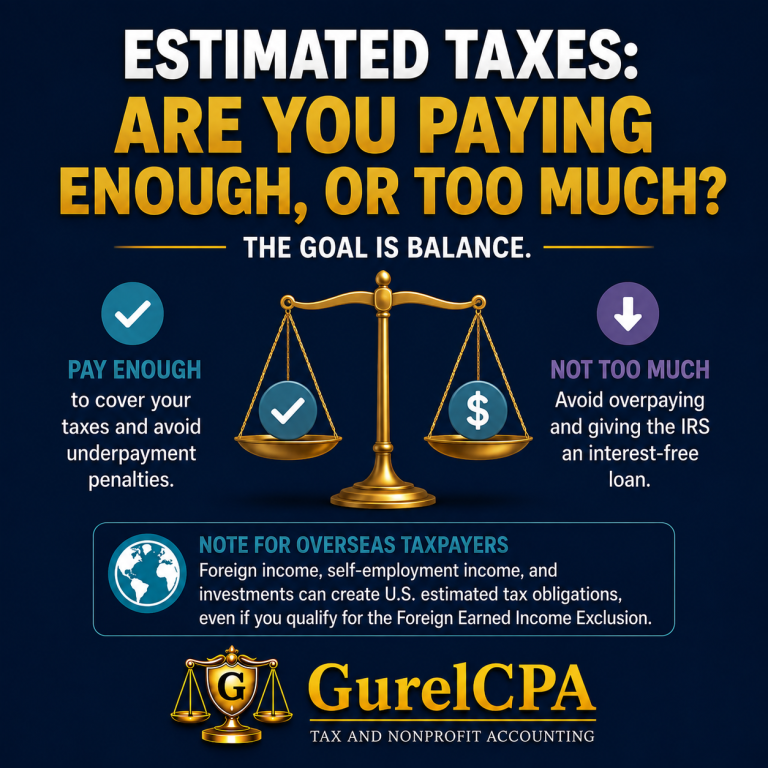
A Special Consideration for Americans Living Overseas
Americans living abroad can have an especially complicated estimated tax picture. Foreign wages may have no U.S. withholding, and foreign investment income, business income, rental income, and U.S.-source income can affect the calculation.
Taxpayers who qualify for the Foreign Earned Income Exclusion may reduce their U.S. income tax, but the exclusion generally does not reduce U.S. self-employment tax. Foreign tax credits can also affect the ultimate U.S. tax liability. For these taxpayers, simply repeating last year's estimated payments may not produce the right result.
The Goal: Pay the Right Amount
Estimated tax planning is ultimately about cash-flow management as well as tax compliance. You do not want to discover a major shortfall when the return is prepared, but you also do not need to intentionally overpay the IRS throughout the year.
If your income or circumstances have changed, reviewing your projected tax liability and payments can help determine whether your estimates should be increased, decreased, or left alone.
Questions about estimated taxes or international tax issues? Contact GurelCPA for a free consultation.
The article is meant for informational purposes only. Please contact me directly to discuss how this applies to your individual tax situation.