Three Important Changes to Charitable Deductions in 2026
Charitable giving gets some significant tax changes beginning in 2026. Some taxpayers will gain a deduction they did not have before, while others may find that the tax benefit of their charitable contributions is reduced.
Here are three changes donors should know about.
1. A New Charitable Deduction for Taxpayers Who Do Not Itemize
Perhaps the most taxpayer-friendly change is a new deduction for people who take the standard deduction.
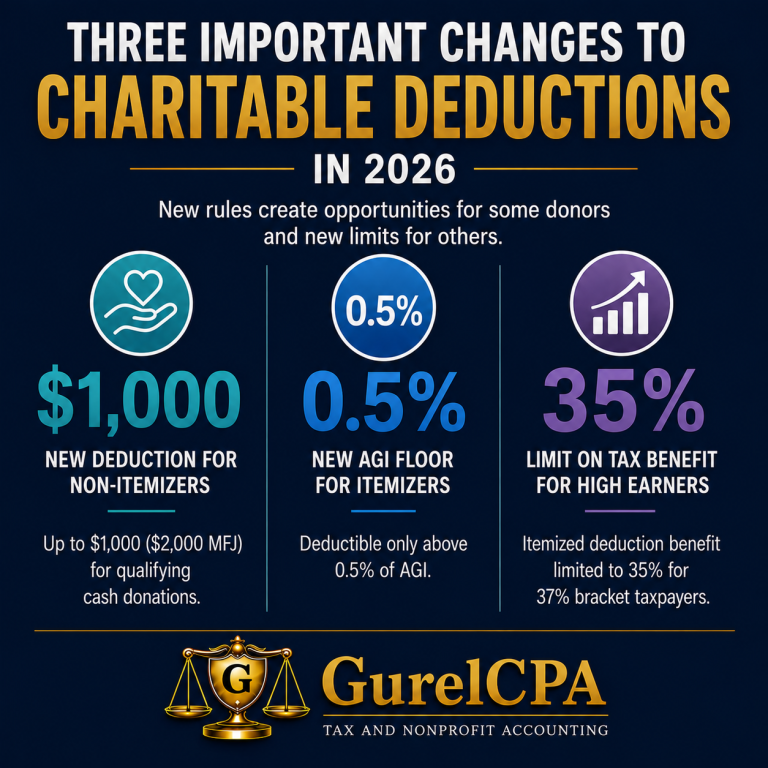
Beginning in 2026, taxpayers who do not itemize may deduct up to $1,000 of qualifying cash charitable contributions, or up to $2,000 for married couples filing jointly.
This is important because most taxpayers take the standard deduction and, in recent years, generally received no federal income tax deduction for their charitable gifts.
The new provision means that qualifying taxpayers can take the standard deduction and still receive an additional tax benefit for certain charitable contributions.
There are limitations. The new deduction generally applies to cash contributions to qualifying charitable organizations, so taxpayers should verify that an organization qualifies and maintain appropriate records of their donations.
2. A New 0.5% AGI Floor for Taxpayers Who Itemize
The news is less favorable for taxpayers who itemize their deductions.
Beginning in 2026, charitable contributions are deductible only to the extent that they exceed 0.5% of the taxpayer's adjusted gross income (AGI).
For example, suppose a taxpayer has AGI of $200,000. The 0.5% floor would be $1,000. If that taxpayer made $10,000 of charitable contributions during the year, the first $1,000 would fall below the new floor, leaving $9,000 potentially deductible, subject to the other charitable contribution rules and limitations.
For taxpayers who regularly make substantial charitable gifts, the effect may be relatively modest. However, it introduces another factor to consider when planning the timing and amount of charitable contributions.
It may also make strategies such as grouping, or "bunching," charitable contributions into particular tax years more useful for some taxpayers.
3. A 35% Limit on the Tax Benefit of Itemized Deductions for High-Income Taxpayers
There is another change affecting taxpayers in the highest federal income tax bracket.
Although the top individual federal income tax rate remains 37%, beginning in 2026 the tax benefit of itemized deductions is effectively limited to 35% for taxpayers subject to the 37% rate.
In simple terms, a dollar of charitable deduction will no longer necessarily reduce federal income tax by 37 cents for a taxpayer in the highest bracket. The maximum benefit is generally limited to 35 cents.
This provision applies to itemized deductions generally, not just charitable contributions, but it can be particularly important for high-income taxpayers making substantial charitable gifts.
Charitable Giving Becomes More of a Planning Issue
Taken together, these changes create an interesting contrast.
For millions of taxpayers who take the standard deduction, charitable giving may produce a federal income tax deduction again.
For taxpayers who itemize, the new 0.5% AGI floor may reduce the amount of their charitable deduction.
And for taxpayers in the highest income tax bracket, the value of itemized deductions is reduced further by the new 35% limitation.
None of these changes should determine whether someone supports a charitable organization. But for taxpayers who already intend to give, when they give, how much they give, and how they structure those gifts can make a difference.
That makes charitable contribution planning worth discussing before the end of the tax year rather than waiting until tax return preparation begins.
The article is meant for informational purposes only. Please contact me directly to discuss how this applies to your individual tax situation.