Business Travel Per Diem for 2026 &2027
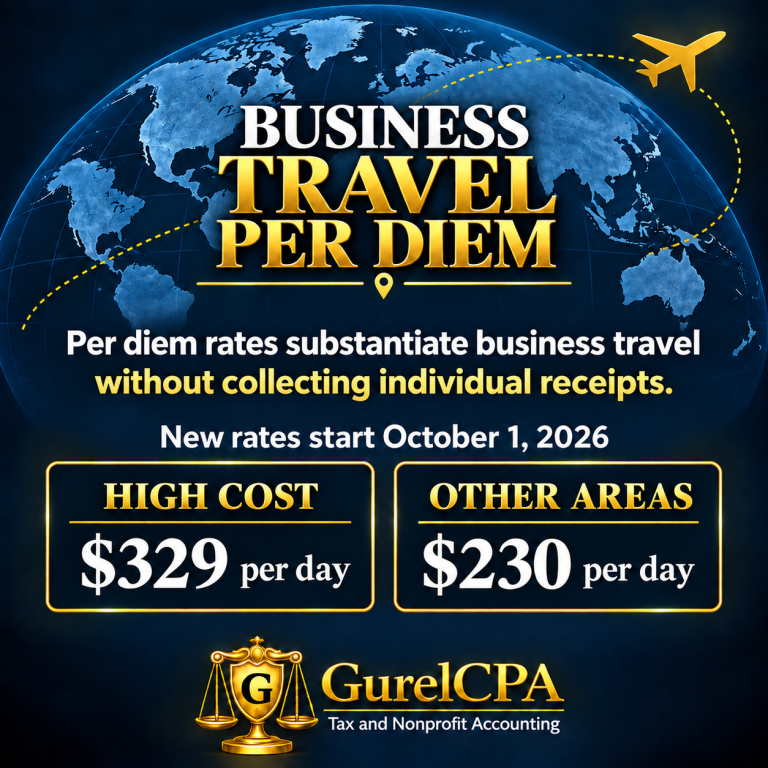
The IRS has released new special per diem rates for business travel beginning October 1, 2026. Per diem is a way to substantiate certain travel costs using a daily rate instead of collecting receipts for every meal or, in an employer reimbursement arrangement, every hotel bill. The rules differ depending on whether you are reimbursing an employee or claiming your own expenses as a self-employed person. Nonprofit employers can use the same approach for qualifying employee travel.
What changed on October 1?
IRS Notice 2026-60 sets the optional high-low rate for travel within the continental United States at $329 per day in designated high-cost localities and $230 elsewhere. Those totals include lodging, meals and incidental expenses. The meal and incidental portions are $86 and $74, respectively. The prior high-low totals were $319 and $225. The notice also sets special meal and incidental rates of $80 within the continental United States and $86 outside it for qualifying transportation industry travel; the incidental-expenses-only rate remains $5 per day.
A destination can qualify as high-cost for only part of the year. For example, the new notice lists Seattle year-round and Port Angeles/Port Townsend from June through September. Check the destination and travel dates before choosing a rate. Employers can also use the federal rate for the particular locality instead of the simplified high-low method, subject to the applicable consistency rules.
When can an employer use per diem?
A business or nonprofit can pay an employee a daily allowance for lodging, meals and incidentals, or for meals and incidentals alone, during qualifying travel away from the employee’s tax home. Under a properly administered accountable reimbursement plan, an allowance up to the amount treated as substantiated does not become taxable wages.
The employee still must document when and where the trip took place and its business purpose. The rate substitutes for proving the amount of covered expenses; it does not establish that the trip was business related. The employee must account for the trip and return amounts attributable to unsubstantiated travel days within a reasonable period. Payments above the substantiated amount that are retained generally become taxable wages.
What about a self-employed person?
A sole proprietor or other self-employed traveler may use the applicable federal meal and incidental expense rate to calculate qualifying travel meals instead of adding up individual meal receipts. The usual 50% limit on deductible business meals still generally applies; certain transportation workers subject to federal hours-of-service rules may qualify for an 80% limit. Keep a record of the dates, destination and business purpose.
The lodging rule is different: a self-employed person generally must substantiate actual lodging costs and cannot claim the full $329 or $230 high-low lodging-and-meals allowance as a personal deduction. The high-low substantiation method is designed for a payor reimbursing employees. An owner who is also an employee of a corporation should evaluate the corporation’s accountable plan and reimbursement separately from the sole proprietor rule.
What about nonprofit volunteers?
A nonprofit should distinguish employees from volunteers. It can adopt a written travel reimbursement policy and reimburse reasonable, documented expenses incurred in carrying out its mission. But the employee per diem rules should not be treated as an automatic deduction for a volunteer, and a volunteer cannot simply claim a per diem amount as a charitable contribution. If a volunteer pays unreimbursed costs, the separate charitable contribution rules govern any potential deduction.
Which trips qualify?
Per diem generally concerns business travel away from the traveler’s tax home that requires sleep or rest to meet work demands. A local meeting, a normal commute or a personal vacation does not turn into qualifying overnight business travel because an organization adopts a daily rate. Meals included in a conference fee or provided by someone else, partial travel days, mixed personal and business travel, and long assignments require closer attention.
A practical travel policy
Before the next trip, decide who qualifies, whether the organization will reimburse actual expenses or use a per diem, which rate source applies, and how partial days and provided meals will be handled. Ask travelers to submit dates, destinations and business purposes promptly. Keep the rate schedule used with the expense report, and review the payroll treatment of any excess allowance. Per diem can reduce receipt collection while preserving a clear record of why the expense belongs to the business or nonprofit.
For help designing an accountable travel reimbursement policy or applying these rules to your business or nonprofit, contact GurelCPA.