Reconstruct Lost Tax & Financial Records After a Disaster
A fire, flood, hurricane, tornado or other disaster can destroy much more than property. Important tax returns, receipts, financial statements, property records and other documents may disappear along with everything else.
That does not necessarily mean the information is lost forever.
The IRS recently reminded taxpayers that records destroyed in a disaster can be reconstructed from other sources. Reconstructing those records is important not only for preparing a tax return, but also for documenting losses for insurance claims and applying for federal disaster assistance.
Start With Your Tax Records
One of the easiest places to begin may be the IRS itself.
Taxpayers can obtain tax return transcripts through their IRS Individual Online Account. A tax return transcript shows most of the information reported on the original tax return and may provide a useful starting point when the taxpayer's own copies have been destroyed. If you do not already have an IRS Individual Online Account, you should get one.
Transcripts can also be requested by mail or through the IRS automated transcript service at 800-908-9946. Another option is Form 4506-T, Request for Transcript of Tax Return.
If an actual copy of a previously filed tax return is needed rather than a transcript, Form 4506 can be used to request one from the IRS.
Reconstruct Bank and Credit Card Records
Even when paper records have been destroyed, financial institutions still have years of information available electronically.
Bank statements, canceled checks, credit card statements and debit card records can help establish purchases, expenses and payments.
These records can be especially valuable when receipts for furniture, appliances, equipment, improvements or other property no longer exist.
Do not overlook online accounts. Bank, credit card and other financial accounts may contain records that survived even though the taxpayer's physical documents did not.
Reconstructing Personal Property
Determining what was actually lost can be one of the hardest parts of recovering from a disaster.
The IRS suggests using photographs, videos, canceled checks and receipts to help establish what property existed and its value. Online sources may also help determine the fair market value of damaged or destroyed items.
Old photographs and videos can be surprisingly useful. A family photograph taken in the living room, for example, may show furniture, artwork, electronics and other belongings in the background.
If photographs are unavailable, try reconstructing the contents of the home room by room. Think about furniture, closets, cabinets, drawers, garages, basements, attics and storage areas.
The IRS provides Publication 584, Casualty, Disaster, and Theft Loss Workbook, which can help individuals organize this process.
Reconstructing Real Estate Records
Records relating to a home or other real property can often be obtained from third parties.
The title company, escrow company or lender involved in the original purchase may be able to provide copies of closing documents.
For improvements to the property, contact the contractors who performed the work. Contractors may have invoices, contracts or other records showing what was done and how much it cost.
Friends and relatives who knew the property before and after improvements may also be able to provide written descriptions.
For inherited property, probate court records may contain information concerning the property's value. If the property passed through an estate or trust, the attorney or other professional who handled the matter may also have useful records.
When other records are unavailable, county assessor records may provide historical information about the property.
Don't Forget Vehicles
Vehicle records can also be reconstructed.
The dealer that sold the vehicle may still have a copy of the purchase agreement. Banks and finance companies may have loan records showing the purchase price and financing.
Online and other vehicle valuation resources can help establish fair market value.
Businesses Can Reconstruct Records Too
The same general principles apply when a disaster destroys business records.
Suppliers may be able to provide copies of invoices. Banks can provide statements showing deposits and payments. Previously filed federal and state tax returns, payroll tax returns, sales tax reports and business licenses may provide evidence of historical business activity.
Photographs and videos can help document equipment and inventory.
The IRS recommends Publication 584-B, Business Casualty, Disaster, and Theft Loss Workbook, to help businesses reconstruct records relating to business and income-producing property.
Why Reconstruction Matters
Reconstructing records is about more than replacing paperwork.
Depending upon the circumstances, taxpayers may need documentation to establish the cost or adjusted basis of property, its fair market value, the amount of a casualty or disaster loss, and the amount received from insurance or other sources.
Records may also be necessary when applying for insurance reimbursement, federal assistance, loans or grants.
The IRS generally looks to documentation supporting the amount being claimed. When original documentation has been destroyed, information gathered from independent sources can become particularly important.
Don't Assume a Lost Receipt Means a Lost Claim
Perhaps the most important point is this: the destruction of your records does not automatically prevent you from documenting your loss.
The information may still exist somewhere else.
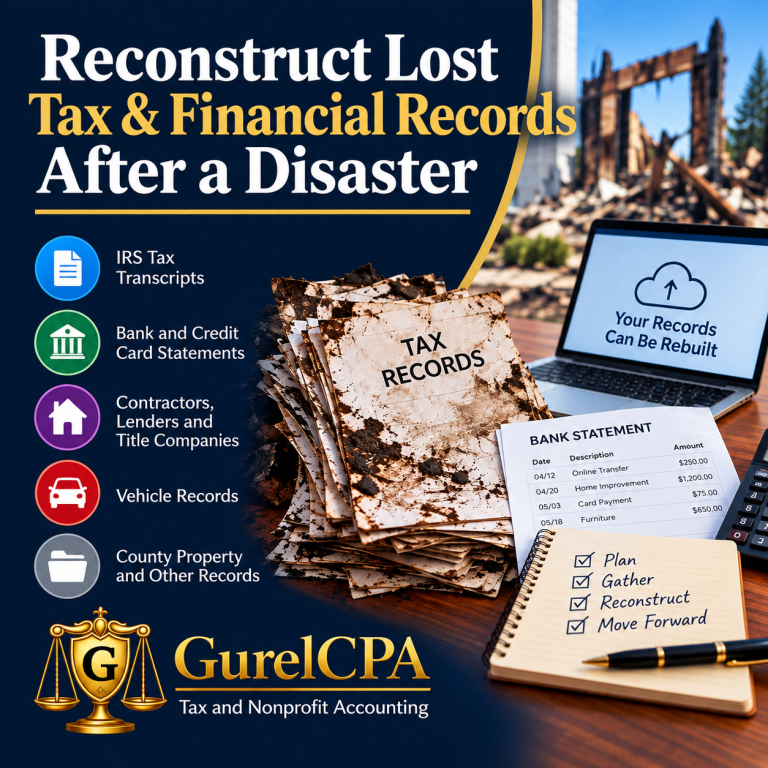
Banks, credit card companies, contractors, lenders, title companies, government agencies, vehicle dealers and previously filed tax returns can all become sources for reconstructing a financial history.
The process may require some detective work, but it is often possible to rebuild a substantial record of what existed before the disaster.
For taxpayers dealing with a significant loss, organizing this information early can make subsequent tax, insurance and disaster-assistance claims much easier to handle.
The article is meant for informational purposes only. Please contact me directly to discuss how this applies to your individual tax situation.