Seven IRS Online Tools Taxpayers and Business Owners Should Know About
The IRS has expanded its online services considerably. Individuals and business owners can now obtain records, review notices, make payments, monitor refunds, protect themselves from tax-related identity theft, and address tax debt without waiting on hold or visiting an IRS office.
Not every feature is available to every taxpayer, and access to business information depends on the type of entity and the user's role. Even with those limitations, the following seven resources can make routine federal tax matters easier to manage.
1. IRS Individual Online Account
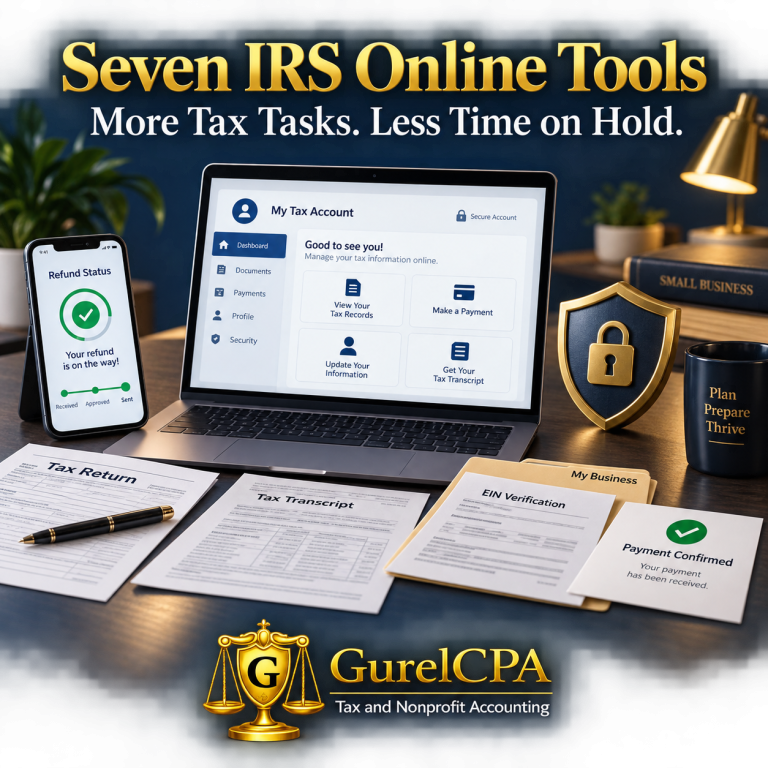
An IRS Individual Online Account provides one secure place to review your personal federal tax information. You can view balances by tax year, access transcripts and tax compliance reports, review up to five years of payment history, and see available information returns such as Forms W-2 and certain Forms 1099.
The account also allows you to check the status of a refund or amended return, view digital notices, go paperless for certain correspondence, receive email notifications, and view the status of audits conducted by mail. You can make or cancel payments, schedule bank-account payments up to 365 days in advance, apply for or revise a payment plan, and create a plan for an amount you expect to owe for the current year.
The Profile section lets you request and retrieve an Identity Protection PIN, or IP PIN, which helps prevent someone else from filing a return using your Social Security number or Individual Taxpayer Identification Number. You can also review and electronically approve certain power of attorney and tax information authorization requests from your tax professional.
2. IRS Business Tax Account
The IRS Business Tax Account is available to an expanding group of businesses and organizations, including eligible sole proprietors with an EIN, partnerships, S corporations, C corporations, tax-exempt organizations, government entities, and Indian tribal governments. Access depends on the entity type and whether the user qualifies for limited access or as a designated official with full access.
Depending on eligibility and role, users may view business information, balances and payment history; make federal tax deposits and other payments; download tax transcripts and tax compliance reports; read digital IRS notices; and manage designated users. Some partners and S corporation shareholders have limited access based on Schedules K-1 already on file.
Eligible full-access users can now download an EIN verification notice from the Tax Records section. The downloadable CP 575 can provide confirmation of the business's EIN and may be used instead of requesting Letter 147C. This can be helpful when a bank, financial institution, licensing agency, or another organization asks for proof of an EIN.
One important limitation remains: a single-member LLC that files as a sole proprietor on Schedule C or Schedule F is not currently eligible for a Business Tax Account solely under that filing status. Because eligibility and available functions continue to change, business owners should check the IRS page for their particular entity and role.
3. IRS Interactive Tax Assistant
The Interactive Tax Assistant asks a series of questions and provides an answer based on the information entered. It covers many common issues, including filing requirements, filing status, dependents, taxable income, retirement distributions, deductions, and eligibility for credits.
The tool can be useful for answering a focused preliminary question, but the result is limited to the facts entered and the topics programmed into the interview. It does not examine your complete tax situation or replace professional judgment when the facts are complicated or uncertain.
4. IRS Tax Withholding Estimator
The Tax Withholding Estimator helps employees and retirees estimate whether enough federal income tax is being withheld during the year. It can help you decide whether to submit a new Form W-4 to an employer or Form W-4P to a pension payer.
A withholding review is especially useful after a marriage, divorce, new job, retirement, major income change, change in dependents, or a tax return that produced an unexpected balance due or refund. Before using the estimator, gather recent pay statements, pension information, other income estimates, and your most recent federal tax return. The estimator provides guidance, but the taxpayer must still complete and submit the appropriate withholding form.
5. Where Is My Refund Tool
Where's My Refund provides the status of federal income tax refunds for the three most recent tax years. For a current-year electronically filed return, information generally becomes available about 24 hours after filing. For an electronically filed prior-year return, it generally appears after three to four days. Paper returns may take about four weeks to appear.
You will need your Social Security number or ITIN, filing status, and exact refund amount. The tool is normally the best source of refund-status information. Calling the IRS usually will not provide more detail unless the tool directs you to call or the normal processing period has passed.
6. IRS Online Payment Options
The IRS offers several ways to pay electronically. Individuals can use IRS Direct Pay to pay from a bank account without a registration fee. Debit cards, credit cards, digital wallets, the Electronic Federal Tax Payment System, and payments through an Individual Online Account may also be available. Processing fees generally apply when using a card or digital wallet through an authorized payment processor.
Depending on the method selected, taxpayers may make balance-due payments, estimated tax payments, extension payments, amended-return payments, and other federal tax payments. An online account can also display pending or scheduled payments and payment history. Always verify the tax year and payment type before submitting a payment, and retain the confirmation number.
7. IRS Tax Debt Help
In 2026, the IRS introduced Tax Debt Help, an interactive tool for individuals and businesses that owe federal taxes. It asks straightforward questions about the taxpayer's circumstances and points to potential next steps. Depending on the situation, those options may include a payment plan, a temporary delay in collection, or an offer in compromise for taxpayers who qualify.
Tax Debt Help does not require a name, Social Security number, address, or other personally identifiable information. That allows taxpayers to explore possible resolution paths privately before deciding what action to take. The tool is educational and does not itself guarantee eligibility or approval for any collection alternative.
Create Your Accounts Before You Need Them
Creating an IRS online account before a filing deadline, payment problem, or missing-document issue can save valuable time. Registration requires identity verification, so it is better to complete that process when there is no immediate crisis.
Use IRS.gov or the IRS2Go mobile app to reach IRS services. Avoid links in unexpected emails, text messages, or social media posts that claim to provide access to an IRS account, refund, or payment portal.
The article is meant for informational purposes only. Please contact me directly to discuss how this applies to your individual tax situation.