The 2027 Federal Standard Deduction Is Going Up
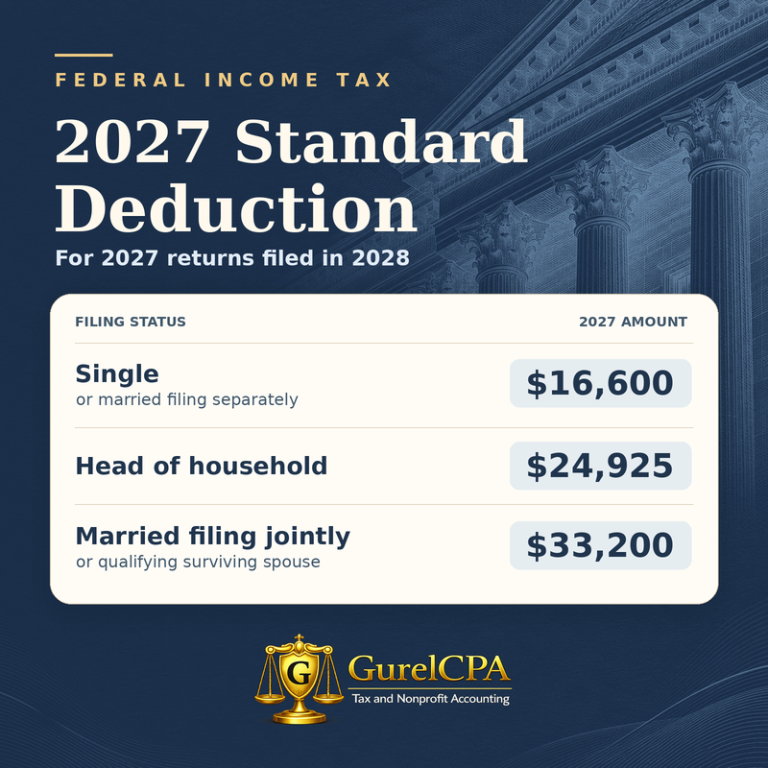
The IRS has announced higher federal standard deduction amounts for 2027. These amounts apply to tax year 2027, for returns most people will file in 2028.
How Much Is The Standard Deduction For 2027
If you’re single or married filing separately, the basic standard deduction rises to $16,600, up $500 from $16,100 in 2026. If you file as head of household, it rises to $24,925, up $775 from $24,150. For married couples filing jointly and qualifying surviving spouses, it rises to $33,200, up $1,000 from $32,200.
Different rules can apply if someone else can claim you as a dependent. If you’re married filing separately and your spouse itemizes, you generally must itemize as well.
What A Larger Deduction Means For Your Tax Bill
The standard deduction reduces the income subject to federal income tax. For example, if you’re single and the full $500 increase reduces income that would otherwise be taxed at 12%, the increase would save you $60 in federal income tax, all else being equal.
Extra Deductions For Older Taxpayers And People Who Are Blind
If you take the standard deduction and are 65 or older or legally blind, you generally get an additional $1,700 for each qualifying condition in 2027. That amount is $2,100 per qualifying condition for unmarried taxpayers filing as single or head of household.
For example, a married couple filing jointly with both spouses age 65 or older would generally have a total standard deduction of $36,600 before considering the separate senior deduction.
The temporary enhanced deduction for seniors also applies in 2027. Eligible taxpayers age 65 or older can claim up to $6,000 per person, whether they take the standard deduction or itemize. The deduction begins to phase out when modified adjusted gross income exceeds $75,000, or $150,000 for joint filers. Married taxpayers must file jointly to claim it.
When It Still Pays To Itemize
If you qualify for the standard deduction, compare it with what you could claim by itemizing. Deductible mortgage interest, state and local taxes, charitable gifts, and qualifying medical expenses can add up, especially in a year when you make a large gift or have unusually high medical bills. If your allowable itemized deductions exceed your standard deduction, itemizing generally gives you the larger federal deduction.
The article is meant for informational purposes only. Please contact me directly to discuss how this applies to your individual tax situation.