Bona Fide Residence vs. Physical Presence:
How Do You Qualify for the Foreign Earned Income Exclusion?
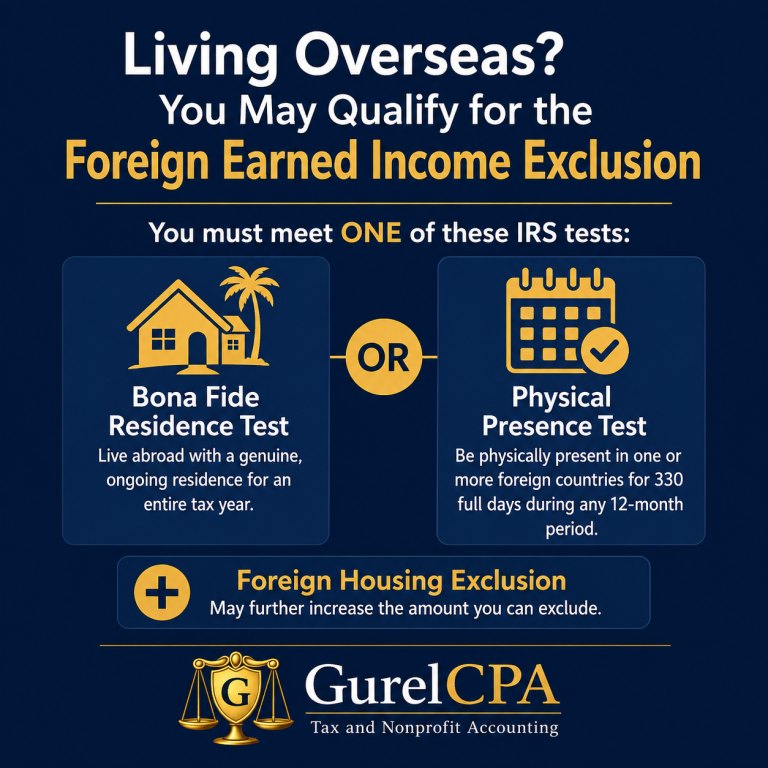
Living overseas does not automatically qualify you for the Foreign Earned Income Exclusion (FEIE). To qualify, you generally must have foreign earned income, have your tax home in a foreign country, and meet either the Bona Fide Residence Test or the Physical Presence Test.
For 2026, the maximum FEIE is $132,900 per qualifying person. If you qualify for only part of the year, the maximum exclusion is generally prorated based on your qualifying days.
First Requirement: A Foreign Tax Home
Before either residence test matters, your tax home generally must be in a foreign country during your qualifying period. Your tax home is usually your regular or principal place of business, employment, or post of duty. Maintaining a home in the United States does not automatically disqualify you, but your family, economic, and personal ties can affect whether your abode remains in the United States.
Bona Fide Residence Test
The Bona Fide Residence Test focuses on whether you have established a genuine residence in a foreign country for an uninterrupted period that includes an entire tax year. For a calendar-year taxpayer, that means January 1 through December 31.
This is a facts-and-circumstances test. The IRS may consider the nature and length of your stay, your intention, your housing, family and community ties, and other evidence showing whether the foreign country has become your residence. A particular foreign resident or work visa is not specifically required under U.S. tax law, although you still must comply with the laws of the foreign country.
This test is often most relevant to long-term expatriates who establish an ongoing life and residence abroad. Brief or temporary trips to the United States do not necessarily end bona fide residence if you intend to return to your foreign residence without unreasonable delay.
Physical Presence Test
The Physical Presence Test is primarily a day-count test. You must be physically present in one or more foreign countries for at least 330 full days during any period of 12 consecutive months.
The 330 days do not have to be consecutive, and the 12-month period does not have to match the calendar year. This test is often useful for contractors, digital nomads, and taxpayers on temporary overseas assignments. Careful travel records are important because partial days and time spent outside a foreign country can affect the count.
Foreign Housing Exclusion or Deduction
Qualifying taxpayers may also be able to exclude or deduct certain foreign housing costs. The foreign housing exclusion generally applies to qualifying housing costs paid with employer-provided amounts, while self-employed taxpayers may qualify for a foreign housing deduction for costs paid from self-employment earnings.
Potential qualifying housing expenses can include:
- Rent
- Utilities other than telephone charges
- Property insurance
- Residential parking
- Certain occupancy taxes
For 2026, the base housing amount for a taxpayer qualifying for the full year is $21,264. The general maximum housing-expense limitation is $39,870, although the IRS allows higher limits for certain high-cost foreign locations. The housing exclusion is calculated before the FEIE, so the two benefits do not simply stack as separate unlimited exclusions.
Important for the Self-Employed: FEIE Does Not Eliminate Self-Employment Tax
This is an important distinction for Americans operating a business or working independently overseas. The FEIE can reduce regular U.S. income tax on qualifying foreign earned self-employment income, but the excluded income generally remains subject to U.S. self-employment tax. A totalization agreement with another country may affect Social Security coverage in some situations, but that is a separate analysis.
Claiming the Exclusion
The FEIE and the foreign housing exclusion or deduction are generally calculated on Form 2555 and filed with Form 1040. Choosing the FEIE can also affect other parts of the return. For example, you generally cannot claim a foreign tax credit for foreign taxes attributable to income you exclude, and special rules apply when calculating tax on income that remains taxable.
Why This Matters
A taxpayer can live abroad and still fail to qualify because the foreign tax home requirement is not met. Others may qualify but use the wrong residence test, miscount travel days, overlook housing benefits, or fail to document their foreign residence and travel carefully.
If you are living or working overseas, whether permanently or temporarily, we can review your situation to determine whether you qualify, which test applies, and whether the foreign housing exclusion or deduction may provide additional tax savings.
Questions? Let’s Talk.
The article is meant for informational purposes only. Please contact me directly to discuss how this applies to your individual tax situation.