Washington Has No State Income Tax, But…
One of the biggest misconceptions about living or doing business in Washington is that the state is "tax free."
It's true that Washington does not impose a personal state income tax like California, Oregon, Idaho, and many other states. However, that doesn't mean Washington residents or businesses avoid state taxes. Instead,Washington relies on a different combination of taxes to fund schools, transportation, public safety, and other essential government services.
Understanding how Washington's tax system works can help individuals, retirees, investors, and business owners avoid surprises and make better financial decisions.
No Personal State Income Tax
For most wage earners and retirees, Washington's biggest tax advantage is straightforward.
There is no Washington state tax on wages, salaries, pensions, IRA withdrawals, 401(k) distributions, Social Security benefits, or most other ordinary income.
For many retirees, this is one of the primary reasons Washington remains an attractive place to live.
But that is only part of the story.
Sales Tax
Washington relies heavily on sales taxes.
Depending on where you live, combined state and local sales tax rates often exceed 9%.
Unlike an income tax, sales tax is paid throughout the year whenever taxable goods and many services are purchased. Because the tax is collected a little at a time, many people underestimate how much they actually pay each year.
Property Taxes
Property taxes are another major source of state and local revenue.
These taxes help support schools, fire districts, libraries, parks, emergency services, and other local government functions.
While Washington's property taxes are lower than those in some states, they still represent a significant annual expense for many homeowners and commercial property owners.
Washington's Capital Gains Tax
Beginning in 2022, Washington imposed a tax on certain long-term capital gains above an annual exemption amount.
Fortunately, many common transactions are excluded, including sales of real estate, IRA and 401(k) distributions, most retirement income, many qualified family-owned businesses, and numerous other specifically exempt assets.
Most Washington taxpayers will never owe this tax. However, individuals selling highly appreciated stock, concentrated investment positions, or certain business interests should consider the tax consequences before completing a transaction.
Washington Estate Tax
Many people assume that because Washington has no personal income tax, it also has no estate tax.
In fact, Washington has one of the more significant state estate tax systems in the country.
Washington currently exempts only the first $3 million of a taxable estate. Estates exceeding that amount may owe Washington estate tax even when no federal estate tax is due. Because the current federal exemption is substantially higher, some families are surprised to learn that Washington estate tax planning may become important long before federal estate tax planning does.
Families with appreciated real estate, investment portfolios, family businesses, or other substantial assets should consider discussing estate planning well before it becomes necessary.
A New Tax on Very High-Income Households
Washington's tax system continues to evolve.
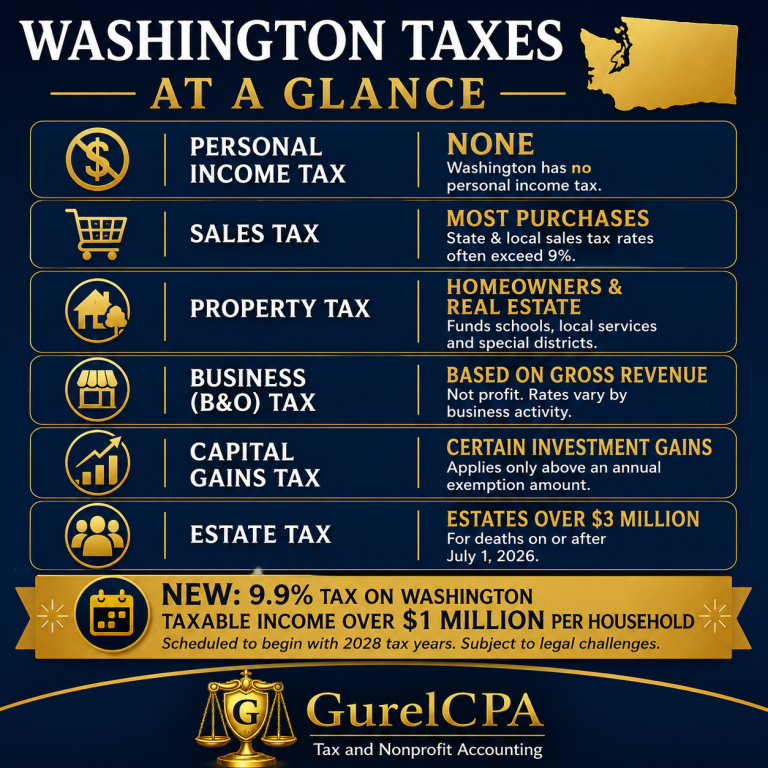
In 2025, lawmakers enacted a new 9.9% tax on Washington taxable income exceeding $1 million per household. The tax is scheduled to apply beginning with tax years starting January 1, 2028, with the first returns generally filed in 2029.
Because Washington has historically operated without a broad personal income tax, this legislation represents a significant change for affected taxpayers. At the same time, legal challenges are expected before the law becomes fully effective, so individuals who may be affected should continue to monitor developments.
Business Taxes
Washington also taxes businesses differently than many other states.
Rather than imposing a traditional corporate income tax, Washington primarily relies on the Business & Occupation (B&O) Tax, which is generally based on gross receipts rather
Washington's Tax System Is Different
Instead of relying primarily on a personal income tax, Washington raises revenue through a combination of sales taxes, property taxes, Business & Occupation (B&O) taxes, estate taxes, capital gains taxes on certain transactions, and new taxes affecting some very high-income households.
Each tax applies to different people under different circumstances, making planning especially important before major financial decisions.
The Bottom Line
Washington's lack of a personal state income tax is certainly an advantage for many residents.
However, it is only one piece of a much larger tax picture.
Whether you are retiring, relocating to Washington, selling investments, starting a business, or planning your estate, understanding how Washington's tax system works can help you avoid costly surprises and make better long-term financial decisions.
The article is meant for informational purposes only. Please contact me directly to discuss how this applies to your individual tax situation. I offer a complimentary initial consultation and would be happy to help determine the best approach for your business.
Washington Has No State Income Tax, But…
One of the biggest misconceptions about living or doing business in Washington is that the state is "tax free."
It's true that Washington does not impose a personal state income tax like California, Oregon, Idaho, and many other states. However, that doesn't mean Washington residents or businesses avoid state taxes. Instead,Washington relies on a different combination of taxes to fund schools, transportation, public safety, and other essential government services.
Understanding how Washington's tax system works can help individuals, retirees, investors, and business owners avoid surprises and make better financial decisions.
No Personal State Income Tax
For most wage earners and retirees, Washington's biggest tax advantage is straightforward.
There is no Washington state tax on wages, salaries, pensions, IRA withdrawals, 401(k) distributions, Social Security benefits, or most other ordinary income.
For many retirees, this is one of the primary reasons Washington remains an attractive place to live.
But that is only part of the story.
Sales Tax
Washington relies heavily on sales taxes.
Depending on where you live, combined state and local sales tax rates often exceed 9%.
Unlike an income tax, sales tax is paid throughout the year whenever taxable goods and many services are purchased. Because the tax is collected a little at a time, many people underestimate how much they actually pay each year.
Property Taxes
Property taxes are another major source of state and local revenue.
These taxes help support schools, fire districts, libraries, parks, emergency services, and other local government functions.
While Washington's property taxes are lower than those in some states, they still represent a significant annual expense for many homeowners and commercial property owners.
Washington's Capital Gains Tax
Beginning in 2022, Washington imposed a tax on certain long-term capital gains above an annual exemption amount.
Fortunately, many common transactions are excluded, including sales of real estate, IRA and 401(k) distributions, most retirement income, many qualified family-owned businesses, and numerous other specifically exempt assets.
Most Washington taxpayers will never owe this tax. However, individuals selling highly appreciated stock, concentrated investment positions, or certain business interests should consider the tax consequences before completing a transaction.
Washington Estate Tax
Many people assume that because Washington has no personal income tax, it also has no estate tax.
In fact, Washington has one of the more significant state estate tax systems in the country.
Washington currently exempts only the first $3 million of a taxable estate. Estates exceeding that amount may owe Washington estate tax even when no federal estate tax is due. Because the current federal exemption is substantially higher, some families are surprised to learn that Washington estate tax planning may become important long before federal estate tax planning does.
Families with appreciated real estate, investment portfolios, family businesses, or other substantial assets should consider discussing estate planning well before it becomes necessary.
A New Tax on Very High-Income Households
Washington's tax system continues to evolve.
In 2025, lawmakers enacted a new 9.9% tax on Washington taxable income exceeding $1 million per household. The tax is scheduled to apply beginning with tax years starting January 1, 2028, with the first returns generally filed in 2029.
Because Washington has historically operated without a broad personal income tax, this legislation represents a significant change for affected taxpayers. At the same time, legal challenges are expected before the law becomes fully effective, so individuals who may be affected should continue to monitor developments.
Business Taxes
Washington also taxes businesses differently than many other states.
Rather than imposing a traditional corporate income tax, Washington primarily relies on the Business & Occupation (B&O) Tax, which is generally based on gross receipts rather
Washington's Tax System Is Different
Instead of relying primarily on a personal income tax, Washington raises revenue through a combination of sales taxes, property taxes, Business & Occupation (B&O) taxes, estate taxes, capital gains taxes on certain transactions, and new taxes affecting some very high-income households.
Each tax applies to different people under different circumstances, making planning especially important before major financial decisions.
The Bottom Line
Washington's lack of a personal state income tax is certainly an advantage for many residents.
However, it is only one piece of a much larger tax picture.
Whether you are retiring, relocating to Washington, selling investments, starting a business, or planning your estate, understanding how Washington's tax system works can help you avoid costly surprises and make better long-term financial decisions.
The article is meant for informational purposes only. Please contact me directly to discuss how this applies to your individual tax situation. I offer a complimentary initial consultation and would be happy to help determine the best approach for your business.