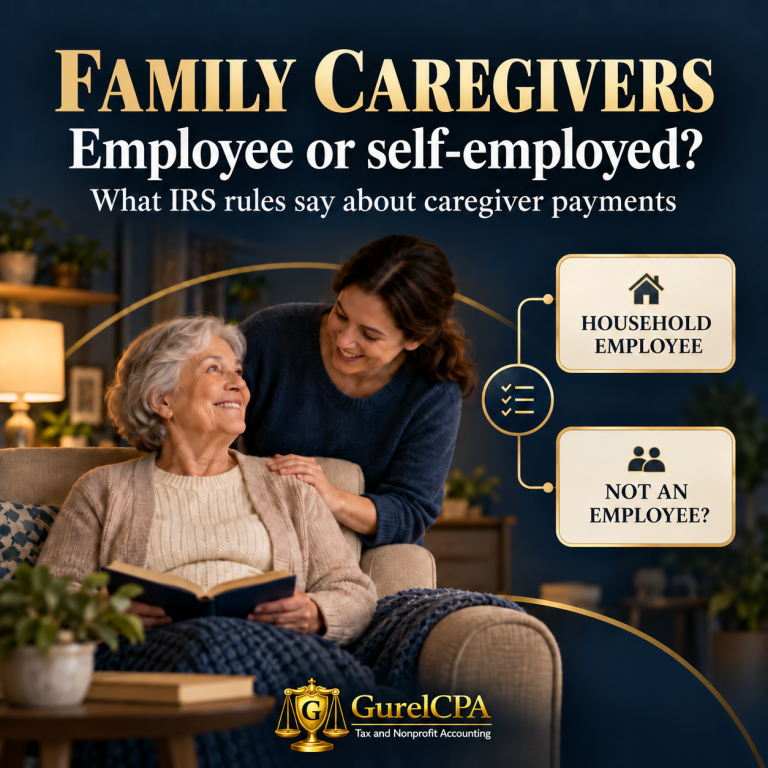
Family Caregivers: Employee or Self-Employed?
Families sometimes pay a relative to care for an older parent, a disabled spouse, or a child. The tax treatment can be confusing: Is the caregiver an employee? If not, is the payment self-employment income? Recent IRS guidance helps explain why those are separate questions and why the answer depends on the actual arrangement.
Start with who controls the work
A caregiver who provides services in someone’s home is often a household employee when the person receiving care, or the person acting for them, has the right to direct not only what work is done but how it is done. The family may set the schedule, assign daily tasks, and decide how the care should be carried out. The fact that the caregiver is a relative does not, by itself, make the worker an independent contractor.
An agency or care business may change the analysis. If the family hires and pays an agency that employs and supervises the caregiver, the agency may be the employer. If a family hires a worker directly, labels the arrangement “contract labor,” or receives a Form 1099, those details alone do not decide worker status. The facts, including who has the right to control the work, matter.
Employee status and payroll taxes are different questions
Some family caregivers are employees even when a special rule means the household employer does not owe certain Social Security, Medicare, or unemployment taxes. For example, the IRS describes special treatment for wages paid to a spouse, a child under 21, a parent in many situations, and certain workers under age 18. These exceptions generally affect which employment taxes apply; they do not automatically turn an employee into an independent contractor. Wages may still need to be reported on Form W-2.
When household employment taxes apply, the family may have responsibilities for withholding and paying employment taxes and reporting them, often through Schedule H with the household employer’s individual income tax return. The exact filing and tax requirements depend on the worker’s relationship to the employer, the services performed, and the amount and timing of payments. Publication 926 provides the current-year thresholds and exceptions.
When a caregiver is not an employee
The IRS also recognizes situations in which a family member receiving care is not the caregiver’s employer. A caregiver may receive payments from an insurance company or state agency, for example. If the caregiver is not an employee and is not operating a caregiving business, the payment may be taxable income without being subject to self-employment tax.
The IRS gives examples of a spouse caring for a disabled spouse at home and a grandparent caring for grandchildren so their parent can work. In the examples, the caregivers do not provide similar services to others or run a caregiving or daycare business. The IRS says the payments are reported as other income on Schedule 1, rather than as self-employment income. These are fact-specific examples, not a blanket rule that every family caregiver is exempt from self-employment tax.
If the caregiver regularly offers services to clients, operates a care business, or otherwise carries on caregiving as a trade or business, self-employment tax may apply to net earnings. Whether a worker is an employee is also distinct from whether income is taxable: compensation generally must be reported even when it is not subject to self-employment tax.
A practical checklist for families
Before deciding how to report payments, write down who hired the caregiver, who pays them, who sets the schedule, who directs the daily work, whether an agency is involved, and whether the caregiver provides services to other clients as a business. Keep agreements, payment records, and any Forms 1099 or statements from insurers or government programs.
Do not rely on a family relationship, a contract label, or the form a payer issued as the only test. If the facts point to household employment, check the current IRS household-employer rules and determine whether Form W-2 and Schedule H are required. If the caregiver is not an employee, determine whether the work is a business and how the income should be reported. When the classification remains uncertain, the IRS says either party may request a worker-status determination using Form SS-8.
The takeaway
The central question is who has the right to control the caregiving work. A family caregiver can be an employee even when family-member exceptions reduce employment taxes. A nonemployee caregiver may still have taxable income, while self-employment tax depends on whether the caregiver is carrying on a trade or business. Reviewing the arrangement before filing can help families report payments correctly and avoid treating a complicated situation as a simple 1099 issue.
The article is meant for informational purposes only. Please contact me directly to discuss how this applies to your individual tax situation.