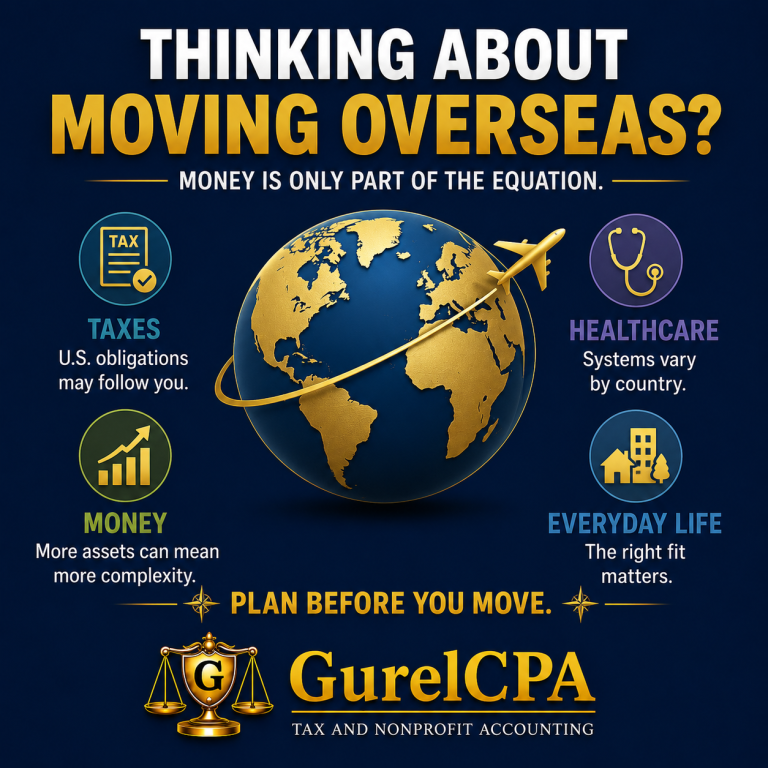
Thinking About Moving Overseas?
Money Is Only Part of the Equation
For many Americans, the idea of living overseas is appealing. A different pace of life, lower living costs, better weather, new experiences, or simply the opportunity for a change can make another country an attractive place to live or retire.
But a successful move overseas requires considerably more planning than simply deciding whether you can afford it.
In fact, having substantial income or assets can sometimes make an international move more complicated, not less.
Every Country Is Different
There is no single set of rules for Americans moving abroad.
Tax residency, income taxes, investment taxation, inheritance and gift taxes, property ownership, visas, and the treatment of retirement income vary dramatically from one country to another.
A country that works beautifully for one person's financial situation may create unexpected problems for someone else.
Before deciding where to live, it is important to understand how that country's rules will apply specifically to you.
Your U.S. Tax Obligations Usually Come With You
Moving overseas does not end a U.S. citizen's federal income tax responsibilities.
U.S. citizens remain subject to U.S. tax reporting on their worldwide income regardless of where they live. However, depending on the circumstances, provisions such as the foreign tax credit or foreign earned income exclusion may help reduce double taxation.
There can also be additional reporting requirements involving foreign bank accounts and financial assets, including FBAR and potentially Form 8938.
Living overseas means dealing with two tax systems at the same time.
More Wealth Can Mean More Complexity
Having substantial assets provides flexibility when moving abroad, but those assets can also create additional complications.
Investment accounts, retirement plans, trusts, business interests, real estate, estate planning, and other investments may receive very different tax treatment in another country.
The reverse is also important. A financial product or investment that is perfectly ordinary in your new country may have complicated U.S. tax consequences.
That is why choosing a destination based primarily on an attractive tax rate can be a mistake. The important question is how the country's tax system interacts with your particular income, investments, retirement accounts, and other assets.
Healthcare Can Be Just as Important as Taxes
Healthcare deserves careful consideration, particularly for retirees.
Some countries have national healthcare systems. Others rely more heavily on private insurance. Eligibility for public healthcare may depend on residency status, employment, age, or other factors.
Medicare generally does not cover healthcare received outside the United States, except in limited circumstances.
Before moving, consider not only the cost of healthcare but also access to physicians and specialists, prescription medications, private insurance, emergency care, and long-term care.
Plan Before You Move
International tax planning is much easier before a move than after one.
Changing tax residency, selling investments, restructuring accounts, moving money, buying foreign property, or establishing foreign financial accounts can have consequences in both the United States and your destination country.
Ideally, Americans considering an international move should review their U.S. tax situation before establishing residency abroad and coordinate that planning with a knowledgeable professional in the country where they intend to live.
The best country is not necessarily the cheapest one or the country offering the most attractive tax incentive. It is the place where your lifestyle, finances, healthcare, residency requirements, and tax situation work together.
If you are considering living or retiring overseas, I offer a free initial consultation to discuss the U.S. tax issues that may apply to your situation.
The article is meant for informational purposes only. Please contact me directly to discuss how this applies to your individual tax situation. I offer a free initial consultation, and I work with U.S. taxpayers living both in the United States and abroad.