What Does Your Form 990 Say About Your Nonprofit?
Your nonprofit's annual filing is also part of its public story.
Many nonprofit leaders think of Form 990 primarily as an annual IRS filing requirement. Once it is completed and filed, they may consider the job finished.
But Form 990 is more than a tax return. It is one of the most visible public documents your nonprofit produces.
The IRS makes Form 990-series filings available through its Tax Exempt Organization Search, and tax-exempt organizations generally must make their annual returns available for public inspection. Potential donors, grantors, board candidates, journalists, volunteers, and community partners may review the return before deciding whether to support or work with an organization.
That means your Form 990 does more than report numbers. It communicates your nonprofit's financial health, priorities, governance, and impact.
Here are five things readers may notice:
1. Revenue Sources and Financial Health
The financial sections of Form 990 show where an organization's revenue comes from and how its financial position has changed.
Readers may look at:
- Contributions and grants
- Program service revenue
- Fundraising revenue
- Investment and other income
- Total expenses
- Assets, liabilities, and net assets
A healthy nonprofit does not necessarily need a large budget or substantial reserves. However, the return should present a financial picture that is understandable and consistent with the organization's size, programs, and stage of development.
Large fluctuations, recurring deficits, declining contributions, or heavy reliance on one revenue source may raise questions. Those figures are not automatically signs of a problem, but the nonprofit should understand what they communicate.
Schedule O and other narrative sections may provide opportunities to explain unusual circumstances, organizational changes, or important financial developments.
2. How Resources Support the Mission
Form 990 reports how the organization uses its resources, including amounts devoted to programs, management and general activities, and fundraising.
Readers may compare what the nonprofit says it exists to accomplish with how it actually spends its money.
Program expenses alone do not tell the entire story. A nonprofit needs administration, financial management, technology, insurance, staff development, and fundraising to operate responsibly. Strong organizations invest in the systems that support their mission.
The important question is whether the spending pattern makes sense for the organization.
The return should help readers understand how financial resources support actual programs and services, rather than leaving them to interpret the numbers without context.
3. Executive Compensation
Form 990 may disclose compensation paid to officers, directors, trustees, key employees, and certain highly compensated employees.
Compensation is not inherently a concern. Nonprofits need qualified leadership, and reasonable compensation can help an organization attract and retain capable people.
Readers may nevertheless ask:
- Is the compensation reasonable for the organization's size and activities?
- Is the amount clearly and accurately reported?
- Did independent board members approve the compensation?
- Did the organization use appropriate comparison information?
- Is the process documented?
Transparency is especially important when an officer or board member is also a paid employee or contractor. Related financial arrangements should be properly reviewed, approved, documented, and disclosed.
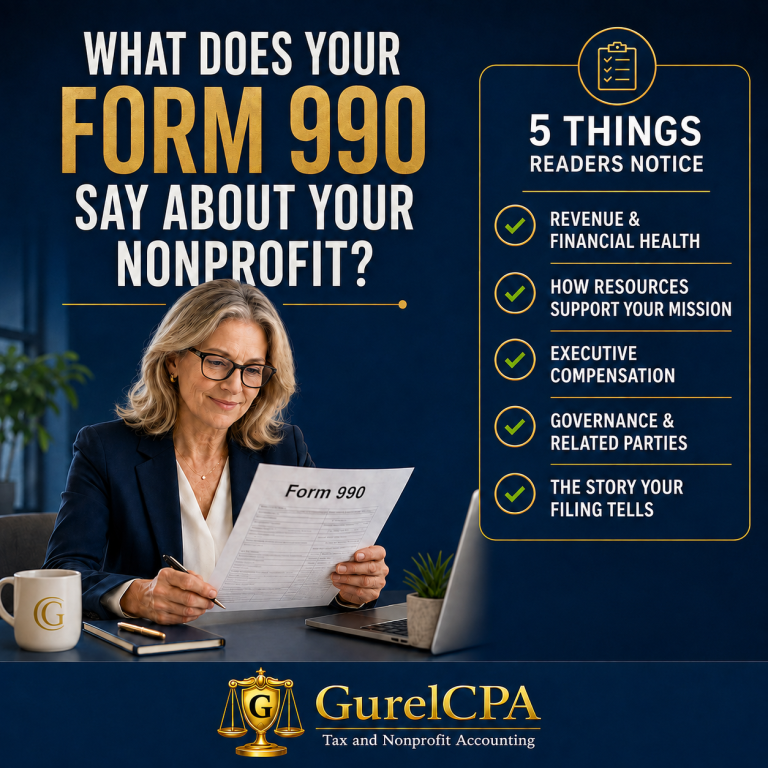
4. Governance and Related Parties
Part VI of Form 990 asks about governance practices, management, and disclosure. It includes questions about board independence, conflicts of interest, document retention, whistleblower policies, compensation procedures, and whether the governing board received a copy of the return before filing.
The IRS does not require the board to review Form 990. However, the return asks the organization to describe its review process in Schedule O. A meaningful board review can demonstrate that the organization treats the filing as an important governance document rather than merely an administrative obligation.
The return may also disclose transactions involving officers, directors, trustees, key employees, family members, and related organizations.
These disclosures help readers evaluate whether the nonprofit has appropriate oversight and whether potential conflicts of interest are being handled responsibly.
5. The Story the Filing Tells
The most overlooked section of Form 990 may be Part III, the Statement of Program Service Accomplishments.
This is where a nonprofit can explain what it actually accomplished during the year. The IRS instructions encourage organizations to describe results using measurements such as the number of people served, events held, services provided, publications issued, or other relevant indicators.
Weak descriptions often repeat a general mission statement without explaining what occurred during the year.
A stronger description answers questions such as:
- What programs did the organization operate?
- Who benefited?
- How many people were served?
- What services were provided?
- What changed because of the organization's work?
- What important results were achieved?
Schedule O can provide additional space when the standard form does not allow enough room to tell the story clearly.
These narratives may be read by people who know little about the organization. They should be accurate, specific, and understandable without requiring inside knowledge.
Review Your Form 990 Through the Reader's Eyes
Before filing, nonprofit leaders and board members should review Form 990 from two perspectives.
First, is the return complete, accurate, and compliant with IRS requirements?
Second, what impression will it create for someone deciding whether to donate, provide a grant, join the board, volunteer, or partner with the organization?
A technically correct return can still miss an important opportunity if it contains vague program descriptions, unexplained financial changes, incomplete governance information, or disclosures that do not reflect the organization's actual strengths.
Your Form 990 is more than a tax return. It is your nonprofit's public story. Make sure it tells that story clearly.
GurelCPA works with small and emerging nonprofits to improve Form 990 and Form 990-EZ reporting, strengthen program accomplishment narratives, and present financial and governance information more effectively. I offer a free one-on-one review for nonprofits that are concerned their current filing may not fully communicate their mission and accomplishments.
The article is meant for informational purposes only. Please contact me directly to discuss how this applies to your individual tax situation.