Standard Mileage vs. Actual Expenses
Which Vehicle Deduction Method Is Better?
If you use your personal vehicle for business, the IRS gives you two ways to deduct the cost:
- The standard mileage rate
- The actual expense method
You might think the question is simple: Which gives the larger deduction? But there are also important rules about when you can switch methods.
The Standard Mileage Rate
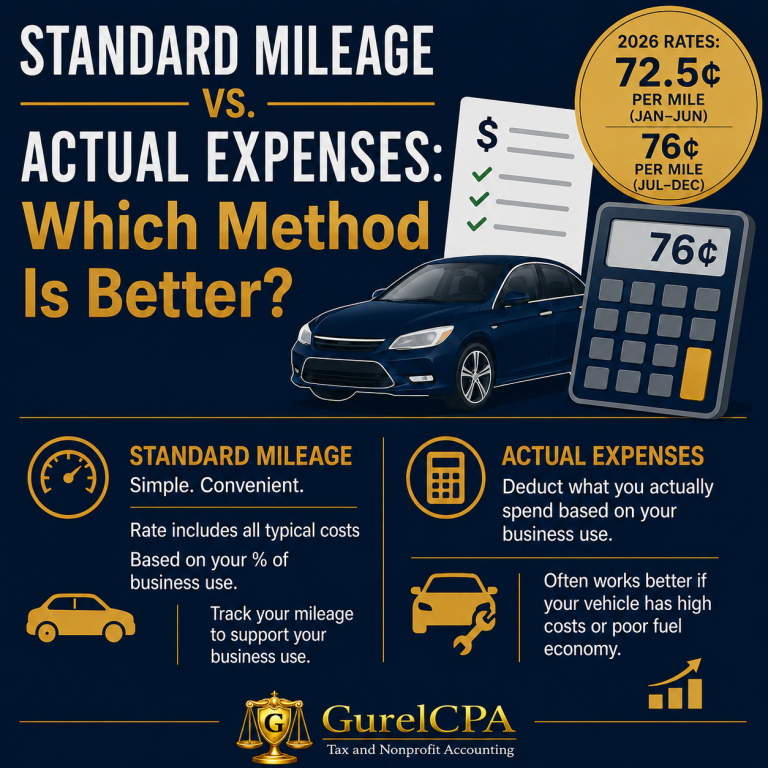
The standard mileage rate is an IRS estimate of the average cost of operating a vehicle. For 2026, it is 72.5 cents per mile for the first half of the year and 76 cents for the second half. The rate applies to cars, vans, pickups, and SUVs. It is intended to cover:
- Gas and oil
- Maintenance and repairs
- Tires
- Insurance
- Registration fees
- Depreciation
- General ownership costs
When you use the standard mileage method, you cannot separately deduct gas, repairs, insurance, depreciation, or most other vehicle expenses. Parking fees and tolls may still be deducted separately. The IRS treats all those costs as already included in the mileage rate.
How Much of the Rate Is Depreciation?
The IRS publishes only the depreciation portion of the standard mileage rate, not separate amounts for gas, insurance, or maintenance.
2024: Standard mileage rate 67 cents per mile; depreciation portion 30 cents per mile.
2025: Standard mileage rate 70 cents per mile; depreciation portion 33 cents per mile.
2026: Standard mileage rate 72.5 cents per mile; depreciation portion 35 cents per mile.
That means nearly half of the mileage rate is considered depreciation. The remainder represents fuel and operating costs.
The depreciation portion matters because it reduces your tax basis in the vehicle, even if you never separately claimed depreciation.
Actual Expenses
Under the actual expense method, you total all vehicle costs, including:
- Gas
- Oil
- Repairs
- Tires
- Insurance
- Registration
- Lease payments or depreciation
Then you multiply the total by your business-use percentage.
Example:
- Total miles driven: 20,000
- Business miles: 12,000
- Business use: 60%
If total vehicle expenses are $12,000, your deduction is:
$12,000 × 60% = $7,200
Which Method Usually Wins?
The standard mileage method often works very well when:
- The vehicle gets excellent fuel economy
- The vehicle is inexpensive to operate
- You drive many business miles
- The vehicle is already several years old
Actual expenses often work better when:
- The vehicle gets poor gas mileage
- Insurance is expensive
- Repairs are significant
- The vehicle is large or costly
- The vehicle is heavily depreciated
Can You Keep Track of Both?
Yes. Many business owners keep records of both mileage and actual expenses each year to determine which method is best.
However, there is an important rule:
If you own the vehicle and want the option of using the standard mileage rate, you must choose that method in the first year the vehicle is used for business.
- You may switch from standard mileage to actual expenses in a later year.
- If you switch to actual expenses, depreciation must generally be calculated using straight-line depreciation.
- If you start with actual expenses and use accelerated depreciation, Section 179, bonus depreciation, or MACRS, you generally cannot later switch to the standard mileage method.
For leased vehicles, if you begin with the standard mileage method, you must continue using it for the entire lease period.
Practical Advice
The safest approach is to keep a mileage log AND receipts for gas, repairs, insurance, registration, and other vehicle costs. Keeping a mileage log is important for determining your business use percentage.
That allows you and your tax preparer to compare both methods annually while preserving flexibility.
The standard mileage method is simple and often favorable for efficient vehicles with high business mileage. Actual expenses may produce larger deductions for trucks, vans, and expensive vehicles. The best method depends not only on this year's costs, but also on preserving the ability to use the most advantageous method in future years.
This article is for general information and not tax advice. The switching rules and depreciation rules can get complicated, especially when Section 179 or bonus depreciation is involved.