Form 1099-K
What Taxpayers Need to Know About Payment Apps, Cards, and Online Marketplaces
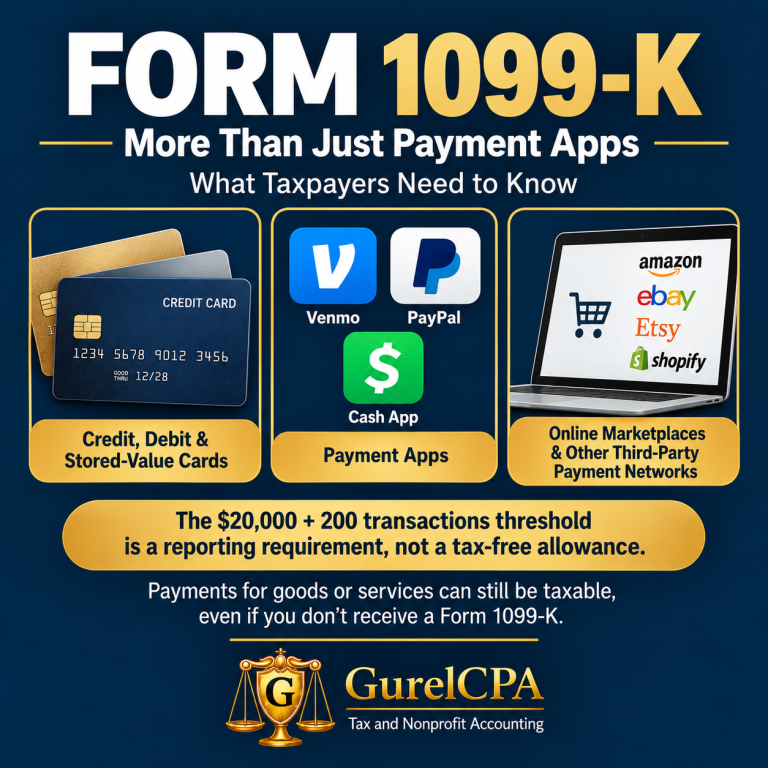
Form 1099-K is no longer something that concerns only traditional businesses accepting credit cards. Taxpayers may encounter the form after receiving payments through credit and debit cards, payment apps such as Venmo, PayPal, and Cash App, or online marketplaces and other third-party payment networks.
That has created considerable confusion about which payments are reportable and, more importantly, which payments are actually taxable.
The most important point is simple: Form 1099-K does not determine whether money is taxable. The reason you received the money determines how it should be treated.
What Is Form 1099-K?
Form 1099-K, Payment Card and Third Party Network Transactions, reports certain payments processed through:
Credit cards, debit cards, and stored-value cards
Payment apps such as Venmo, PayPal, and Cash App
Online marketplaces and other third-party settlement organizations
The payment processor sends a copy of Form 1099-K to both the taxpayer and the IRS. The form generally reports the gross amount processed, before subtracting expenses such as fees, refunds, shipping costs, or the cost of items sold.
Not All Form 1099-K Payments Use the Same Reporting Threshold
This is an important distinction. The familiar $20,000 and 200-transaction threshold applies to third-party settlement organizations for payments for goods and services. It does not apply in the same way to payment card transactions.
Under current federal law, a third-party settlement organization generally must issue Form 1099-K when payments for goods and services:
Exceed $20,000 during the calendar year, and
Involve more than 200 transactions
Both conditions must be met. However, payment processors may issue Form 1099-K below the federal threshold, and some states have lower reporting thresholds.
Credit and debit card payments operate under different rules. Payment card transactions may be reported on Form 1099-K regardless of the amount or number of transactions.
The Reporting Threshold Is Not a Tax-Free Allowance
The $20,000 and 200-transaction threshold is a reporting requirement for certain payment processors. It is not an income-tax exemption.
If you receive $5,000 for freelance work through Venmo, PayPal, Cash App, or another payment method, the income is generally taxable even if you do not receive Form 1099-K. Taxable business, gig, and self-employment income must be reported regardless of the amount received, the number of transactions, the method of payment, or whether a tax form was issued.
Cash payments and checks do not become tax-free simply because they are not reported on Form 1099-K.
Personal Payments Are Generally Not Taxable
Money received through a payment app is generally not taxable when it represents a personal transaction, such as:
A friend reimbursing you for dinner
A roommate paying a share of the rent or utilities
Family members sending birthday or holiday gifts
Repayment of a personal loan
Reimbursement for travel or shared household expenses
These payments are not income merely because they moved through a payment app.
Users should make sure personal payments are correctly identified as personal or as payments between friends and family. Incorrectly marking a reimbursement or gift as payment for goods or services could cause it to be included in Form 1099-K reporting.
Business Payments Are Taxable Income
Payments received for goods or services are generally taxable business income. Examples include freelance or consulting work, rideshare or delivery work, lawn care or repairs, online sales made as a business, rental or other income-producing activities, and payments received by an independent contractor.
Business owners should report their total business income based on their books and records, not simply copy the Form 1099-K amount onto the tax return.
Form 1099-K reports gross processed payments. The business may still be entitled to deduct ordinary and necessary business expenses, including payment-processing fees.
Online Marketplaces and Sales of Personal Property
Online marketplaces can generate Form 1099-K reporting, but the amount shown on the form does not necessarily equal taxable income. This is particularly important when taxpayers sell used personal belongings.
Suppose you bought a piece of furniture for $1,000 and later sold it through an online marketplace for $600. You received $600, but you did not have a taxable profit. The $400 personal loss is generally not deductible.
If you bought an item for $500 and sold it for $800, however, the $300 gain is generally taxable.
Form 1099-K may report the entire payment. It does not show what you originally paid for the item. Taxpayers should therefore keep purchase receipts or other evidence of their cost whenever possible.
What If Form 1099-K Includes Personal Payments or Is Incorrect?
Review every Form 1099-K carefully. Confirm that the taxpayer's name and identification number are correct, the reported amount belongs to the taxpayer, the form is not a duplicate, personal gifts or reimbursements were not incorrectly included, and the amount is assigned to the correct business.
If the form is incorrect, contact the issuer listed on the form and request a corrected Form 1099-K. Keep copies of the original form, the corrected form, and all correspondence.
Do not ignore an incorrect form. Because the IRS also receives a copy, an unexplained difference could result in an IRS notice. The return can still be prepared using the correct tax treatment and appropriate explanatory entries if a corrected form has not arrived.
Good Recordkeeping Matters
Taxpayers who regularly accept payments through cards, payment apps, or online marketplaces should maintain records that identify who made each payment, the reason for the payment, whether it was personal or business-related, refunds or payment reversals, processing fees, the original cost of personal property sold, and related business expenses.
For taxpayers who use payment apps for both personal and business purposes, maintaining separate personal and business accounts can make recordkeeping much easier.
The Bottom Line
Form 1099-K can arise from several different types of payment activity, including credit and debit cards, payment apps, and online marketplaces. Receiving a Form 1099-K does not automatically mean the entire amount is taxable, and not receiving one does not make otherwise taxable income tax-free.
Personal gifts, reimbursements, and shared expenses generally are not income. Payments for services, business activities, and profitable sales generally are taxable. The reason for the payment, not the payment method or the presence of Form 1099-K, determines the proper tax treatment.
The article is meant for informational purposes only. Please contact me directly to discuss how this applies to your individual tax situation.