What Nonprofits Should Tell Their Donors About Year End Giving in 2026
As nonprofits prepare their year-end appeals, donors may have questions about how new federal tax rules affect charitable gifts. Two changes took effect for 2026: some people who take the standard deduction may now claim a limited deduction for cash gifts, while people who itemize can deduct charitable gifts only to the extent they exceed a new income-based threshold. The changes affect donors’ tax calculations.
A new deduction for some donors who do not itemize
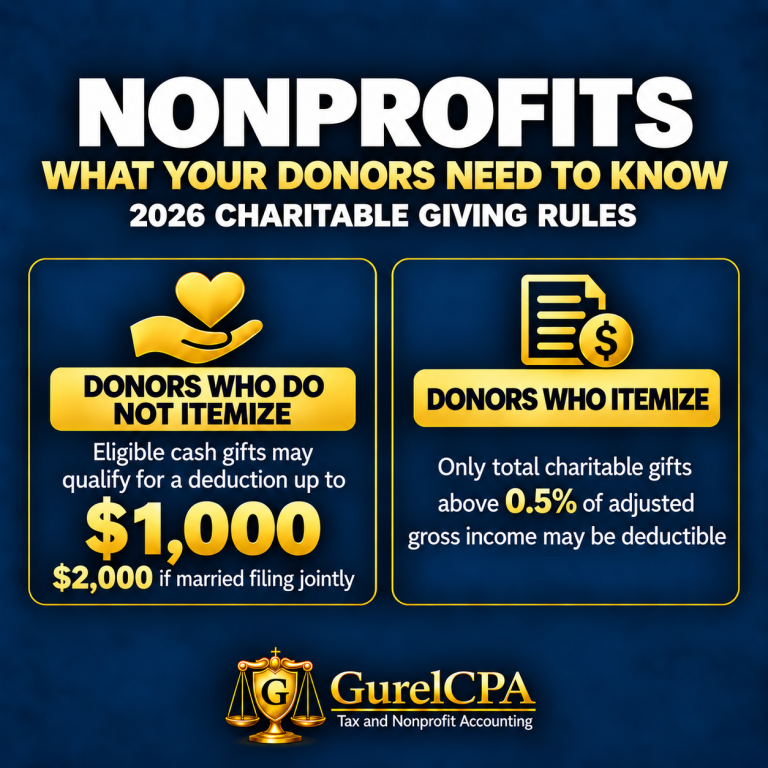
Beginning with 2026 tax returns, people who take the standard deduction may be able to deduct up to $1,000 in cash contributions, or $2,000 for married couples filing jointly, to eligible charitable organizations. That could make a federal tax deduction available to some donors who previously received no charitable deduction because they did not itemize.
The deduction is limited to cash gifts made during the tax year. Donations of stock, clothing, or other property do not qualify for this provision. Gifts to donor-advised funds and supporting organizations are also excluded. Donors should check whether their intended recipient qualifies and ask a tax professional about their own eligibility.
A new threshold for donors who itemize
For donors who itemize deductions, charitable contributions are deductible only to the extent that their total gifts exceed 0.5% of adjusted gross income. For example, a donor with $100,000 of adjusted gross income would generally have a $500 floor: the first $500 of charitable contributions would not be deductible under this rule. Other deduction limits may also apply.
This threshold does not prevent a donor from giving below it, and it does not change the nonprofit’s ability to accept a gift. It changes how much of a donor’s giving may be deductible on a federal return.
Businesses may also be affected
C corporations face a new rule for tax years beginning after December 31, 2025. Their charitable deduction generally applies only when total contributions exceed 1% of taxable income, and the deduction is subject to a 10% limit. Unused amounts may qualify for a carryforward under certain conditions. Nonprofits that receive corporate gifts will want to encourage business donors to discuss the rules with their tax advisers.
Practical reminders for year end gifts
Donors should consider their giving plans early, especially when making gifts of stock or other property that may require coordination with a brokerage firm or another institution. A tax deduction is not guaranteed just because a gift is made to a nonprofit; the organization and the type of contribution must meet federal requirements.
Nonprofits can help by keeping donation pages current, clearly identifying accepted payment methods, and issuing accurate acknowledgments. Donors generally need a written acknowledgment for any deductible contribution of $250 or more. For a contribution made in exchange for goods or services, the nonprofit must provide a disclosure statement when the payment exceeds $75.
These changes are a good reason for nonprofits to give donors clear, timely information as year end approaches. Donors with questions about whether a particular gift is deductible should consult a qualified tax professional. For many supporters, the most important reason to give remains the organization’s work and the people it serves.
The article is meant for informational purposes only. Please contact me directly to discuss how this applies to your individual tax situation.