Accrual Versus Cash Accounting
Small business owners, gig workers, and self-employed workers face the decision whether to keep financial records on the cash or accrual basis. (We’ll ignore for the moment that there are “Other Basis of Accounting” for a few niche situations.)
For most businesses with meaningful differences between when work happens and when money changes hands, accrual accounting gives a clearer picture of operating performance. Cash accounting can still be the better practical choice for a small, simple operation. The right answer also depends on tax rules and any financial reporting requirements.
What the Two Methods Show
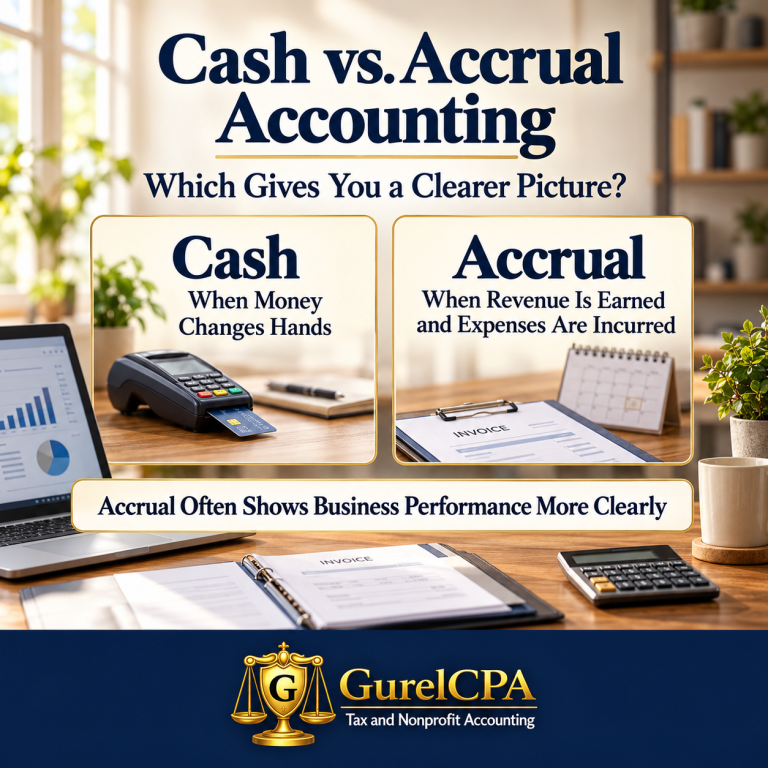
Cash accounting records income when payment is received and expenses when payment is made. Accrual accounting records business income when it is earned and expenses when they are incurred, with appropriate treatment of assets, prepayments, and other items.
Consider a service business that completes a $10,000 project in December. The customer pays in January. The business also incurs $3,000 in subcontractor costs for that project in December and pays the bill in January.
Assuming no other activity or recognition complications, an accrual income statement shows $10,000 of December revenue, $3,000 of December expense, and $7,000 of December profit. Cash accounting shows neither transaction in December and reports the $7,000 profit in January instead.
Both methods describe real transactions. Accrual places the result in the month the work occurred, making it easier to compare performance from month to month.
Why Accrual Often Gives Owners Better Information
Accrual reporting helps you see whether sales are covering the costs of producing them. It also shows receivables from customers and payables to suppliers, rather than allowing collection and payment dates to drive the entire picture. Accrual accounting matches the income and the expenses that produce that income in the same accounting period.
That becomes especially useful when you invoice customers, carry inventory, receive customer advances, or have substantial payroll and other bills outstanding at month end. Paying an annual insurance premium, for example, should not make one month look dramatically worse than every other month when you are evaluating operating performance.
When Cash Accounting Can Be the Better Choice
More detail is useful only when it helps someone make a decision. Cash accounting can be a good fit for a solo service provider who gets paid promptly, has no inventory, owes few unpaid bills, and has straightforward expenses.
If a tutor collects payment at each lesson and pays routine expenses as they arise, cash and accrual results may be very similar. The additional bookkeeping needed for accrual may provide too little benefit to justify its cost. A small volunteer nonprofit with simple donations and expenses may reach the same conclusion, provided its reporting obligations permit it.
For a cash method business, we still recommend tracking unpaid customer invoices, upcoming bills, and major commitments. Simplicity should help you maintain reliable records and understand what is coming next.
Accrual Profit Still Needs a Cash Check
A business can report a profit and struggle to make payroll because customers have not paid. Accrual reporting does not replace cash management. Review the income statement and balance sheet alongside cash flow, overdue receivables, and upcoming payments.
Likewise, a cash basis income statement is not a complete cash flow report. Loan proceeds, loan principal payments, and owner contributions or withdrawals can change the bank balance without being operating revenue or expense.
When Accrual Accounting Is Required
Financial reporting requirements and tax requirements are separate questions. Financial statements prepared in accordance with U.S. generally accepted accounting principles, or GAAP, use accrual accounting. A lender, investor, grant agreement, or regulator may require GAAP statements. A requirement for an audit should be checked for the specified reporting basis; the word audit alone does not establish that basis.
For federal income taxes, Section 448 generally restricts cash accounting for C corporations, partnerships with a C corporation partner, and tax shelters. Exceptions include qualifying small businesses, qualified personal service corporations, and certain farming businesses.
For tax years beginning in 2026, the Section 448(c) gross receipts threshold is $32 million, generally measured over the preceding three tax years. Related business aggregation rules can affect eligibility. This is not a universal rule requiring every business above $32 million to use accrual.
Inventory calls for accrual treatment of purchases and sales, but eligible small business taxpayers have exceptions. Special rules can also apply to particular industries and transactions.
Does Filing Form 990 Require Accrual Accounting
A 501(c)(3) nonprofit is not required to use accrual accounting merely because it files Form 990. Part XII, line 1, expressly provides cash, accrual, and other accounting method choices.
The IRS instructs organizations to use the method they regularly use for their books and records when reporting revenue and expenses on Form 990 and its schedules, unless specific instructions say otherwise. Changes in method require attention to IRS consent rules and Schedule O disclosures.
Separate obligations still matter. State reporting requirements or funding and lending agreements may require GAAP financial statements even though Form 990 itself permits cash accounting. The nonprofit should check each obligation before choosing a method.
For a nonprofit with employees, significant unpaid bills, reimbursement arrangements, or pledges, accrual reporting often gives the board more useful information. Contribution and grant recognition has its own rules; a donation is not simply treated like a customer sale. Donor restrictions also need separate tracking. Choosing accrual does not, by itself, identify which funds are available for general operations.
Choose Useful Reports and an Appropriate Tax Method
A business may maintain accrual books for management and use the cash method on its tax return if eligible, with the necessary reconciliation and tax adjustments. Changing a report setting does not authorize a change in tax accounting method. A formal method change generally requires IRS consent, often through Form 3115.
At GurelCPA, we help businesses and nonprofits choose records and reports that support their decisions and meet their obligations. For many growing organizations, that means accrual financial reports, regular cash flow review, and a separately evaluated tax reporting method.
The article is meant for informational purposes only. Please contact me directly to discuss how this applies to your individual tax situation.