Capital Gains Tax: Why Waiting Could Save Thousands
When taxpayers sell an investment for a profit, the tax bill may depend less on how much they made and more on how long they owned it.
That timing difference can dramatically change the federal tax rate.
In some cases, waiting just long enough to cross the one-year holding period may reduce the tax rate from ordinary income tax rates down to the much lower long-term capital gains rates.
For some taxpayers, qualifying long-term capital gains may even be taxed at 0%.
What Is a Capital Gain?
A capital gain generally occurs when a capital asset is sold for more than its cost basis.
Examples include:
• Stocks and mutual funds
• Cryptocurrency
• Investment real estate
• Land
• Business interests
Sales Price – Cost Basis = Capital Gain
Short-Term vs. Long-Term Capital Gains
Short-Term Capital Gains
Assets held for one year or less are generally taxed at ordinary income tax rates.
Long-Term Capital Gains
Assets held for more than one year generally qualify for preferential long-term capital gains tax rates.
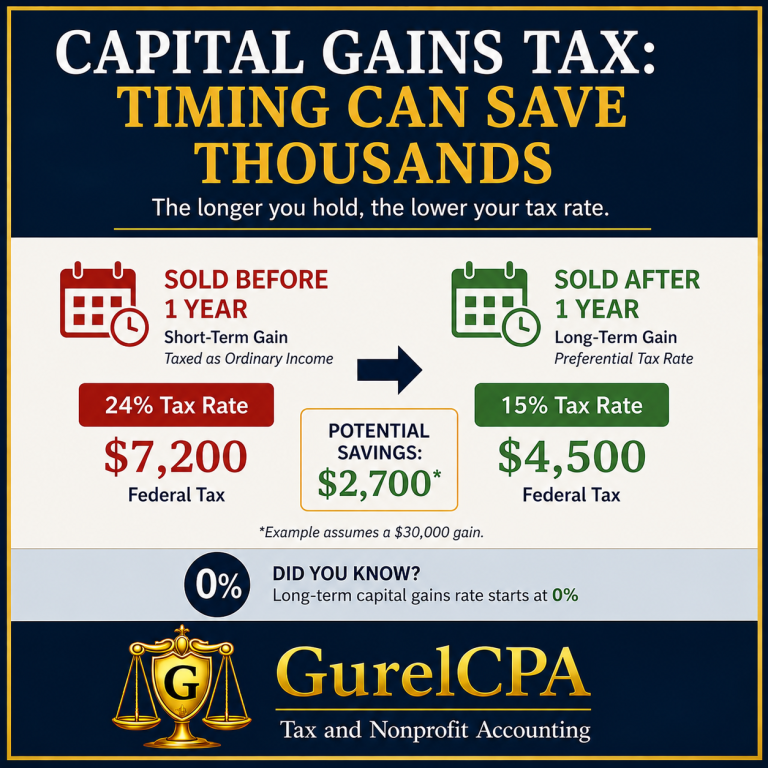
Example: The Cost of Selling Too Soon
Assume a taxpayer buys stock for $20,000 and later sells it for $50,000.
The gain is $30,000.
Sold Before One Year
If the gain is short-term and the taxpayer falls into the 24% ordinary income tax bracket, the estimated federal tax could be approximately $7,200.
Sold After One Year
If the gain qualifies for long-term capital gains treatment and the taxpayer qualifies for the 15% capital gains bracket, the estimated federal tax could be approximately $4,500.
Potential Tax Savings
In this simplified example, waiting long enough to qualify for long-term treatment could reduce federal taxes by approximately $2,700.
Long-Term Capital Gains Tax Rates
Federal long-term capital gains rates generally fall into three categories:
• 0%
• 15%
• 20%
The applicable rate depends on the taxpayer’s taxable income.
Yes, Some Capital Gains Are Taxed at 0%
Taxpayers in lower income ranges may be able to realize qualifying long-term capital gains without paying federal capital gains tax.
This can create planning opportunities for retirees, taxpayers between jobs, young investors, lower-income households, and taxpayers strategically managing taxable income.
Timing Matters
Capital gains planning is not just about what to sell. It is often about when to sell.
Strategies may include:
• Waiting until the holding period exceeds one year
• Selling during lower-income years
• Using capital losses to offset gains
• Managing taxable income to remain in lower capital gains brackets
Final Thoughts
Capital gains tax rules can create substantial planning opportunities for taxpayers who understand the difference between short-term and long-term treatment.
In some situations, simply waiting to sell until after the one-year holding period may produce meaningful tax savings.
Before selling appreciated investments or other capital assets, taxpayers may benefit from reviewing the potential tax impact in advance.
This article is intended for informational purposes only and should not be considered tax or legal advice. Capital gains taxation can become complex, especially when state taxes, depreciation recapture, investment surtaxes, or special asset rules apply. Please contact GurelCPA directly for a free consultation regarding your individual tax situation.