Injured Spouse Relief: Protecting
Your Refund
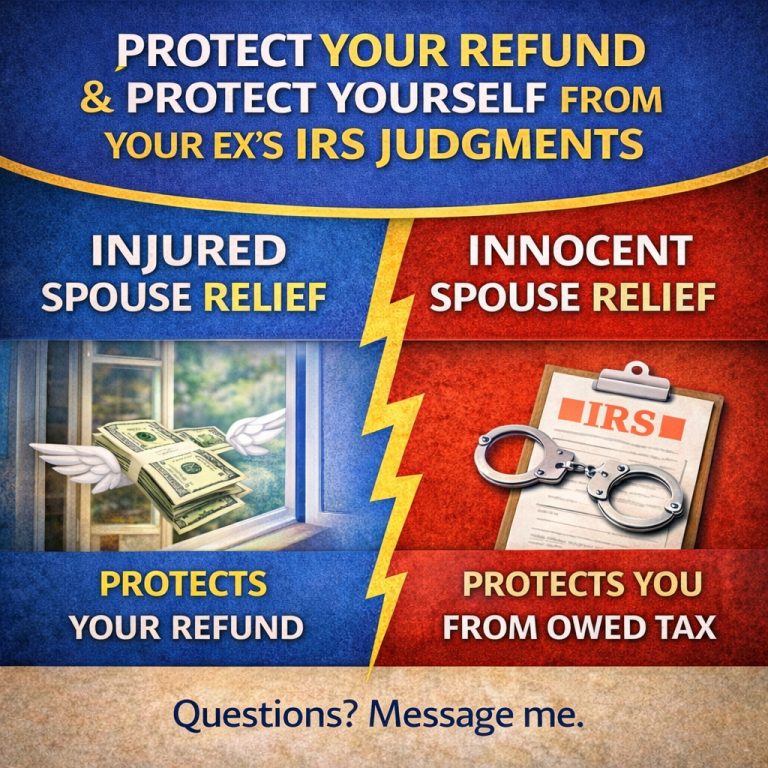
Injured Spouse Relief applies when a couple files a joint return and the IRS takes the entire refund to pay one spouse’s debt.
This commonly happens when one spouse owes back taxes, defaulted student loans, child or spousal support, or certain state debts. If the debt belongs only to one spouse, the other spouse can request their portion of the refund instead of losing it to the debt.
In short, injured spouse relief protects your share of a refund, not the tax liability itself.
Why This Matters During Separation or Divorce
Tax problems often surface during separation or divorce. Refunds may suddenly disappear, or the IRS may pursue payment for issues tied to a former spouse. Decisions about filing jointly versus separately can also affect outcomes. In some cases, filing jointly still produces better tax results, but additional protections may be needed.
This article is for informational purposes only and does not constitute tax advice. Every situation is unique. If you are dealing with separation, divorce, or concerns about a spouse’s tax debt, contact me at GurelCPA for personalized guidance. We’re happy to offer a free consultation to help you protect your financial future.
Injured Spouse Relief vs. Innocent Spouse Relief: What’s the Difference?
When tax problems arise in a marriage, many people assume both spouses are automatically responsible. But the IRS actually provides two different forms of relief designed to protect one spouse from the other’s tax issues.
These rules are often confused, yet they apply in very different situations. Understanding the difference is especially important for people who are separated, newly divorced, or concerned about a spouse’s past tax problems.
Innocent Spouse Relief: Protecting You From Tax Owed
Innocent Spouse Relief is different. It applies when there is additional tax owed because of errors or omissions on a joint return caused by one spouse.
This can occur when the other spouse failed to report income, improper deductions or credits were claimed, or understated tax due to only one spouse’s actions.
In these cases, the IRS may normally hold both spouses liable. Innocent spouse relief allows one spouse to avoid responsibility if they did not know — and had no reason to know — about the issue.
Final Thought
Marriage doesn’t always mean sharing tax consequences forever. If you are separating, divorcing, or concerned about a spouse’s past tax problems, it’s important to understand what protections are available before filing.