Some categories need especially strong documentation
Business meals and travel
Business meals and travel are areas where taxpayers often run into trouble. You should keep records showing the amount, date, place, and business purpose of the expense. For meals, it is also helpful to note who was involved.
Vehicle expenses and mileage
If you claim business mileage, you should keep a contemporaneous mileage log showing the date, destination, business purpose, and miles driven. Reconstructing mileage later is much weaker.
Charitable contributions
For charitable deductions, the rules are stricter than many people realize.
For any single contribution of $250 or more, you generally need a contemporaneous written acknowledgment from the charity.
For smaller donations, a bank record, receipt, or written communication from the organization may be enough, depending on the facts.
What about the “under $75” rule?
Many taxpayers have heard that receipts are not required for amounts under $75. That idea is often misunderstood.
There are limited exceptions in certain situations, but taxpayers should not treat “under $75” as a general rule for undocumented deductions. As a practical matter, if you are claiming it, keep the record.
How long should taxpayers keep receipt records?
A common rule of thumb is at least three years after the return is filed. Some records should be kept longer.
If the records relate to property basis, depreciation, investments, or other items that affect future returns, keep them as long as they remain relevant, plus the applicable retention period after the item is sold or disposed of.
What happens if you do not have receipts?
If you cannot substantiate a deduction, the IRS may disallow it. That can lead to additional tax, penalties, interest, and stress.
Good recordkeeping is not just paperwork. It is part of protecting the deduction itself.
Practical advice for taxpayers
The easiest approach is to use a simple system and stay consistent.
- Save receipts when the purchase happens.
- Use a separate business bank account or credit card for business activity.
- Scan or photograph paper receipts.
- Keep digital folders by year and category.
- Make notes about business purpose while the details are still fresh.
- Maintain mileage logs in real time.
Do I Need to Keep These Paper Receipts?
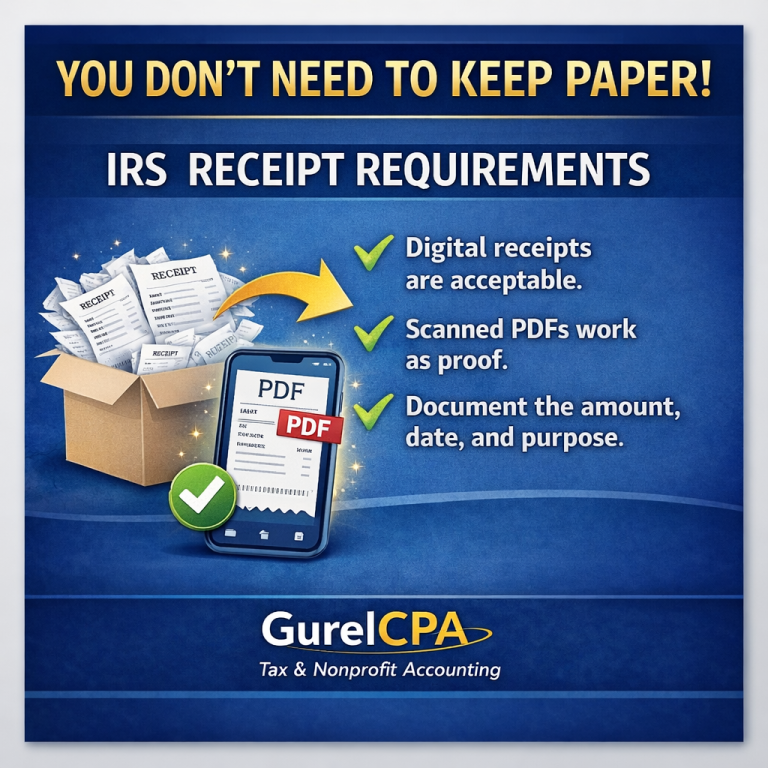
IRS Receipt Requirements
Many taxpayers think the IRS requires a receipt for every deduction. That is not exactly the rule.
The real rule is this: if you claim a deduction, credit, or business expense, you must be able to substantiate it. In plain English, you need records that show what you spent, when you spent it, and why it was deductible.
What does “substantiate” mean?
To substantiate an expense means you can support it with records. Depending on the item, that may include a receipt, invoice, canceled check, bank or credit card statement, mileage log, charitable acknowledgment, or other documentation.
But a bank or credit card statement alone is often not enough. It may show that money was spent, but not exactly what was purchased or whether it was deductible.
Are digital receipts acceptable?
Yes. Digital records are acceptable.
Scanned receipts, PDF invoices, emailed confirmations, bookkeeping software records, and organized electronic files are all fine as long as they are legible, accurate, and accessible.
You do not have to keep boxes of paper if you have a reliable digital system.
Do you always need a receipt?
Not always in the narrowest technical sense, but in practice, keeping the receipt is usually the safest approach.
If you want to deduct an expense, keep the receipt and any related backup that helps explain it. A store receipt may show what was purchased, while a credit card statement may only show the total charge.
Why receipts matter
Receipts and supporting records help in three ways.
- They help you prepare an accurate return.
- They help your tax preparer determine what is and is not deductible.
- They protect you if the IRS questions the return later.
If the IRS examines your return and you cannot support a deduction, the deduction may be denied even if you really did spend the money.
Final thoughts
IRS receipt requirements are really about proof.
The question is not just whether you spent the money. The question is whether you can show that the expense was legitimate, deductible, and properly reported.
Good records make tax preparation easier, reduce audit risk, and put you in a stronger position if the IRS ever asks questions.
Questions? Let’s Talk
At GurelCPA.com, I help taxpayers and business owners not only file accurate returns, but also build practical recordkeeping habits that support those returns.
This article is for informational purposes only and does not constitute legal, tax, or accounting advice for your specific situation. Tax rules can vary based on the facts and circumstances involved. Please contact me directly to discuss your situation and schedule a free consultation.