What About Self-Employed Retirement Plans?
If you are self-employed, certain plans allow contributions after year-end:
- SEP-IRA: Contributions can typically be made up to the tax filing deadline, including extensions.
- Solo 401(k): Employee deferrals must be elected by year-end, but employer contributions can be made up to the filing deadline.
Contribution Limits Still Apply
Even though you have extra time, the annual contribution limits do not change.
Important: Designate the Correct Tax Year
When making a contribution between January 1 and April 15, you must tell the custodian which year the contribution is for.
Why This Matters
This strategy can be especially valuable if:
- Your income was higher than expected last year
- You owe more tax than anticipated
- You want to boost retirement savings while reducing taxes
Final Thought
Too often, taxpayers assume tax planning ends on December 31. In reality, there’s still a window of opportunity—and IRA contributions are one of the easiest ways to take advantage of it.
Questions? Let’s Talk.
Please contact me directly to discuss how this applies to your individual tax situation. I offer a free consultation to review your options and help you make the most of available tax strategies.
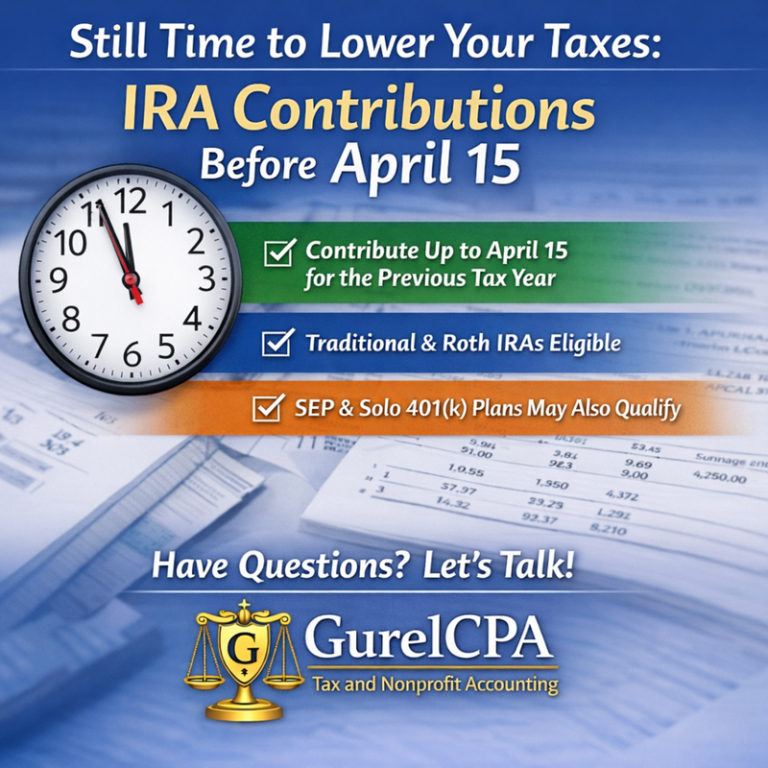
Still Time to Lower Your Taxes: IRA Contributions Before April 15
Many taxpayers think the opportunity to reduce last year’s tax bill ended on December 31. That’s not always true.
If you haven’t fully funded your retirement account, you may still have time to make a contribution up to April 15 and have it count for the prior tax year.
That’s one of the most overlooked tax planning opportunities available.
How It Works
The IRS allows certain retirement contributions made between January 1 and April 15 to be designated for the previous tax year.
For example: A contribution made on March 20 can still count as a prior-year IRA contribution—as long as you clearly designate it that way with your financial institution.
This can:
- Reduce your taxable income (Traditional IRA)
- Increase tax-free retirement savings (Roth IRA)
- Potentially improve eligibility for other tax benefits
Which Retirement Accounts Qualify?
This rule primarily applies to Individual Retirement Accounts (IRAs):
Eligible:
- Traditional IRA
- Roth IRA
Not Eligible:
- Employer plans like 401(k), 403(b), 457 plans
The article is meant for informational purposes only. Please contact me directly to discuss how this applies to your individual tax situation.