The IRS Is Targeting FBAR Non-Filers and Technology is Helping Them
Many taxpayers assume that if no tax is due, there is nothing to worry about. That assumption can be costly when it comes to the FBAR.
The Foreign Bank Account Report (FinCEN Form 114) is not a tax return. There is no tax calculated and no payment submitted. It is simply an information report. But the penalties for failing to file can be significant, and the IRS has made FBAR non-filers an explicit enforcement priority.
Why the FBAR Exists
The FBAR requirement comes from the Bank Secrecy Act and is designed to combat money laundering, terrorist financing, tax evasion, and other illicit financial activity.
It gives the U.S. government visibility into foreign financial accounts held by U.S. persons.
If your foreign accounts exceed $10,000 in total at any point during the year even for one day, an FBAR is required.
The IRS Has Publicly Elevated FBAR Enforcement
In recent compliance strategy announcements, the IRS has specifically identified offshore reporting and FBAR non-filers as focus areas.
With increased funding and renewed attention to high-balance foreign accounts, offshore compliance is now part of the IRS’s active enforcement agenda.
This article is for informational purposes only and does not constitute tax advice. Every taxpayer’s situation is unique. Contact me directly to discuss your specific circumstances.
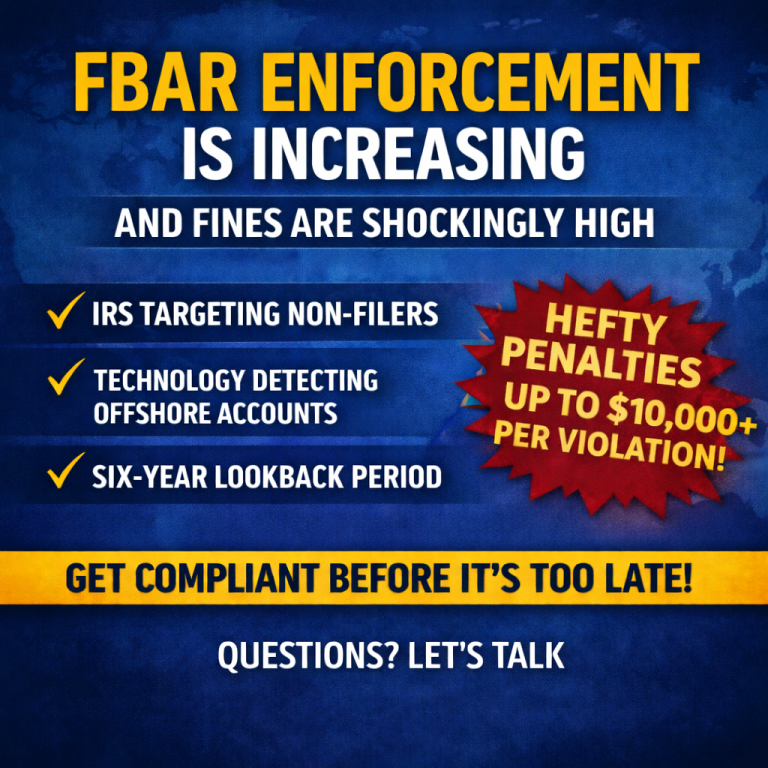
Technology Has Changed the Risk
Foreign financial institutions report account data under FATCA. International information-sharing agreements are widespread. The IRS uses advanced data analytics to identify mismatches and potential non-filers.
In many cases, the government already has access to the underlying account information.
The Penalties and the Six-Year Lookback
There is a six-year statute of limitations for assessing FBAR penalties. That means the government can review up to six years of potential non-compliance.
Penalties can apply even when the failure was non-willful. Willful violations carry much more severe consequences.
The filing itself is generally straightforward. The penalties are not.
There Is a Way to Correct Past Non-Filing
Questions? Let’s Talk.
If you have foreign accounts and want to ensure you are fully compliant — or need to file back FBARs — contact me for a confidential strategy call to determine the best path forward.