Charity Bunching: A Smart Tax Strategy for Charitable Donors
Many taxpayers give to nonprofits every year because they believe in supporting organizations whose missions match their values. What many people don’t realize is that the timing of those donations can affect whether they receive a tax benefit for their generosity.
A strategy called “charity bunching” can help taxpayers maximize their charitable deductions while still supporting the organizations they care about.
What Is Charity Bunching?
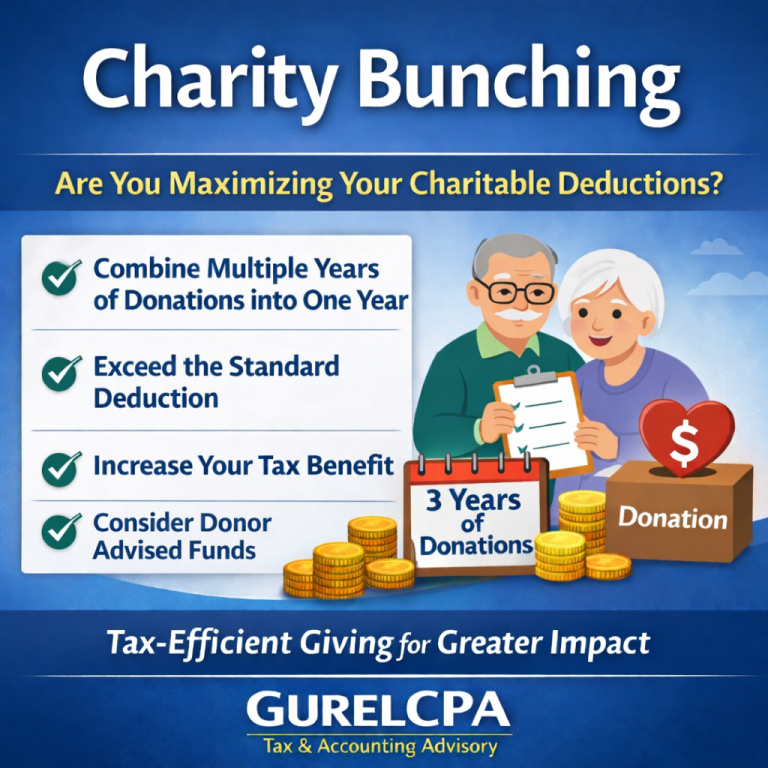
Charity bunching means concentrating multiple years of charitable donations into a single tax year so that you can itemize deductions in that year.
Instead of donating the same amount every year, a taxpayer might combine two or three years of donations into one year, itemize deductions that year, and take the standard deduction in the following years.
This allows taxpayers to increase their total deductions over time while continuing to support the organizations they care about.
Why Some Charitable Donations Don’t Produce a Tax Deduction
Since the standard deduction increased in recent years, fewer taxpayers itemize deductions on their tax returns.
For many households, the standard deduction is roughly:
Single: about $15,000
Married Filing Jointly: about $30,000
Taxpayers who are age 65 or older may also qualify for an additional $6,000 senior deduction, which raises the threshold even further. This means a married couple where both spouses qualify for the senior deduction could potentially have a standard deduction approaching $42,000.
To benefit from charitable contributions on a tax return, total itemized deductions must exceed the standard deduction.
Itemized deductions typically include:
Mortgage interest
State and local taxes (subject to a $40,000 SALT cap)
Charitable contributions
Certain medical expenses
Because the standard deduction can now be quite high, especially for seniors, many taxpayers find that their charitable donations do not actually change their tax result because they do not itemize.
Example for a Typical Household
Suppose a married couple has the following deductions:
State and local taxes: $20,000
Mortgage interest: $7,000
Charitable donations: $5,000 per year
Their itemized deductions would be:
$20,000 + $7,000 + $5,000 = $32,000
Because the standard deduction for married couples is around $30,000, the tax benefit from itemizing is relatively small.
But if they bunch two years of donations into one year, their deductions would be:
SALT: $20,000
Mortgage interest: $7,000
Charitable donations: $10,000
Total itemized deductions: $37,000
Now the difference between itemizing and taking the standard deduction becomes more meaningful.
In the following year, they could simply take the standard deduction.
Example for Seniors
Now consider a married couple both over age 65.
Their standard deduction could approach $42,000 once the additional senior deduction is included.
Suppose their annual deductions are:
State and local taxes: $20,000
Mortgage interest: $5,000
Charitable donations: $6,000
Total itemized deductions:
$20,000 + $5,000 + $6,000 = $31,000
Because their standard deduction is about $42,000, they would not itemize and their charitable donations would not produce any additional tax benefit.
However, if they bunch three years of charitable donations into one year, their deductions would become:
SALT: $20,000
Mortgage interest: $5,000
Charitable donations: $18,000
Total itemized deductions: $43,000
Now they exceed the standard deduction and can receive a tax benefit from their charitable giving.
Using a Donor-Advised Fund
One concern people have about bunching donations is that charities often rely on steady annual contributions. A helpful solution is a Donor-Advised Fund (DAF).
With a donor-advised fund, a taxpayer can:
Make a larger charitable contribution in one year and claim the tax deduction.
Place the funds in the donor-advised account.
Recommend grants to charities over several future years.
This allows donors to maintain steady support for nonprofits while still using the tax advantages of bunching.
Final Thoughts
Tax law often creates opportunities for taxpayers who plan ahead. Charity bunching is one example of how thoughtful timing of charitable donations can increase the tax benefit of giving without reducing support for the organizations doing important work.
If you regularly donate to charitable organizations, it may be worth reviewing whether a bunching strategy could make your giving more tax-efficient.
This article is provided for informational purposes only and should not be considered tax advice. Every taxpayer’s situation is different. If you would like to discuss how strategies such as charity bunching may apply to your circumstances, please contact GurelCPA directly to schedule a consultation. I offer a free initial tax strategy meetings to help determine the best approach for your situation.