Filing and Paying Are Two Separate Obligations
The IRS treats these as two different responsibilities, and the penalties are very different.
Failure-to-File Penalty
If you do not file your tax return on time, the IRS can assess a penalty of 5% of the unpaid tax per month, up to a maximum of 25%.
Failure-to-Pay Penalty
If you file on time but cannot pay the tax immediately, the penalty is much smaller — generally 0.5% per month of the unpaid balance. Interest also accrues on the unpaid tax.
Because the failure-to-file penalty is ten times larger, the first priority should always be: File the return on time.
An Extension Gives You More Time to File , Not More Time to Pay
Some taxpayers think filing an extension solves the problem.
It doesn’t.
A standard extension moves the filing deadline to October, but the tax is still due April 15.
There are limited exceptions for certain taxpayers overseas or members of the military in specific circumstances, but for most people the payment deadline does not change.
The Best Solution: Set Up an IRS Payment Plan
If you cannot pay the full amount when you file, the IRS offers a practical solution: an installment agreement.
In most cases, taxpayers can apply online in just a few minutes. The IRS generally allows payment plans of up to 60 months (five years).
That means the balance due can be spread across monthly payments that fit your budget.
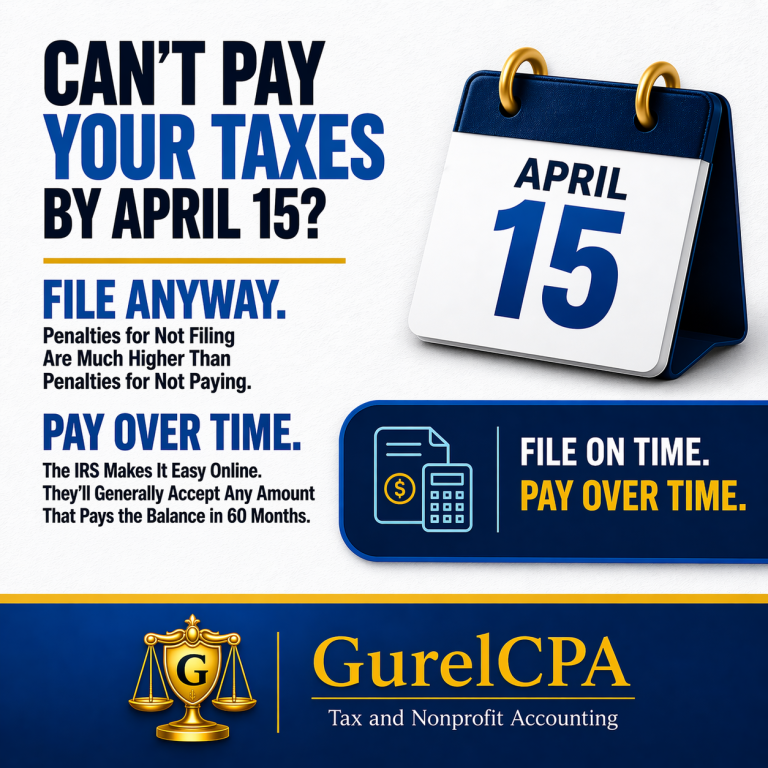
Can’t Pay Your Taxes by April 15? File Anyway, Then Set Up a Payment Plan
Every tax season, many taxpayers find themselves in the same stressful situation:
You’ve finished preparing your tax return… and the numbers show that you owe more tax than you can afford to pay right now.
If that happens, the most important thing to understand is this:
You should still file your tax return on time — even if you cannot pay the amount due.
Failing to file your return creates a much larger problem than failing to pay the tax.
Why Setting Up a Plan Early Helps
Taking action quickly can prevent additional collection activity and help you stay in control of the situation. A payment plan also shows the IRS that you are making a good-faith effort to resolve the balance.
How the IRS Payment Plan Works
1. File your tax return on time.
2. Apply for an IRS Online Payment Agreement.
3. Choose a monthly payment amount that will pay the balance within 60 months.
4. Set up automatic monthly payments from your bank account.
The Bottom Line
If you cannot pay your taxes by April 15:
• File your tax return on time
• Pay as much as you can
• Set up an IRS payment plan for the remaining balance
In most cases, the process is straightforward and can make a difficult tax bill much easier to manage.
This article is for general informational purposes only and should not be considered tax advice. Every taxpayer’s situation is different. If you need help filing your return or setting up an IRS payment plan, contact GurelCPA to discuss your situation and schedule a free consultation.